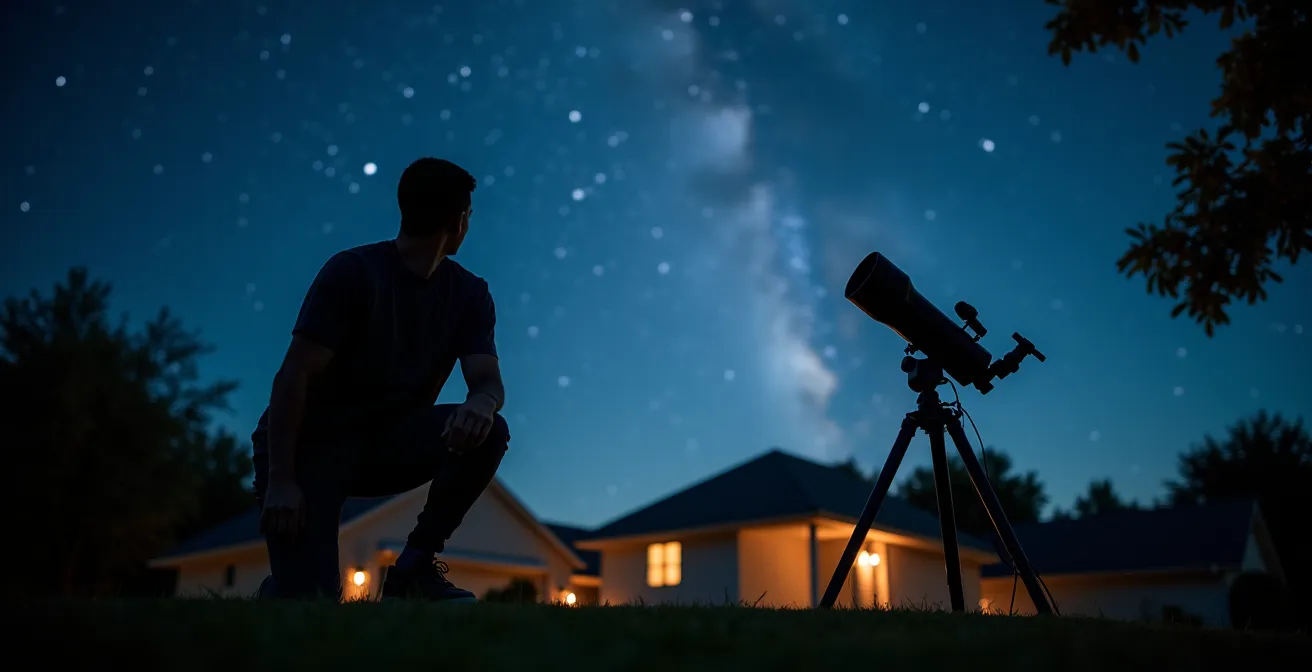
Your passion for the stars can be more than a hobby; it’s a vital resource for real scientific research.
- Human intuition remains crucial for tasks like galaxy classification, where AI still falls short.
- Your local observations, when standardized, contribute to global datasets on everything from light pollution to climate change.
Recommendation: Start by joining a structured project like Zooniverse or GLOBE Observer to ensure your data has scientific value.
Have you ever looked up at the night sky and wondered if your passion could be more than just a solitary pursuit? For many of us in the amateur astronomy community, the dream is to contribute something meaningful, to be part of the great story of discovery. The common advice is often to “download an app” or “join a project,” but this barely scratches the surface. It suggests participation is as simple as clicking a button, which misses the profound opportunity and responsibility we have as citizen scientists.
The reality is that contributing to NASA or other major research institutions is not about simply collecting data; it’s about understanding your role within a larger scientific system. It involves appreciating the nuances of data quality, recognizing potential biases in our observations, and leveraging the collaborative infrastructure that turns our individual efforts into a powerful, collective force. Many projects exist, from classifying galaxies in Galaxy Zoo to tracking asteroids, but their success hinges on a well-informed and dedicated community.
But what if the real key wasn’t just *participating*, but understanding *how* to be a valuable participant? This guide is built on that very idea. We’re going to move beyond the platitudes and explore the system of citizen science. We’ll look at why your human intuition is still irreplaceable, how to ensure your data is scientifically robust, and how your local observations fit into the global picture of discovery. Together, we’ll uncover the path from being a backyard hobbyist to becoming a genuine contributor to modern science.
In this guide, we’ll walk through the essential pillars of effective citizen science. We’ll start by understanding the importance of data validation and peer review, then explore practical ways you can get involved, and finally, address the critical challenges and best practices that make this collaboration between amateurs and professionals so successful.
Summary: Your Guide to Becoming a Citizen Scientist
- Why Peer Review Is Essential Even for Open-Source Scientific Data?
- How to Track Local Air Quality Using Low-Cost Sensors?
- AI Pattern Recognition vs. Human Intuition: Which Spot Galaxy Mergers Better?
- The Sampling Error That Skews Results in 40% of Citizen Science Projects
- When Does Local Bird Watching Become Global Climate Data?
- Night Train or Short-Haul Flight: Which Is Truly More Efficient?
- The Energy Mistake of Deploying Millions of Sensors Without Green Batteries
- How to Track Local Air Quality Using Low-Cost Sensors?
Why Peer Review Is Essential Even for Open-Source Scientific Data?
When we, as a community of citizen scientists, submit our observations, it’s easy to think the job is done. But where does that data go? The journey from your backyard to a scientific paper involves a crucial step: scientific validation. This isn’t about questioning our passion or skill; it’s about ensuring the data is robust, reliable, and free from errors. Even in open-source projects where data is freely shared, a form of peer review is essential for maintaining data integrity. It’s the process that transforms a collection of individual sightings into a credible scientific dataset.
The scale of our collective contribution is staggering. On platforms like Zooniverse, citizen scientists have performed tasks that would be equivalent to 34 years of full-time work for a single researcher. With such a massive volume of data, quality control becomes paramount. Projects often implement a consensus model. Instead of relying on a single observation, they compare the classifications from multiple volunteers for the same object. This approach brilliantly balances speed and accuracy.
As the Marine Biofouling Community Research Team noted in Frontiers in Marine Science, this collaborative method is incredibly effective. They found that having just “four volunteers in consensus balanced efficiency and accuracy when compared to gold standard scientist identifications.” This is a powerful testament to our collective strength.
four volunteers in consensus balanced efficiency and accuracy when compared to gold standard scientist identifications
– Marine Biofouling Community Research Team, Frontiers in Marine Science
This system ensures that an honest mistake by one person doesn’t corrupt the final result. It’s a safety net that makes the entire collaborative infrastructure trustworthy. So, when you participate, know that your contribution is part of a sophisticated process designed to produce the highest quality science. It’s not just about what you see; it’s about how your observation is verified and integrated with others.
How to Track Local Air Quality Using Low-Cost Sensors?
While our eyes are often turned to the distant cosmos, some of the most valuable data we can collect is right here in our own atmosphere. Tracking local air quality is a perfect entry point into citizen science because it directly connects our environment to astronomical observation. Haze, humidity, and particulate matter don’t just affect our health; they dramatically impact the clarity of the night sky. By monitoring these conditions, you’re not just contributing to atmospheric science—you’re helping fellow astronomers understand and calibrate their own observations.
NASA actively encourages this through projects like GLOBE Observer. This initiative isn’t a small-scale effort; it’s an international network of citizen scientists working together to help NASA scientists understand our planet from the ground up. By submitting observations on clouds, mosquito habitats (an indicator of environmental conditions), and other atmospheric phenomena, you provide “ground truth” data that is used to validate and calibrate what satellites see from space. It creates a complete, multi-layered picture of our atmosphere.
Getting started is incredibly accessible. The primary tool is often your smartphone. By downloading the GLOBE Observer app, you join this global community. The app guides you through the process of making and submitting observations. It’s a fantastic example of a well-designed collaborative infrastructure, turning a simple, localized action into a data point with global significance. You become a sensor in a worldwide network, contributing to a massive dataset that no single institution could gather on its own.
This work directly benefits our passion for astronomy. Understanding local atmospheric conditions helps predict nights of good “seeing.” By contributing to these projects, you’re not just helping climate scientists; you’re helping our entire community plan for better, clearer nights under the stars. It’s a perfect synergy of Earth and space science, driven by our shared passion for observation.
AI Pattern Recognition vs. Human Intuition: Which Spot Galaxy Mergers Better?
In an age of ever-smarter algorithms, it’s natural to wonder if the human eye is becoming obsolete in astronomy. Can an AI truly replace the nuanced intuition of a human observer? When it comes to complex pattern recognition tasks, like identifying faint, distorted galaxies in the process of merging, the answer is a resounding “not yet.” While AI is fantastic at processing vast amounts of data, it often struggles with the unusual, the unexpected, and the downright weird—and that’s where our community shines.
The sheer scale of human participation is a force to be reckoned with. The Zooniverse platform alone is a testament to this, with over 2.5 million volunteers contributing to hundreds of projects. This isn’t just about quantity; it’s about the unique quality of human perception. Our brains are wired to spot anomalies and make connections that algorithms, trained on “typical” examples, might miss. This is especially true for identifying rare objects like Hanny’s Voorwerp, a bizarre “ghost” nebula discovered by a Dutch schoolteacher through the Galaxy Zoo project.
Case Study: Galaxy Zoo and the Power of the Crowd
Galaxy Zoo is the original citizen science project that revolutionized how we study galaxies. By showing millions of galaxy images to volunteers and asking simple questions about their shape (“Is it smooth or does it have features?”, “Is there a bar?”), the project harnessed the collective power of human intuition. As Astrobites highlights, this process not only helped astronomers classify known galaxies but also led to the discovery of entirely new classes of objects. It proved that for morphological classification, the human brain remains an unparalleled pattern-recognition engine, capable of spotting subtleties that are difficult to code into an algorithm.
This is why we, as citizen scientists, are not just “data labelers” for machines. We are the explorers on the front lines of discovery. AI can do the heavy lifting, sorting through petabytes of data to flag potential candidates, but it often takes a human to make the final call, to spot the “lumpy” galaxy that signals a cosmic collision or the faint smudge that turns out to be a groundbreaking discovery. Our role is complementary to AI, not in competition with it.
The Sampling Error That Skews Results in 40% of Citizen Science Projects
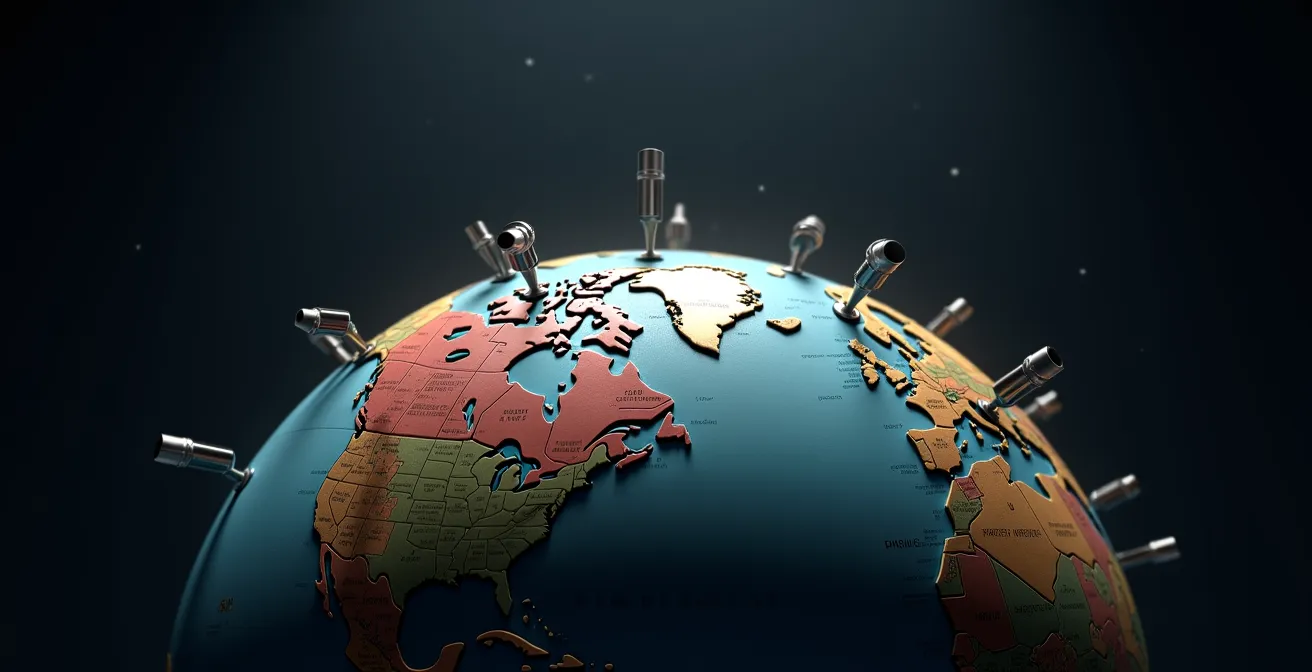
One of the greatest challenges in citizen science is something called observational bias. It’s a simple but critical problem: we tend to observe what’s convenient. Most of the world’s amateur astronomers are located in the Northern Hemisphere, in or near populated areas. This creates huge gaps in our coverage of the sky, particularly over the southern oceans and Antarctica. If a major cosmic event, like a supernova, were to happen in one of these “blind spots,” we might miss it entirely. This sampling error can skew our understanding of the universe, making us think certain events are rarer than they actually are.
The illustration below visualizes this challenge perfectly. The concentration of “telescopes” in certain regions and the vast empty spaces elsewhere highlight the geographic bias we must work together to overcome. It’s a powerful reminder that where we observe is just as important as what we observe.
This is precisely why global networks are so vital. Organizations like the American Association of Variable Star Observers (AAVSO) have built a community with members from 52 countries represented, all working to observe and analyze variable stars. By coordinating observations across different time zones and hemispheres, we can create 24/7 light curves of stars, tracking their brightness changes continuously. This is something no single professional observatory could ever achieve.
professional astronomers do not have the time or the telescopes to gather brightness changes in thousands of variable stars
– Astrobites Editorial Team, Guide to Citizen Science Efforts
This is our unique advantage. As the Astrobites team points out, there simply aren’t enough professional resources to monitor everything. By being mindful of observational bias and participating in global networks, we can help fill these crucial gaps. Your location, no matter how remote, might be the key to unlocking a new piece of the cosmic puzzle.
When Does Local Bird Watching Become Global Climate Data?
The title might seem out of place, but the principle behind it is at the very heart of citizen science. Think about how local bird counts, collected by thousands of enthusiasts, are aggregated to track migration patterns and reveal the large-scale impacts of climate change. A single observation is just a data point; a million coordinated observations become a powerful scientific tool. The same is true for astronomy. Your local observation of the night sky, when combined with thousands of others, can contribute to a global understanding of our planet and the universe.
NASA fully embraces this philosophy, offering a wide array of projects where your local environment is the laboratory. Currently, there are 36 active NASA citizen science projects open to anyone, anywhere in the world. These projects range from identifying clouds to tracking landslides, all contributing to a richer understanding of Earth as a complex system. The key is standardization—by using the same methods to collect data, we ensure that our observations can be compared and combined into a cohesive global dataset.
Case Study: Globe at Night and Fighting Light Pollution
A perfect example of this “local to global” principle is the Globe at Night campaign. This international project empowers citizen scientists to measure the brightness of their local night sky. Using simple star charts or a smartphone app, participants identify the faintest stars they can see from their location. These individual measurements are then submitted to an interactive online map. The result is a stunning, crowd-sourced visualization of light pollution across the globe. This data is invaluable not only for astronomers seeking dark-sky sites but also for ecologists studying the impact of artificial light on wildlife.
This is how your simple, local action—like noting the visibility of a constellation—becomes part of a global scientific endeavor. You are providing a crucial piece of the puzzle that, when joined with others, reveals the bigger picture. Whether it’s light pollution, air quality, or even counting meteors, your backyard is a vital node in a global network of scientific observation. It’s not just bird watching; it’s collaborative science in action.
Night Train or Short-Haul Flight: Which Is Truly More Efficient?
In the world of astronomy, “efficiency” isn’t just about time or money; it’s about maximizing scientific output while minimizing wasted resources. We can think of two approaches to observation. One is the “short-haul flight”: a solo effort, requiring significant personal resources and limited by your specific location and time zone. The other is the “night train”: a collaborative, networked approach where data flows seamlessly across the globe, creating a continuous, highly detailed picture. It’s this second model that represents the future of citizen astronomy.
The power of this networked approach is beautifully illustrated by the observation of Comet ATLAS’s disintegration. A group of just 40 citizen astronomers from around the world, part of a coordinated network, simultaneously observed the comet. By combining their data, they were able to build a “super image” of such high detail that it clearly showed the comet breaking apart. No single observer could have captured this. It was the result of a highly efficient, collaborative infrastructure that leveraged the geographic distribution of its members.
Case Study: The Unistellar Network’s Remote Efficiency
The UNISTELLAR Network, working in partnership with the SETI Institute, is a prime example of this “night train” efficiency. It connects a worldwide community of citizen astronomers who use their smart telescopes to collect data remotely. Members don’t need to be experts in data processing; they simply observe, and their data is automatically sent to a central server for analysis by professional astronomers. This system allows for rapid responses to transient events like supernovae or near-Earth asteroids, turning a distributed network of small telescopes into a single, powerful, and incredibly efficient observatory.
This model is fundamentally more efficient. It eliminates the “sampling bias” of a single location, allows for 24/7 observation of targets, and pools resources to achieve results that would otherwise require a multi-million dollar professional telescope. By joining such a network, you are no longer a passenger on a short-haul flight to a single destination; you are part of a smooth, powerful locomotive of discovery, continuously moving forward.
The Energy Mistake of Deploying Millions of Sensors Without Green Batteries
As our community grows and technology becomes more accessible, we are deploying an ever-increasing number of sensors, cameras, and telescopes. This is fantastic for science, but it comes with a hidden cost: energy consumption. The “energy mistake” is assuming that our passion for the stars has no environmental footprint on Earth. A single telescope setup running all night, multiplied by millions of us around the world, represents a significant energy draw. True sustainable astronomy requires us to be as mindful of our power cords as we are of our optics.
The solution isn’t to stop observing. As the UNISTELLAR team reminds us, our contributions are desperately needed. The challenge is to observe smarter and more sustainably.
There are simply not enough devices and time to collect all the information that exists about our universe, so citizen scientists use their passion to help gather and analyze data
– UNISTELLAR Citizen Science Team, UNISTELLAR CITIZEN SCIENCE
This is where conscious choices come into play. It means opting for energy-efficient equipment, using rechargeable power sources, and considering participation in projects that require minimal hardware. Many valuable contributions can be made with just a smartphone or a laptop, analyzing data that has already been collected. By being conscious of our energy use, we ensure that our quest to understand the universe doesn’t come at an unnecessary cost to our own planet.
Your Action Plan for Sustainable Backyard Astronomy
- Build your own radio telescope to study Jupiter and the Milky Way galaxy, often using low-power components.
- Use smartphone apps for data collection whenever possible to minimize the need for dedicated, power-hungry equipment.
- Join projects that require only a laptop or smartphone for data analysis, contributing your time and intellect instead of kilowatts.
- Participate in visual observation projects, like meteor counting or constellation identification, that need no electronic equipment at all.
- Share equipment with local astronomy clubs to reduce individual consumption and build a stronger community.
By adopting these practices, we can continue to fuel scientific discovery in a way that is responsible and sustainable. It’s about aligning our love for the cosmos with our responsibility to our home world.
Key Takeaways
- True contribution goes beyond participation; it requires understanding the system of data quality, bias, and validation.
- Human intuition is a vital scientific tool, especially for identifying unusual or complex astronomical objects that AI can miss.
- Your local observations, when part of a coordinated network, are essential for building global datasets and overcoming geographic sampling bias.
How to Track Local Air Quality Using Low-Cost Sensors?
We’ve discussed the “what” and “why” of tracking atmospheric conditions, but let’s get practical about the “how.” Setting up a system to correlate air quality with your astronomical observations is a powerful way to elevate your hobby. It moves you from being a passive observer of “seeing” conditions to an active analyst of them. The goal is to build a dataset that answers the question: “Under what specific atmospheric conditions do I get my best views?”
The core of this setup involves pairing your telescope with low-cost environmental sensors. A simple PM2.5 sensor, which measures fine particulate matter, and a humidity/temperature sensor can provide a wealth of information. These sensors are widely available and can be connected to microcontrollers like an Arduino or Raspberry Pi to log data automatically. By time-stamping this data, you can directly compare it to your astronomical logs and images.
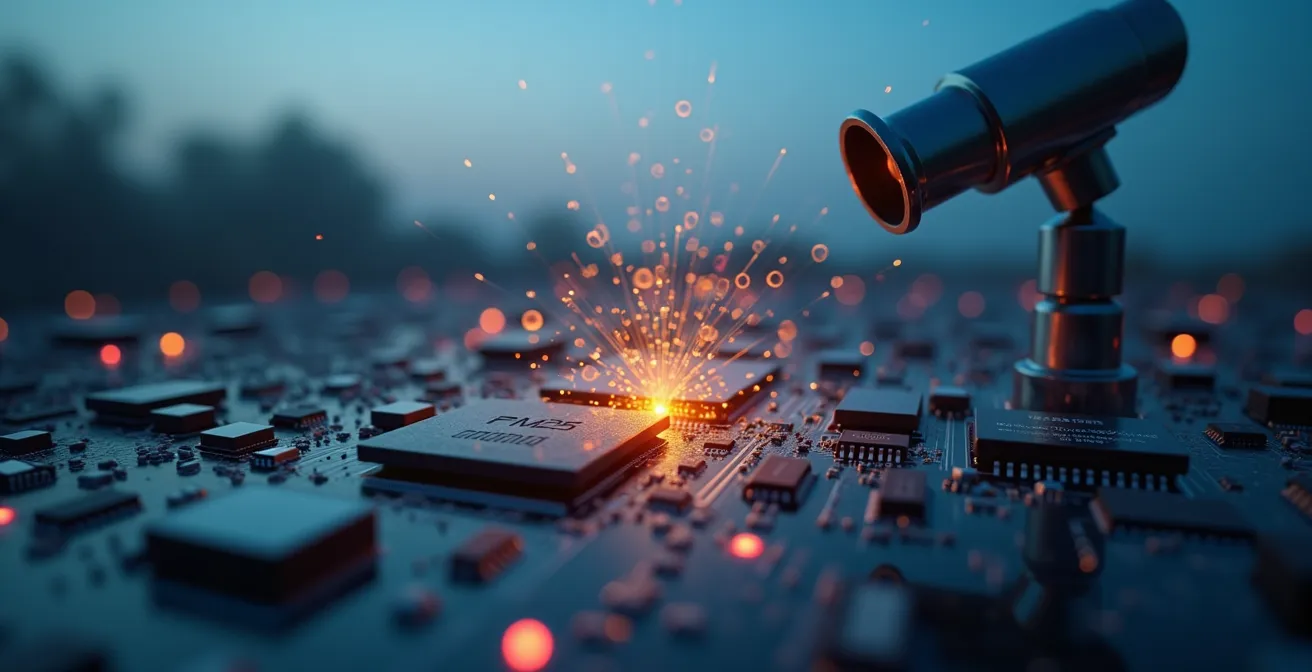
The beauty of this approach, as the image above suggests, is the direct link between the environment and your equipment. You can start to see clear patterns. For example, you might find that your best planetary images are captured when humidity is below a certain threshold and particulate matter is minimal. This is your personal data integrity in action; you’re actively working to understand and account for variables that could affect your results. This process of calibration and correlation is a fundamental scientific practice.
Furthermore, this data has value beyond your own use. By sharing your findings with a local astronomy club or online forum, you contribute to a collective understanding. You could help create a local “seeing” forecast based on environmental sensor data. This is grassroots science at its best—using accessible technology to answer practical questions and sharing that knowledge to benefit the entire community. It transforms your backyard setup into a miniature, interconnected research station.
Now that you’re equipped with the knowledge and tools, the next logical step is to join the global community and put your passion to work. Projects are waiting for your unique perspective and observations. By participating in a structured program, you ensure your efforts contribute directly to the grand, ongoing mission of scientific discovery. Start today by exploring the project portals at NASA or Zooniverse, and become part of something bigger than yourself.