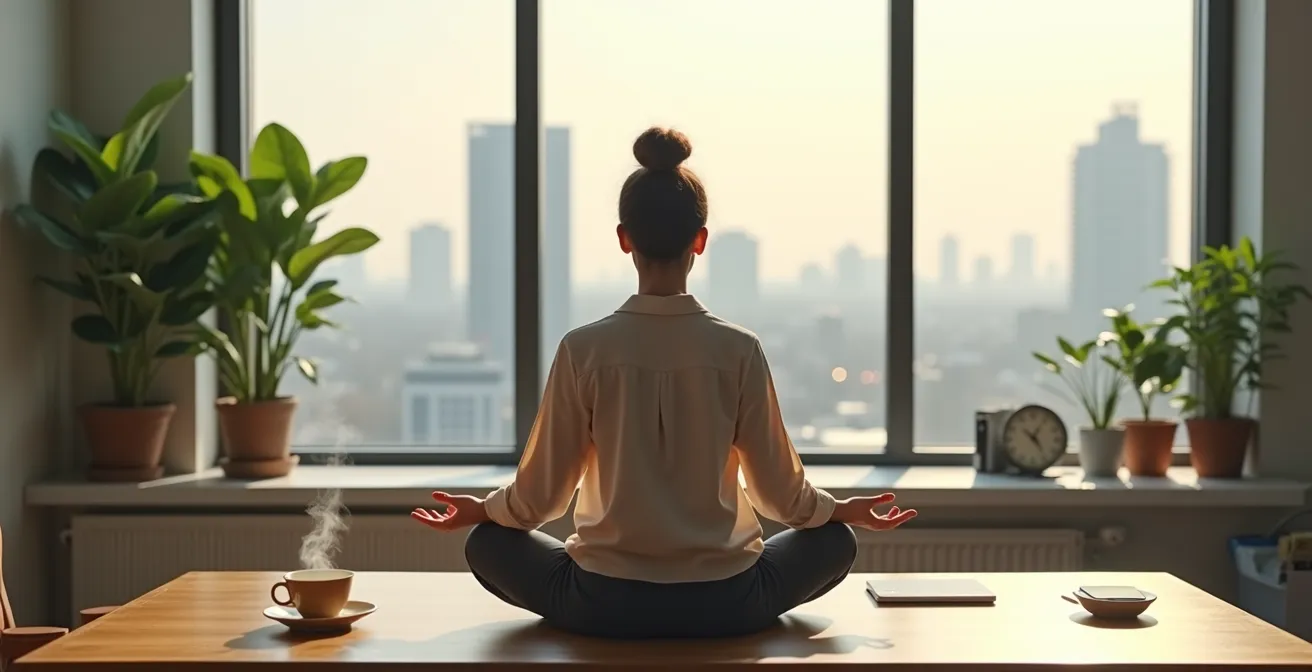
The secret to slow living on a packed schedule isn’t finding more time, but reclaiming the moments you already have by redesigning your personal systems.
- Checking email first thing spikes stress hormones; creating “digital office hours” after 10 AM protects your focus.
- True calm comes from productively processing emotions, not suppressing them with toxic positivity.
Recommendation: Start by choosing one “micro-practice,” like scheduling a 15-minute “do nothing” block or practicing a two-minute meditation at your desk, to build sustainable change.
The hum of the laptop, the constant chime of notifications, the calendar packed from sunrise to sunset—this is the reality for many ambitious professionals. You’re dedicated, you’re driven, but you’re also exhausted. The concept of “slow living,” with its images of handcrafted pottery and long walks in the woods, can feel like a distant, unattainable dream. You might think it requires a radical life change, like quitting your demanding job or moving to the countryside. But what if that’s a misunderstanding of the core principle?
The common advice—wake up earlier for yoga, take long digital detoxes—often feels like adding more to an already overflowing plate. This approach is unsustainable for someone navigating a 50-hour work week. The true path to a slower, more intentional life doesn’t lie in escaping your reality, but in consciously redesigning it from within. It’s about strategic subtraction, not overwhelming addition. It’s about learning to reclaim the small, in-between moments and transforming the very systems that cause you stress.
This guide offers a different perspective. We won’t ask you to overhaul your life overnight. Instead, we’ll explore practical, compassionate strategies to weave the principles of slow living into your existing routine. You will learn how to create pockets of peace at your desk, manage your digital world without feeling deprived, and cultivate mental clarity even in a tiny apartment. It’s time to stop fighting against your schedule and start making it work for you.
Summary: Your guide to integrating slow living into a busy professional life
- Why Checking Email Before 10 AM Increases Daily Cortisol Levels?
- How to Feng Shui Your Tiny Apartment for Better Mental Clarity?
- Minimalism or “Cluttercore”: Which Style Actually Reduces Anxiety?
- The “Good Vibes Only” Mistake That Suppresses Real Emotional Growth
- When to Schedule “Do Nothing” Blocks in Your Calendar?
- How to Set Up “Do Not Disturb” Modes That Actually Work?
- How to Move Beyond “Tourist Bubbles” Without Being Intrusive?
- How to Practice “Micro-Meditation” at Your Desk Without Anyone Noticing?
Why Checking Email Before 10 AM Increases Daily Cortisol Levels?
The first thing many of us do upon waking is reach for our phones. That immediate dive into emails, messages, and news starts the day in a state of reaction, not intention. You’re immediately flooded with other people’s agendas, problems, and demands. This isn’t just a feeling; it has a physiological impact. Your body responds to this perceived urgency by releasing cortisol, the primary stress hormone. Research confirms this, showing that adults experiencing work-related anxiety on Mondays have 23% higher cortisol levels in hair samples.
By checking your email before you’ve even had a chance to ground yourself, you are essentially pre-stressing your system for the day ahead. This makes it harder to focus, manage your emotions, and think creatively. The solution is to create intentional friction between you and your inbox. Reclaim your mornings by establishing “digital office hours.” This isn’t about ignoring your responsibilities; it’s about taking control of your focus. Start by:
- Setting up an auto-reply message stating you review emails after 10 AM to allow for focused morning work.
- Blocking your calendar from 8-10 AM for “Deep Work,” signaling to colleagues that you are unavailable for meetings.
- Creating a morning routine that is completely device-free, such as stretching, journaling, or simply enjoying a cup of coffee in silence.
This simple system redesign protects your most valuable asset: your morning energy and focus. It allows you to start your day on your own terms, setting a calmer, more productive tone for everything that follows.
How to Feng Shui Your Tiny Apartment for Better Mental Clarity?
For many urban professionals, “home” is a small studio or a one-bedroom apartment where the lines between work, rest, and life blur into a single, cluttered space. The idea of creating a serene sanctuary can feel impossible when your desk is five feet from your bed. However, the principles of Feng Shui, or more broadly, intentional spatial design, are not about having more space, but about how you define the space you have. The goal is to create psychological zones that signal to your brain when it’s time to work and when it’s time to unplug.
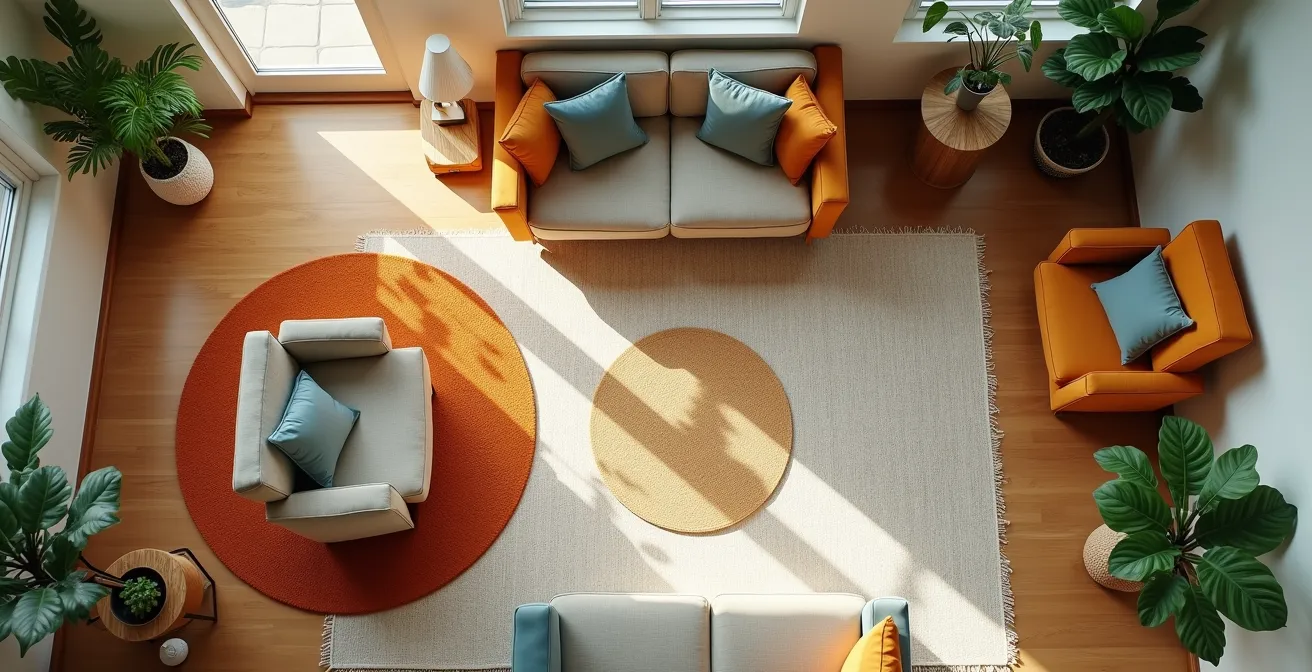
As the image above illustrates, you can use simple cues like furniture placement, lighting, and rugs to create distinct areas. For example, a small armchair and a warm lamp in a corner can become a dedicated “reading nook.” A specific rug can delineate your “work zone.” Even something as simple as putting your laptop away in a drawer at the end of the day signals a mental shift. This practice of creating intentional zones is proven to encourage reflection and help you step into the present moment, which is the essence of slow living. It transforms your home from a place of constant multitasking into a sequence of mindful experiences.
Start by identifying the primary functions of your space: work, sleep, eat, and relax. Then, use these tools to create subtle boundaries:
- Lighting: Use a cool, bright light for your workspace and warm, soft lighting for your relaxation area.
- Textiles: A different rug or set of cushions can visually separate your “living room” from your “office.”
- Plants: Use plants as natural, beautiful dividers to create a sense of separation.
This isn’t about a complete redesign; it’s about small, thoughtful changes that have a profound impact on your mental clarity and ability to switch off.
Minimalism or “Cluttercore”: Which Style Actually Reduces Anxiety?
The popular narrative around slow living often champions minimalism as the only path to a clear mind. The idea is simple: less stuff equals less stress. While this holds true for many, it’s not a universal solution. For some, a sparse, minimalist environment can feel cold, sterile, and even create a new kind of anxiety—the pressure to maintain a perfect, empty space. On the other end of the spectrum is “cluttercore,” an aesthetic that celebrates an abundance of meaningful objects. The question is, which one is right for you? The answer lies in understanding your own sensory and emotional needs, not in following a trend.
A more balanced approach is what we might call “curated maximalism”—a space that is full but not chaotic, where every object has a purpose or brings you joy. It’s the difference between a pile of unsorted mail and a shelf of beloved books. Both minimalism and a more curated, full style can reduce anxiety, but they do so in different ways. The key is intention. As author Antonia Colins from Balance Through Simplicity notes, the goal is to deliberately declutter to create a life on your own terms, not someone else’s.
| Style | Anxiety Triggers | Stress Relief Benefits | Best For |
|---|---|---|---|
| Minimalism | Performative pressure, decision fatigue about keeping items | Clear mental space, reduced visual stimulation | High sensory sensitivity individuals |
| Curated Maximalism | Initial setup effort | High ‘joy per square foot’ without emptiness or chaos | Creative professionals seeking balance |
| Cluttercore | Potential sensory overload, cleaning complexity | Emotional anchoring through meaningful objects, identity reinforcement | Those needing visual memory cues |
Instead of asking “Should I be a minimalist?”, ask yourself: “What kind of environment makes me feel most at peace and most like myself?” For some, it’s a clear desk and empty walls. For others, it’s being surrounded by art, photos, and mementos that serve as emotional anchors. The slow living approach isn’t about owning less; it’s about owning with more intention.
The “Good Vibes Only” Mistake That Suppresses Real Emotional Growth
In a world saturated with motivational quotes, there’s immense pressure to maintain a facade of relentless positivity. The “good vibes only” mantra, while well-intentioned, can become a tool for toxic positivity—the belief that you should suppress or deny any “negative” emotions like frustration, anxiety, or disappointment. For busy professionals, this is particularly damaging. Suppressing these feelings doesn’t make them go away; it just forces them underground, where they fester and contribute to burnout, anxiety, and a sense of inauthenticity.
Slow living teaches us to embrace the full spectrum of human experience, not just the pleasant parts. It’s about creating space to acknowledge and process our feelings without judgment. This doesn’t mean dwelling on negativity. It means treating your emotions as data. What is this frustration telling you about a boundary that was crossed? What is this anxiety revealing about a future uncertainty you need to address? True emotional growth comes from this gentle, curious inquiry, not from suppression.
Your 5-Minute Productive Acknowledgment Plan
- Name the emotion specifically (e.g., “I feel frustrated,” not “I feel bad”).
- Identify the trigger event or situation without adding judgment or story.
- Rate the intensity of the emotion on a simple scale of 1-10.
- State one small, controllable action you can take in response within the next 24 hours.
- Schedule that specific action in your calendar immediately, giving it the same importance as a work task.
This technique transforms a vague feeling of unease into a concrete, manageable plan. It moves you from a passive state of feeling overwhelmed to an active state of self-care and problem-solving. This is the compassionate, practical way to handle emotional turbulence without letting it derail your day.
When to Schedule “Do Nothing” Blocks in Your Calendar?
In a culture that glorifies productivity, “doing nothing” is often equated with being lazy or wasting time. Our calendars are packed with meetings, tasks, and deadlines, but we rarely schedule time for the most crucial activity of all: strategic rest. A 50-hour work week is a marathon, not a sprint. Without intentional periods of rest and integration, you are heading for burnout. As slow living advocate Helena Woods puts it, we aren’t machines meant to constantly create; spending a lifetime churning out content with no periods to percolate is exhausting.
This is where scheduling “Do Nothing” blocks or “Strategic Integration Time” becomes a non-negotiable professional practice. These are 15- to 30-minute appointments with yourself where the only agenda is to not have an agenda. You can stare out the window, listen to music without multitasking, or simply sit and breathe. The goal is to let your mind wander and decompress. These moments are when your best ideas often surface and when your nervous system gets a chance to downshift from “fight or flight” to “rest and digest.”
The best times to schedule these blocks are during natural transition points in your day:
- Mid-morning: After a 90-minute block of deep work, to reset before your next task.
- Post-lunch: To avoid the afternoon slump and aid digestion.
- Before a big meeting: To clear your head and approach the discussion with a calm, focused mind.
Treat these appointments with the same respect you would a meeting with your boss. They are essential for long-term performance, creativity, and well-being.
How to Set Up “Do Not Disturb” Modes That Actually Work?
The single greatest obstacle to slow living in the modern world is the constant barrage of digital notifications. Each ping and buzz is a tiny interruption that hijacks your attention, fragments your focus, and keeps your nervous system in a low-grade state of alert. For professionals who work long hours, especially remotely, the struggle is real. Indeed, research shows that more than 61% of remote employees struggle to disconnect from work. The solution isn’t to throw your phone away, but to become the master of its settings.
Most smartphones now offer sophisticated “Focus” or “Do Not Disturb” modes that go far beyond a simple on/off switch. You can create context-aware focus layers that automatically filter notifications based on your activity, location, or time of day. This is a powerful form of system redesign that builds a digital fortress around your attention, allowing you to engage deeply with the task at hand without constant interruption. A well-configured setup allows urgent communications to get through while silencing the non-essential noise.
Here is a practical guide to setting up layers that work for you:
- “Deep Work” Mode: Block all notifications except for calls from a few key contacts (like your boss or partner) and alerts from essential work tools.
- “Commute” Mode: Allow only music and navigation apps to function, silencing all other notifications to create a mental buffer between work and home.
- “Family Time” Mode: Automatically block all work-related apps and notifications after a certain time, such as 7 PM, allowing you to be fully present with your loved ones.
- Emergency Bypass: For every mode, configure the “Emergency Bypass” feature for 2-3 critical contacts (like elderly parents or your children’s school) so their calls will always ring through.
By taking 30 minutes to set up these layers, you are investing in hundreds of hours of reclaimed focus and peace of mind.
How to Move Beyond “Tourist Bubbles” Without Being Intrusive?
When we think of slowing down, we often picture a vacation—a “slow travel” experience where we immerse ourselves in a new culture. But you don’t need a plane ticket to have this experience. A core principle of slow travel is to participate in the normal rhythm of a place rather than just observing it as a tourist. This exact principle can be applied to your own life and neighborhood. After a 50-hour work week, it’s easy to feel like a tourist in your own life, rushing through errands and engaging with your community on a superficial level. The antidote is to practice “slow localism.”
This means intentionally engaging with your immediate surroundings with a sense of curiosity and presence. It’s about finding the magic in the mundane and reconnecting with the place you call home. Instead of seeing your neighborhood as just the backdrop to your busy life, see it as a destination worthy of exploration. This shift in perspective can be profoundly grounding and requires no extra time or money, only a change in awareness. It’s a powerful way to disconnect from work-brain and reconnect with yourself and your community.
Here are some simple ways to practice slow localism:
- Visit your neighborhood library or a local coffee shop on a weekend morning without a laptop.
- Shop at a local farmer’s market and have a real conversation with a vendor.
- Attend a free community event, like a concert in the park or a local festival.
- Use public transportation during non-rush hours and simply observe the city’s rhythm.
- Find a favorite bench in a nearby park and spend 15 minutes just watching the world go by.
These small acts help you move beyond the “tourist bubble” of your own routine and participate in the life of your community, fostering a sense of belonging and peace.
Key takeaways
- The essence of slow living for busy people is redesigning existing systems (like your morning routine or notification settings), not just adding more wellness tasks.
- Embrace “micro-dosing stillness” by scheduling short, 5-15 minute “do nothing” blocks throughout your day to prevent burnout and boost creativity.
- Your environment profoundly impacts your mental state; create psychological zones in your home and choose a decor style (minimalism or curated maximalism) that genuinely reduces your personal anxiety.
How to Practice “Micro-Meditation” at Your Desk Without Anyone Noticing?
The word “meditation” often conjures images of sitting cross-legged on a cushion for 30 minutes—an impossibility for most during a hectic workday. But the benefits of mindfulness don’t require a formal, lengthy practice. You can access a state of calm and focus through “micro-meditations”—short, discreet moments of awareness that you can practice right at your desk without anyone even noticing. These aren’t just feel-good exercises; they are scientifically supported interventions. A comprehensive meta-analysis reveals that mindfulness and meditation interventions are effective in reducing cortisol levels.
The key is to anchor your attention to a simple, present-moment sensation for just one or two minutes. This act of gentle focus interrupts the cycle of stress and mental chatter, acting as a reset button for your brain. It’s the ultimate tool for reclaiming the “in-between” moments—the time spent waiting for a document to load, the minute before a call begins, or the brief pause between tasks.
Here are three simple micro-meditations you can do at your desk:
- The Keyboard Anchor: Gently rest your hands on your keyboard. Close your eyes or soften your gaze. Bring your full attention to the sensation of your fingertips on the keys. Notice the texture, the temperature, the slight pressure. Do this for ten slow breaths.
- The Three-Breath Reset: Inhale slowly through your nose for a count of four, hold for a moment, and exhale slowly through your mouth for a count of six. The longer exhale helps activate the parasympathetic nervous system, promoting calm. Repeat three times.
- Mindful Listening: Close your eyes and simply listen. Notice the most distant sound you can hear, then the closest. Try to identify three distinct sounds in your environment without labeling them as “good” or “bad.” Just let them be.
These practices are your secret weapon against the accumulated stress of a long day. They are proof that you don’t need to escape your job to find peace; you can cultivate it right where you are, one breath at a time.
The journey to a slower life begins not with a giant leap, but with a single, intentional breath. Start today by choosing one micro-practice from this guide and weaving it into the fabric of your day. You have the power to reclaim your peace, right here and now.