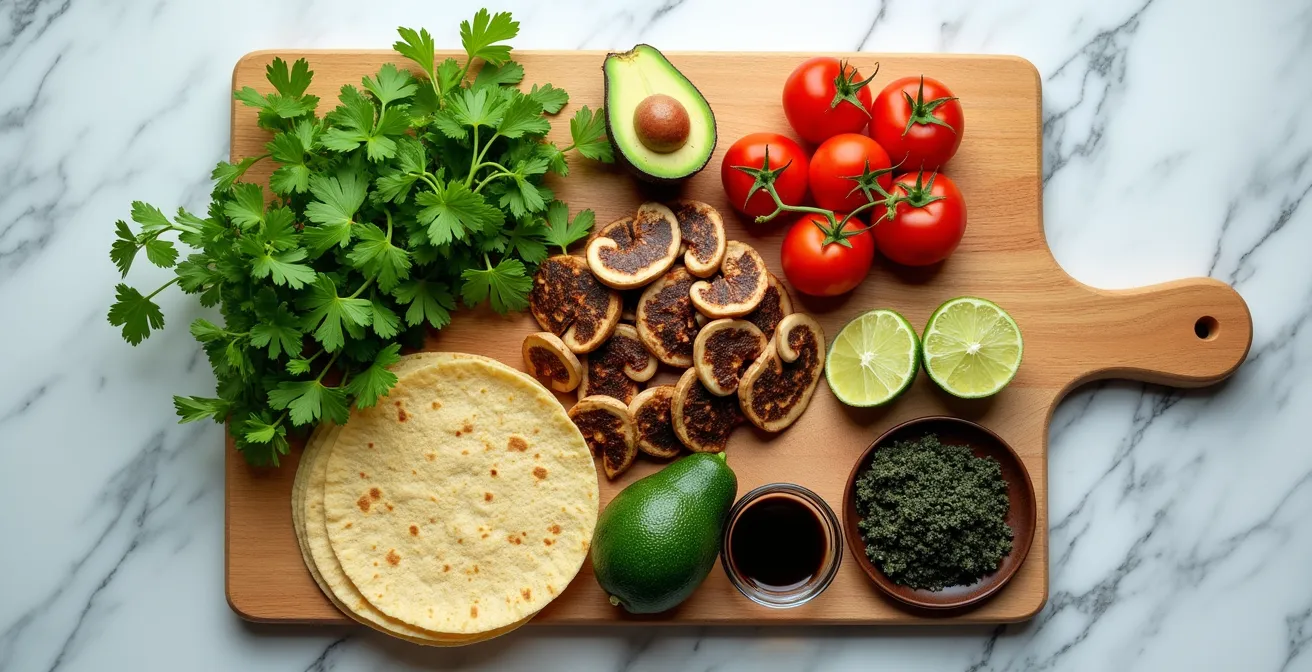
The frustrating “mess” from your fusion experiments comes from treating cooking like mixing, not architecture. Success in combining Mexican and Japanese cuisines isn’t about random creativity; it’s about understanding the shared scientific foundations (like umami), respecting the integrity of each pillar ingredient, and deliberately engineering contrasts in texture and temperature. This guide provides the blueprint to move from chaotic collisions to curated, harmonious dishes.
You’ve been there. In a flash of inspiration, you envisioned the perfect “sushi taco”: a crispy corn tortilla cradling jewel-like tuna, a dollop of spicy guacamole, and a drizzle of soy sauce. The concept was brilliant, a collision of your two favorite cuisines. But the first bite was… confusing. A chaotic clash of flavors where nothing quite sang, leaving you with a sense of culinary disappointment. This is the common pitfall for the creative cook—the fusion idea is strong, but the execution results in a muddled mess.
Most advice falls flat, telling you to simply “be creative” or “follow your taste buds.” But when dealing with two culinary giants like Mexico and Japan, with their own profound philosophies and powerful flavor profiles, intuition alone is not enough. The key isn’t to simply throw ingredients together and hope for the best. It’s about a more deliberate, more thoughtful process. But what if the true secret wasn’t about finding more things to *add*, but about understanding the fundamental structures that hold these cuisines together?
The solution lies in shifting your mindset from that of a simple cook to that of a culinary architect. True fusion is not anarchy; it is a discipline. It requires you to understand the foundational pillars of each cuisine and then build bridges between them or create deliberate, controlled counterpoints. This is not about limiting creativity, but about focusing it. Throughout this guide, we will deconstruct this architectural approach, exploring the shared science of flavor, the philosophy of respectful curation, the art of textural contrast, and even the lessons hidden in seemingly unrelated culinary traditions.
This article provides a structured path to mastering the art of fusion. We’ll delve into the specific principles that allow these distinct flavors to harmonize, ensuring your next creation is a masterpiece, not a mistake.
Summary: A Chef’s Guide to Fusing Mexican and Japanese Flavors
- Why Soy Sauce and Parmesan Cheese Share the Same Umami DNA?
- Chaos or Curation: Which Style of Fusion Actually Tastes Good?
- The Respect Mistake: How to Fuse Cuisines Without Insulting Tradition?
- How to Match the Crunch of a Tostada With the Softness of Sashimi?
- When to Add Wasabi to Guacamole for Maximum Impact?
- How to Eat With Your Hands in India Without Offending Your Hosts?
- How to Use Red and Yellow to Trigger Hunger Subconsciously?
- How to Use Agar-Agar to Create Vegan Gelatin That Actually Sets?
Why Soy Sauce and Parmesan Cheese Share the Same Umami DNA?
The first step in our architectural approach is to find a shared foundation. In the case of Japanese and Mexican food, one of the most powerful and often overlooked connections is umami, the fifth taste. It’s that savory, deep, and satisfying flavor that makes broths rich and aged cheeses irresistible. While you might not think of a taco and a bowl of ramen as having much in common, their ability to deliver profound satisfaction often stems from this shared flavor compound: glutamate.
Both Japanese and Mexican cuisines are masters of developing umami through processes like fermentation, aging, and slow cooking. In Japan, this is famously achieved by creating *dashi*. As one study on umami concentration in traditional ingredients explains, kelp (konbu) is dried over long periods and bonito flakes are smoked and cured to create the hardest food in the world, all to concentrate glutamate. When you taste soy sauce, you’re tasting umami from fermented soybeans.
Now, think of Mexican cuisine. The deep savoriness of slow-cooked carnitas, the roasted tomatoes and chipotles in a salsa, or the aged cotija cheese sprinkled on top—these are all rich sources of glutamate. The reason soy sauce and Parmesan cheese seem to work so well together is that they are both umami bombs. They speak the same chemical language. As a fusion architect, your job is to identify these flavor bridges. Instead of just adding soy to a taco, you can use a soy-lime marinade for your carne asada, consciously using the umami from the soy to amplify the natural umami of the grilled meat.
Chaos or Curation: Which Style of Fusion Actually Tastes Good?
Once you’ve identified a flavor bridge, the next step is assembly. This is where most fusion dishes fail, descending from a brilliant idea into chaos. The mistake is treating the dish like a salad bowl, where everything is tossed together. The architectural approach demands curation. This means you must define the roles of your ingredients: which one is the “pillar” and which is the “accent”?
The pillar is the heart of the dish; it’s the element that is most true to its original cuisine. It could be a perfectly fried corn tortilla or a bowl of impeccably seasoned sushi rice. You do not deconstruct this pillar. You respect its integrity. The accent is the element from the other cuisine that you introduce thoughtfully. It’s the yuzu kosho in your salsa, the shiso leaf on your carnitas, or the tempura-fried jalapeño next to your sashimi. The accent should complement or contrast the pillar, not overwhelm it.
The visual below demonstrates this principle in action. Notice the structure: the taco is the clear pillar, while the Japanese elements are placed with precision and purpose. This isn’t a mess; it’s a statement.
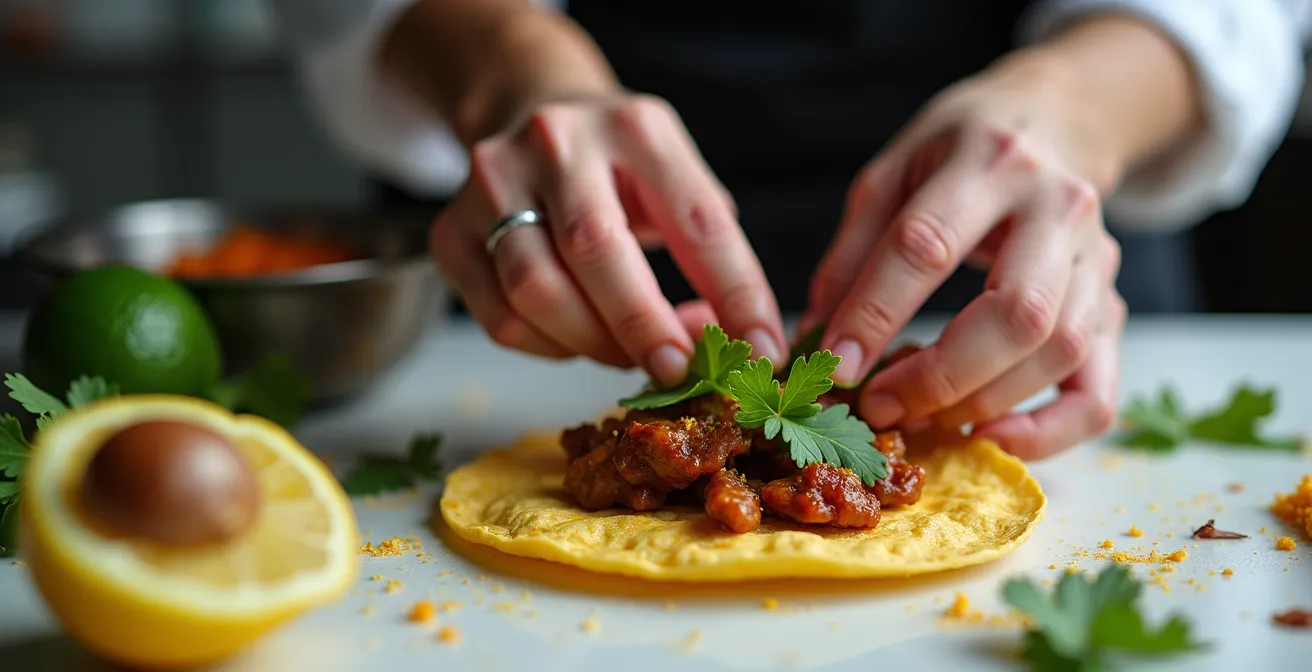
This curated approach ensures clarity of flavor. When you take a bite, your palate isn’t confused. It can clearly identify the Mexican foundation of the dish while being pleasantly surprised and elevated by the Japanese accent. This is the difference between a thoughtless mixture and a dish that tells a coherent, delicious story. The goal is harmony, not noise.
The Respect Mistake: How to Fuse Cuisines Without Insulting Tradition?
Beyond technique, successful fusion requires a deep sense of respect. A common mistake is to “borrow” ingredients without understanding their cultural context or culinary purpose, which can feel less like fusion and more like appropriation. To avoid this, your dish must have a narrative, a reason for being that goes beyond “it seemed like a cool idea.”
As Fort Worth chef Martinez noted in a Texas Monthly interview on the subject, this principle is what separates thoughtful creation from a careless mashup.
A respectful fusion dish should have a logical story you can tell. If the story is just ‘I threw things together,’ it’s likely appropriation, not fusion.
– Martinez, Fort Worth chef, Texas Monthly
This “logical story” can be historical, personal, or based on the flavor science we discussed. A fantastic historical example of respectful fusion is the story of *cacahuates japoneses* (Japanese peanuts). This iconic Mexican snack was not invented in Japan; it was created in Mexico City in 1945 by Japanese immigrant Yoshihei Nakatani. He took a familiar Japanese technique of coating peanuts in a flour shell and adapted it with a hint of soy sauce, creating something entirely new yet born of a genuine cultural exchange. It tells a story of immigration, adaptation, and shared culinary ground.
Case Study: The Authentic Fusion of Cacahuates Japoneses
The creation of Japanese peanuts in Mexico City by Yoshihei Nakatani and his wife Emma Ávila is a prime example of fusion emerging from lived experience. The product wasn’t a superficial gimmick but a result of an immigrant applying his own culinary heritage to his new home’s palate. This demonstrates that the most successful and enduring fusion dishes often arise from authentic cross-cultural connections, not from a chef simply raiding another cuisine’s pantry for trendy ingredients.
Before you create, ask yourself: what is the story of this dish? Is it about the shared umami of chiles and kombu? Is it about the textural play between a crispy tostada and soft tuna? If you can articulate the “why,” you are practicing respectful, meaningful fusion.
How to Match the Crunch of a Tostada With the Softness of Sashimi?
Flavor is only half the battle. One of the most powerful tools in a fusion chef’s arsenal is the deliberate use of texture. A dish that fails on texture can feel monotonous or jarring, even if the flavors are correct. The architectural principle here is to create textural counterpoint: a conscious and dramatic contrast that makes each bite more exciting. The combination of a crispy tostada and silky sashimi is a classic example of this principle at its finest.
The goal is to maximize the contrast. The tostada must be shatteringly crisp, not tough or chewy. The sashimi must be impeccably fresh and cut to a thickness that feels luxurious and soft, almost melting on the tongue. The pleasure of the dish comes from the moment these two opposing textures meet. It’s a sensory surprise that elevates the entire experience. This is not just about adding “crunch”; it’s about engineering the most satisfying mouthfeel imaginable.
The image below captures this exact moment of textural tension. The rough, cratered landscape of the fried corn meets the smooth, glistening plane of the raw fish. It’s a visual promise of the sensory experience to come.
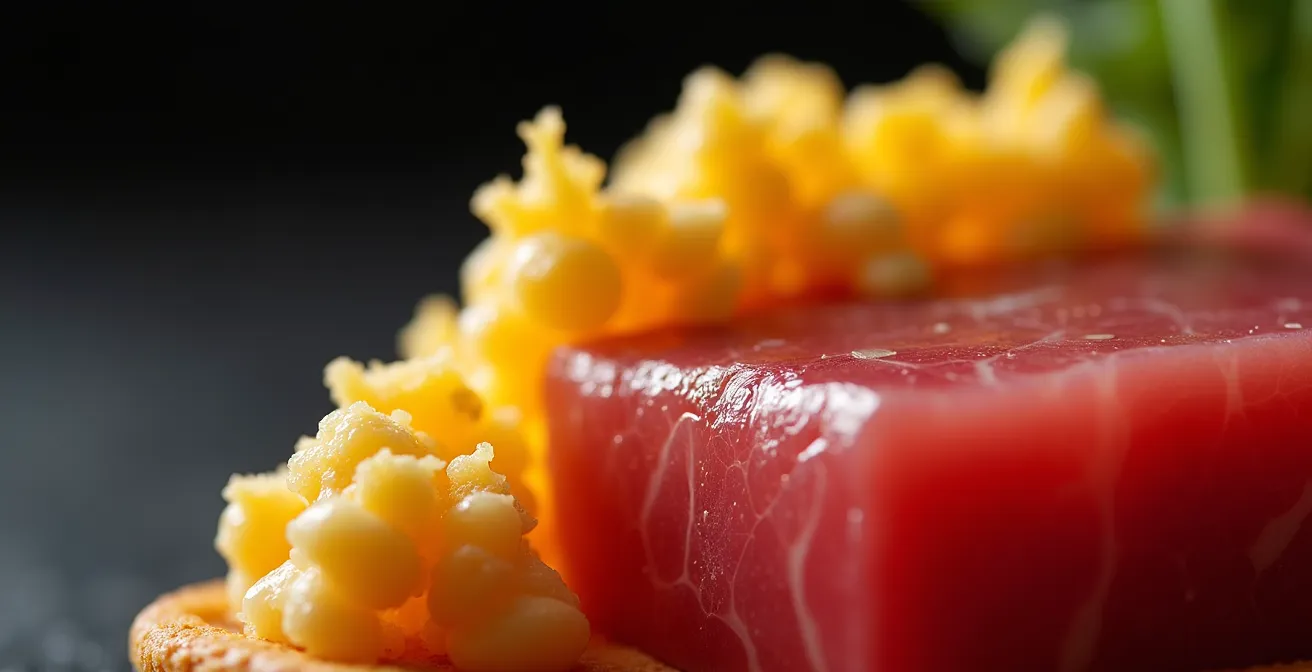
You can apply this principle in countless ways. Think of the contrast between creamy avocado and crispy tempura bits, or the pop of fish roe against a soft corn masa. When designing your dish, don’t just think about flavor pairings. Map out your textures. If your pillar ingredient is soft, your accent should have a decisive crunch, snap, or pop. This deliberate contrast is what turns a good dish into an unforgettable one.
When to Add Wasabi to Guacamole for Maximum Impact?
Now we move to a very specific, technical challenge: heat. Both cuisines use it, but the nature of the heat is completely different. Mexican chiles derive their heat from capsaicin, an oil-based compound that creates a slow-building, lingering burn. Japanese wasabi gets its kick from isothiocyanates, volatile, water-soluble compounds that deliver a sharp, sinus-clearing blast that dissipates quickly. They are two entirely different tools. The amateur throws them together; the architect chooses one.
Fusing wasabi into guacamole is a brilliant idea, but timing and technique are everything. The volatile compounds in fresh wasabi are extremely fragile. They degrade rapidly upon exposure to air and heat. Mixing it in too early or too aggressively will destroy its signature pungent kick, leaving you with just a faint, mustardy bitterness. The goal is to preserve that explosive, fleeting heat signature and deliver it as a surprise within the creamy, familiar context of guacamole.
To achieve this, you must follow a strict protocol. The following checklist outlines the scientific and culinary steps for a perfect wasabi-guacamole integration, ensuring you achieve maximum impact without creating a muddled, spicy mess.
Your Action Plan: The Wasabi-Guacamole Protocol
- Choose your heat: Never combine wasabi with chile-based heat. The goal is to replace the capsaicin burn with the isothiocyanate sharpness, not to layer them.
- Use fresh paste: Prepare wasabi paste from powder just before use. Pre-made tubes have lost many of the volatile compounds that provide the signature kick.
- Fold, don’t mix: Gently fold the wasabi into the *finished* guacamole. Over-mixing will break down the compounds. This should be the absolute last step.
- Time it perfectly: Incorporate the wasabi no more than 15 minutes before service. The heat is volatile and will fade quickly.
- Start small and adjust: The heat intensifies slightly after mixing. Begin with 1/4 teaspoon of prepared wasabi per avocado and taste before adding more.
- Serve immediately: Oxygen is the enemy of wasabi’s potency. Get the dish to the table as soon as it’s ready to deliver that perfect, pungent punch.
How to Eat With Your Hands in India Without Offending Your Hosts?
The principles of respectful fusion extend beyond the plate. To truly understand a cuisine, you must also understand its rituals. The question of eating with one’s hands in India, while seemingly unrelated, offers a profound lesson in context and respect that is directly applicable to our work as fusion architects. In many parts of India, eating with the right hand is not merely a custom; it’s an intimate, sensory part of the dining experience that connects the person to their food. It is considered the clean, proper way to eat, with deep cultural and religious roots.
Using the left hand, traditionally used for personal hygiene, would be a sign of disrespect. Furthermore, the act itself is technical: specific fingers are used to mix rice and curry, to shape a morsel, and to bring it to the mouth without smearing. It’s a skill. A tourist attempting this without understanding the rules—using the wrong hand, making a mess—is analogous to a chef throwing wasabi and habanero together. Both actions show a lack of understanding and respect for the underlying system.
What does this teach us about Mexican-Japanese fusion? It teaches us that context is everything. Before you fuse, you must understand the “rules” of each cuisine. You must know why certain ingredients are paired, what textures are valued, and how dishes are traditionally eaten. Just as you learn to use only your right hand for a traditional *sadhya* on a banana leaf, you learn not to drown delicate sashimi in a heavy, overpowering mole sauce. Understanding the “why” behind the rules of another culture is the highest form of culinary respect.
How to Use Red and Yellow to Trigger Hunger Subconsciously?
As chefs, we know that we eat with our eyes first. The visual presentation of a dish is its opening argument, and color is our most powerful tool. The psychology of color in food is a well-studied phenomenon, and the use of red and yellow to stimulate appetite is a classic principle. This concept is highly relevant to our fusion architecture, as it dictates the visual harmony—or clash—of our final creation.
Mexican cuisine is a masterclass in using warm, vibrant colors. The deep reds of roasted chiles, fresh tomatoes, and achiote paste, paired with the sunny yellows of corn tortillas, masa, and tropical fruits, create a palette that is inherently appetizing and energetic. These colors are subconsciously associated with ripeness, energy, and flavor.
Japanese cuisine, by contrast, often employs a more subtle and naturalistic palette. It celebrates the intrinsic colors of its ingredients: the pearly white of rice, the verdant green of wasabi and shiso, the deep pink of tuna, and the dark black of nori. The beauty is one of Wabi-sabi—understated, natural, and serene. The architectural challenge, then, is to bridge these two visual philosophies. How do you integrate the fiery energy of a Mexican palette without overwhelming the quiet dignity of the Japanese one?
The key is to use color with the same “pillar and accent” principle we apply to flavor. If your pillar is a Japanese-style dish, like a pristine piece of sashimi, use a vibrant red salsa as a carefully placed accent—a few drops, not a flood. Conversely, if your pillar is a golden-yellow tostada, use finely slivered green shiso leaves or black sesame seeds as a contrasting visual highlight. By controlling the quantity and placement of color, you can create a dish that is visually exciting and triggers hunger without looking chaotic.
Key Takeaways
- Successful fusion is culinary architecture, not random mixing. Define the “pillar” and “accent” for clarity.
- Build flavor bridges by identifying shared scientific compounds, like the glutamates that create umami in both cuisines.
- Create excitement with textural counterpoint, deliberately contrasting elements like crispy and soft.
- Respect tradition by ensuring your dish tells a logical story, whether it’s historical, personal, or scientific.
How to Use Agar-Agar to Create Vegan Gelatin That Actually Sets?
The final frontier of fusion architecture involves not just combining existing ingredients, but creating entirely new components through modern techniques. This is where an ingredient like agar-agar becomes an invaluable tool. Derived from seaweed, agar-agar is a powerful gelling agent central to many Asian desserts, but its properties offer incredible potential for the innovative fusion chef.
Unlike animal-based gelatin, agar-agar sets firmly at room temperature and has a higher melting point, allowing you to create warm gels. It also produces a texture that is distinctively firm and brittle, rather than soft and jiggly. Mastering it requires precision. The key is to fully dissolve the agar-agar powder in a liquid by bringing it to a boil and holding it there for a minute or two. If it is not fully dissolved, your gel will not set properly, resulting in a grainy, weak structure. The standard ratio is about 2 teaspoons of powder per 4 cups of liquid, but this can be adjusted for a harder or softer set.
Now, let’s apply this to our Mexican-Japanese fusion. Imagine moving beyond a simple salsa to create a “salsa gelée”—a firm, translucent cube of gelled spicy tomato and chipotle broth. You could place this cube on a piece of Hamachi sashimi. When a diner takes a bite, the gel melts on their warm tongue, releasing the salsa flavor in a clean, intense burst that doesn’t sog the fish. Or, consider a firm mango-habanero gel, cut into a fine brunoise and sprinkled over a tuna tostada, providing a surprising textural pop and a controlled burst of sweet heat. Agar-agar allows you to deconstruct a flavor from one cuisine and present it in a completely new textural form, creating a truly novel and architectural dining experience.
Now that you understand the core principles of flavor, texture, and philosophy, the next step is to apply this architectural approach to your own creations. Start by deconstructing a single dish from each cuisine and find one logical bridge or a single, powerful counterpoint to build upon. This disciplined process is the path from a chaotic mess to a harmonious masterpiece.