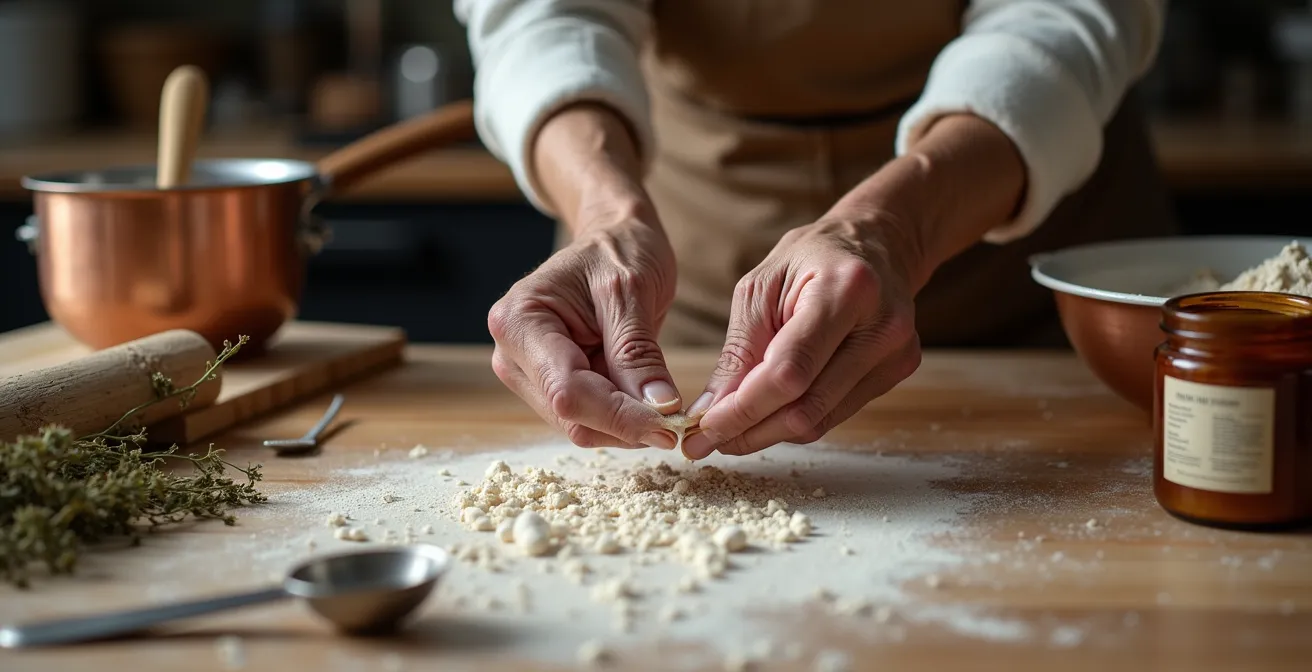
Preserving a family recipe isn’t about writing down ingredients; it’s about translating a multi-sensory experience and its emotional context into a usable archive for those who never witnessed the original.
- Document the “why” behind specific ingredients and the stories that give the dish its soul.
- Use video to capture the non-verbal “kinetic knowledge”—the precise way hands move and stir.
- Create a family-specific culinary glossary to define unique terms and intuitive measurements.
Recommendation: Act as a culinary archivist. Your mission is to observe, question, and record not just what goes into the pot, but the irreplaceable senses and stories that surround it.
The scent of a specific dish can transport you back decades. A single bite can feel like a conversation with ancestors you may have never met. This is the power held within family recipes. For many, the desire to preserve this heritage becomes urgent when we realize the keepers of these traditions—our grandmothers, our fathers, our aunts—cook from memory, using measurements like “a pinch of this” or “until it looks right.” These aren’t recipes; they are rituals, and they defy simple transcription.
The common advice is to “just write it down” or “ask for the recipe.” But this approach often fails because it misses the point. An intuitive cook doesn’t measure; they feel. They listen to the sizzle in the pan, they know the texture of the dough by touch, and they recognize the exact shade of gold on a browning onion. Simply listing ingredients on a notecard is like preserving the sheet music of a concert without capturing the performance itself. The soul of the recipe—the story, the technique, the sensory cues—is lost.
But what if the true key isn’t to force concrete measurements onto an intuitive process, but to become a culinary archivist? The goal is not just to document a list of ingredients, but to perform a kind of culinary forensics: to translate a multi-sensory, emotional experience into a living archive. It’s a shift from asking “how much?” to asking “how do you know when it’s right?”
This guide provides a methodological framework for that translation. We will explore how to document the subtle choices behind ingredients, capture the stories that give food meaning, record the physical techniques that are the heart of a dish, and organize this precious data for the generations to come. It’s a process of preserving not just a meal, but a piece of your family’s identity.
This article will guide you through the essential steps to becoming your family’s culinary archivist. The following sections break down the process, from capturing the nuances of ingredients and techniques to organizing your findings into a lasting family treasure.
Summary: How to Document “A Pinch of This” Measurements for Future Generations?
- San Marzano or Local Tomatoes: Which Preserves the Authentic Taste of Nonna’s Sauce?
- Why Sharing the Origin Story Makes the Food Taste Meaningful?
- The “Hack” Mistake That Ruins Traditional Risotto Texture
- How to Organize 50 Years of Handwritten Notes Into a Searchable Database?
- When Is the Right Age to Teach Kids Ancestral Cooking Methods?
- Why Learning Just 20 Words Can Change How Locals Treat You?
- How Does Salt and Water Turn Cabbage Into a Superfood?
- Why Sourdough Bread Is Digestible for People Who Can’t Eat Yeast Bread?
San Marzano or Local Tomatoes: Which Preserves the Authentic Taste of Nonna’s Sauce?
The first step in culinary forensics is to look beyond the ingredient list and investigate the ingredient itself. When your grandmother says “a can of tomatoes,” does she mean any can? Or does the recipe’s soul depend on a specific brand, grown in a particular region? The choice between Italian San Marzano tomatoes and juicy, sun-ripened local tomatoes isn’t just about taste; it’s about authenticity and history. This is where your work as an archivist begins: documenting the unspoken preferences that define a dish.
An intuitive cook’s knowledge is often built on a foundation of sensory cues. They don’t measure a “handful” of salt; they know what that handful looks and feels like. Your job is to translate this. Ask them to place their “pinch” into a measuring spoon *after* they’ve portioned it out by feel. Weigh their “fistful” of flour. This process of reverse-engineering measurements from instinct is crucial. As one expert guide on documenting family recipes suggests, it’s essential to cook alongside the recipe holder rather than just asking questions, using weighing scales and video to capture the unmeasurable ‘andaaza’ or intuitive style.
This detective work extends to brands and origins. Does the recipe fail without a specific brand of olive oil? Was a certain type of flour used because it was what was available during a particular era? Each choice is a clue. This is less about being rigid and more about understanding the original aromatic fingerprint of the dish. By documenting these specifics, you’re creating a baseline, a “control version” from which future generations can innovate, knowing they can always return to the authentic taste of the original.
Action Plan: Documenting Ingredient Choices
- Use a video recorder: Capture cooking sessions without distraction, allowing you to focus on the experience and observe subtle actions.
- Ask for a “slow-motion” replay: Politely ask family members to slow down and show you the exact measurements, like how much salt is in their palm before it goes in the pot.
- Document sensory cues: Ask how things should look, sound, smell, taste, and feel at different stages. Note these descriptions verbatim.
- Get the story behind the choice: Ask when they learned the recipe, who taught them, and why they use specific ingredients or brands.
- Request feedback on your attempt: After making the dish yourself, ask them to taste it. Check for texture, seasoning, and get suggestions for improvement.
Why Sharing the Origin Story Makes the Food Taste Meaningful?
A list of ingredients creates a meal, but the story behind it creates a memory. Documenting a family recipe without its narrative is like owning a beautiful heirloom locket with no photo inside. The story is what gives the food its meaning, transforming it from mere sustenance into a culinary time capsule. It answers the crucial questions: Who created this dish? What celebration was it for? What does it remind you of? This context is the invisible ingredient that makes everything taste better.
As author Laurie Colwin beautifully articulated, “No one who cooks, cooks alone. Even at her most solitary, a cook in the kitchen is surrounded by generations of cooks past, the advice, and menus of cooks present, the wisdom of cookbook writers.” When we record the origin stories, we are honoring this invisible community. We create an heirloom that connects our children and grandchildren to the people they may have never met. A case study in recipe preservation highlights a family who created a cookbook with photos and stories, noting it helped a daughter-in-law learn about family members who had passed away years before she joined the family. The book became a bridge across generations.
The act of capturing these stories is part of the preservation process. While the food is simmering, ask about the first time they remember eating it. Inquire about the person who taught them the recipe. These narratives provide vital context, explaining why a particular shortcut was taken or why a seemingly odd ingredient is non-negotiable. It’s the story that explains why your grandfather always added a splash of beer to his stew, or why a holiday cake must have exactly seven layers. Without the story, you have a recipe. With the story, you have a legacy.
No one who cooks, cooks alone. Even at her most solitary, a cook in the kitchen is surrounded by generations of cooks past, the advice, and menus of cooks present, the wisdom of cookbook writers. As we record the thoughts, ideas, and processes of our traditional family meals we create an heirloom that will be handed down to our children, grandchildren and great-grandchildren.
– Laurie Colwin, The Family History Guide Blog
The “Hack” Mistake That Ruins Traditional Risotto Texture
Many modern recipes promise “hacks” and “shortcuts,” like no-stir risotto or quick-soak beans. While convenient, these modifications often destroy the very texture and character that define a traditional dish. The slow, methodical stirring of risotto isn’t just a tedious step; it’s the process that coaxes the starch from the Arborio rice, creating its signature creamy-yet-firm texture. Skipping this step is not a hack; it’s a fundamental misunderstanding of the food’s science and soul.
This is where documenting technique—the kinetic knowledge of the cook—becomes paramount. It’s the way your grandmother folds the dough, the specific rhythm she uses to whisk a sauce, or the visual cue she looks for when searing meat. This knowledge often cannot be expressed in words. It must be seen. This is why a simple written recipe is often not enough. To truly preserve these methods, you must observe and record the physical actions.
The best tool for this is your phone’s video camera. According to an expert guide from Food Network, filming your loved one walking through a recipe can clarify measurements and, most importantly, show techniques visually, adding context and personality that get lost on paper. Record their hands as they work. Ask them to describe what they’re feeling. Note the sounds of the kitchen—the “shuffling pebbles” sound of rice being toasted, or the sharp sizzle that indicates a pan is hot enough. These sensory indicators are the true instructions.
By documenting the “why” behind each technique—”you have to stir constantly so it doesn’t stick and the cream is released”—you are preserving the wisdom of generations. You are teaching not just a series of steps, but the underlying principles. This ensures that even if a future cook uses a different stove or a different pan, they understand the goal and can adapt, preserving the integrity of the original dish far better than any “hack” ever could.
How to Organize 50 Years of Handwritten Notes Into a Searchable Database?
After weeks of observing, questioning, and recording, you’re left with a mountain of precious data: stained notecards, scribbled-on napkins, audio recordings, and hours of video. This collection is a treasure, but in its raw state, it’s an overwhelming and unusable archive. The next critical phase of your work as a culinary archivist is to bring order to this chaos, transforming it into a searchable, shareable, and sustainable database.
The first step is digitization. Handwritten notes are fragile and unique; a kitchen fire or a simple spill could erase them forever. A family historian successfully tackled this challenge by using a scanner app to quickly digitize a huge collection. In a case study on digital preservation, a historian used the Photomyne app to scan recipe collections, which automatically crops and separates multiple items in a single photo, making it ideal for large batches of notes. Scanning each artifact at a high resolution (at least 300 DPI) ensures readability for years to come.
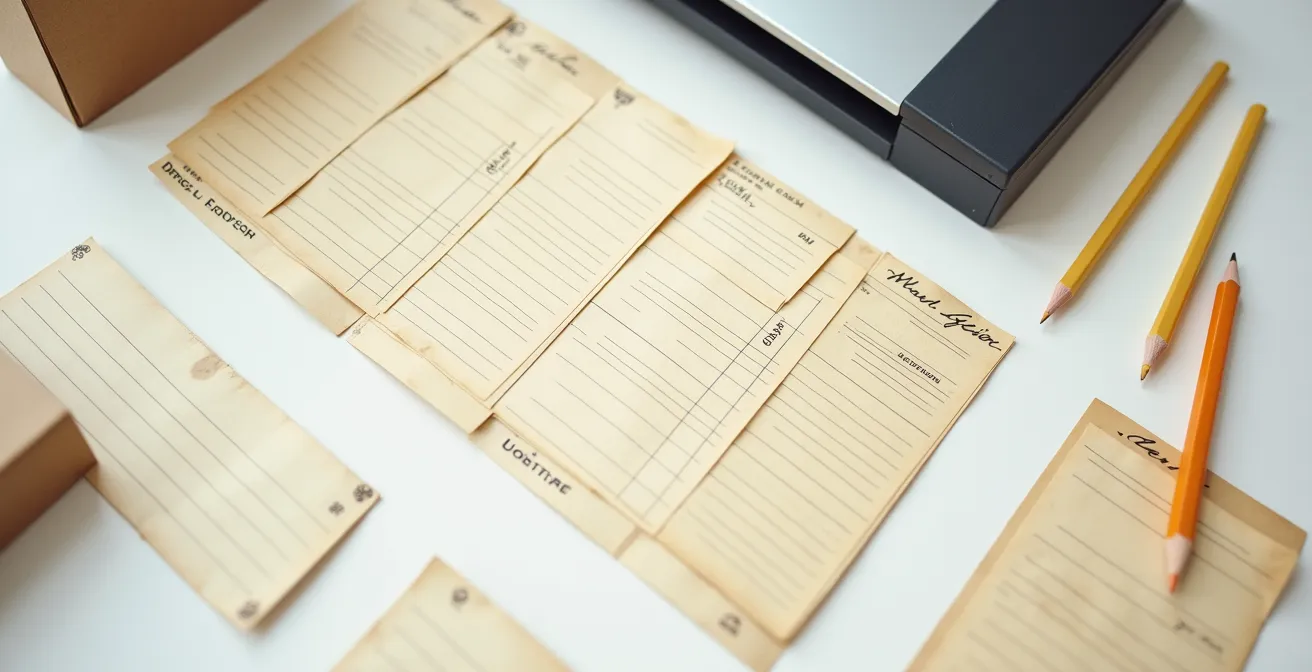
Once digitized, organization is key. Create a consistent folder structure and file-naming system (e.g., `Grandma_Leone_Lasagna_Recipe_Card.jpg`). More powerfully, use metadata or tags. A simple system can make your collection incredibly useful. Tag recipes with keywords like #holiday, #dessert, #grandma-recipe, #technique-fermenting. This allows anyone in the family to quickly find “all of Grandma’s Christmas recipes” or “every recipe that uses sourdough starter.”
Finally, ensure longevity. A single hard drive can fail. The best practice is the 3-2-1 backup rule: three copies of your data, on two different types of media, with one copy off-site. This could mean storing your archive on your computer, an external hard drive, and a cloud storage service like Google Drive or Dropbox. This redundancy ensures that your family’s culinary legacy is protected from digital and physical disasters, ready to be accessed and added to by the next generation of family cooks.
When Is the Right Age to Teach Kids Ancestral Cooking Methods?
A living archive is one that is used and passed on. The ultimate goal of documenting these recipes is not to place them in a museum, but to get them back into the kitchen, especially into the hands of the next generation. This raises a common question: when is the right age to start teaching children these ancestral cooking methods? The answer is likely much younger than you think. Involving children in the kitchen is the final, crucial step in ensuring a recipe’s survival.
Involving kids in meal preparation is not just about teaching them a life skill; it’s about connecting them to their heritage in a tangible way. Research shows that children who participate in cooking are more likely to try nutritious foods and develop a healthier relationship with eating. More importantly, it creates a natural and joyful environment for storytelling and the transmission of family traditions. As they wash vegetables or stir a pot, you can share the stories you’ve collected about the recipe’s origin.
The key is to assign age-appropriate tasks to build confidence and ensure safety. A 4-year-old can’t chop onions, but they can wash vegetables and stir ingredients in a bowl. A 7-year-old can snap green beans or shuck corn. By the time they are pre-teens, they can begin to follow a recipe and use the stove with supervision. This gradual apprenticeship builds skills and, more importantly, a sense of ownership and connection to the food.
The following table, based on research into child development in the kitchen, offers a practical guide for getting kids involved at every age.
This guide breaks down kitchen tasks by age, providing a clear path to safely involve children. Based on research from OSU Extension, it shows how even the youngest family members can participate.
| Age Group | Recommended Tasks | Skills Developed |
|---|---|---|
| 3-5 years | Wash fruits/vegetables, brush oil, use cookie cutters | Basic motor skills, following instructions |
| 6-7 years | Peel potatoes, break eggs, snap beans, shuck corn | Fine motor skills, hand-eye coordination |
| 8-9 years | Open cans, beat eggs, juice lemons, check temperatures | Tool usage, measurement understanding |
| 10-12 years | Boil pasta, microwave, follow recipes, chop vegetables | Recipe reading, timing, knife skills |
Why Learning Just 20 Words Can Change How Locals Treat You?
When traveling, learning a few words in the local language can transform your experience. The same is true in the geography of a family kitchen. Every family has its own dialect—a unique vocabulary of food terms, nicknames for techniques, and special names for dishes that wouldn’t be found in any cookbook. Learning this “local language” is essential to fully understanding and preserving your family’s culinary traditions. This lexicon is a key part of the recipe’s soul.
This “kitchen dialect” might include a specific word for the crispy bits at the bottom of the rice pan, a special name for a secret ingredient, or a verb that describes a very particular way of kneading dough. For one family, the instruction for brisket simply says “browning sauce,” a term that refers to a specific brand—Kitchen Bouquet—that is “eyeballed” into the dish and used for nothing else. Without this insider knowledge, a future cook would be completely lost. Your role as an archivist is to create a family culinary glossary.
This glossary should document these unique terms. What does “Grandma’s teacup” actually measure? What is “that blue bowl” used for, and why only that one? Record the names of ethnic dishes and capture their correct pronunciation. This act of documenting language does more than just clarify instructions; it honors the unique culture of your family. It acknowledges that the way you talk about food is as much a part of the heritage as the food itself.
Jews in the Chicagoland area often make a savory brisket using browning sauce. On one recipe card, it simply says ‘browning sauce’. My grandmother and mother both ‘eyeball’ it. Further, they both use Kitchen Bouquet as their browning sauce—a pantry item I’ve never seen used for any other recipe in my life. These kinds of details are where you’ll need to spend time being the record keeper in your family.
– Write the World Blog
Learning these “20 words” or more of your family’s culinary dialect is the key to unlocking the recipe’s deepest secrets. It shows respect for the tradition and ensures that the nuances and personality of the instructions are not lost in translation. It ensures you are treated not as an outsider, but as a true “local” in your own family’s kitchen.
How Does Salt and Water Turn Cabbage Into a Superfood?
Some of the most ancient and treasured family recipes are not about heat and spice, but about time and transformation. Fermentation—the process that turns cabbage into sauerkraut or kimchi, cucumbers into pickles, and milk into yogurt—is a cornerstone of culinary heritage in many cultures. The process seems magical: with just salt, water, and patience, a simple vegetable is preserved and turned into a probiotic-rich superfood. Documenting this wisdom is a special challenge, as it relies heavily on sensory markers and environmental conditions.
The science behind it is lacto-fermentation. Salt draws water out of the cabbage, creating a brine. In this salty, anaerobic environment, beneficial bacteria (like *Lactobacillus*) thrive, while harmful bacteria cannot survive. These good bacteria convert sugars in the cabbage into lactic acid, which acts as a natural preservative and gives fermented foods their characteristic tangy flavor. This process not only preserves the food but also enhances its nutritional value.
When documenting a family fermentation recipe, precision and sensory details are equally vital. A chef documenting his family’s recipe for lacto-fermented onions noted the precise weight of the onions and spices, but also included the crucial traditional instruction: the brine must “taste distinctly salty.” This blend of scientific measurement and sensory wisdom is the key. The process can be a family staple, with the same fermentation method working across different vegetables like turnips or carrots, making the core technique highly versatile.
Your documentation should capture all variables: the type of salt used (iodized salt can inhibit fermentation), the temperature of the room (warmer temperatures speed up the process), and the sensory cues of a successful ferment (bubbling, a pleasant sour smell). By capturing both the “what” (the ingredients) and the “how” (the environmental and sensory cues), you preserve not just a recipe, but a timeless, self-sustaining food preservation technique.
Key Takeaways
- Act as a Culinary Archivist: Your goal is to translate intuitive, sensory knowledge into a repeatable format.
- Document More Than Ingredients: Capture the origin stories, specific brand choices, and family-specific language that give a recipe its soul.
- Film the Technique: Use video to record the physical “kinetic knowledge”—the hand movements and rhythms that words cannot describe.
Why Sourdough Bread Is Digestible for People Who Can’t Eat Yeast Bread?
Among the most cherished of living heirlooms is the sourdough starter—a bubbling, living culture of wild yeast and bacteria passed down through generations. It is the heart of sourdough bread, and the reason many people who struggle with commercial yeast bread find it more digestible. This is not just a different ingredient; it is a different biological process, and preserving it requires a unique approach that blends science with family lore.
The magic of sourdough lies in its slow fermentation process. Unlike the fast-acting commercial yeast in most modern breads, the wild yeasts and lactobacilli in a sourdough starter work over many hours. During this long fermentation, they begin to break down the complex carbohydrates and gluten in the flour. This pre-digestion makes the final bread easier on the gut. It’s not that the gluten disappears, but it is fundamentally altered, making it more tolerable for many. This ancient method of leavening is a testament to the wisdom embedded in traditional food practices.
Preserving a sourdough starter is like adopting a family pet. It requires care, feeding, and a deep understanding of its personality. The best way to document this is to create a “birth certificate” for the starter. This document should include its origin (who gave it to you and when), its known lineage (how many generations it has traveled), its preferred feeding schedule and flour types, and a log of when portions are shared. This transforms a simple jar of starter into a documented piece of family history.
As Mary Lynn Ritzenthaler of the National Archives states, family recipes hold a unique power. This is especially true for something as alive as a sourdough starter. Its preservation is the ultimate act of culinary archiving.
Some of the most treasured items that are passed along in a family are recipes: Grandma’s apple pie or Dad’s special barbecue sauce. They evoke wonderful memories and keep traditions alive. Nowadays, recipes are easily found online, but they are not the same as using original recipe cards and note paper—with ingredients recorded in familiar handwriting.
– Mary Lynn Ritzenthaler, National Archives
You now possess the framework of a culinary archivist. The journey from a vague “pinch of this” to a detailed, living archive is a profound act of love and preservation. Begin your work today by choosing one recipe, scheduling time to cook with its keeper, and starting your first archive entry. Your family’s history is waiting to be written.