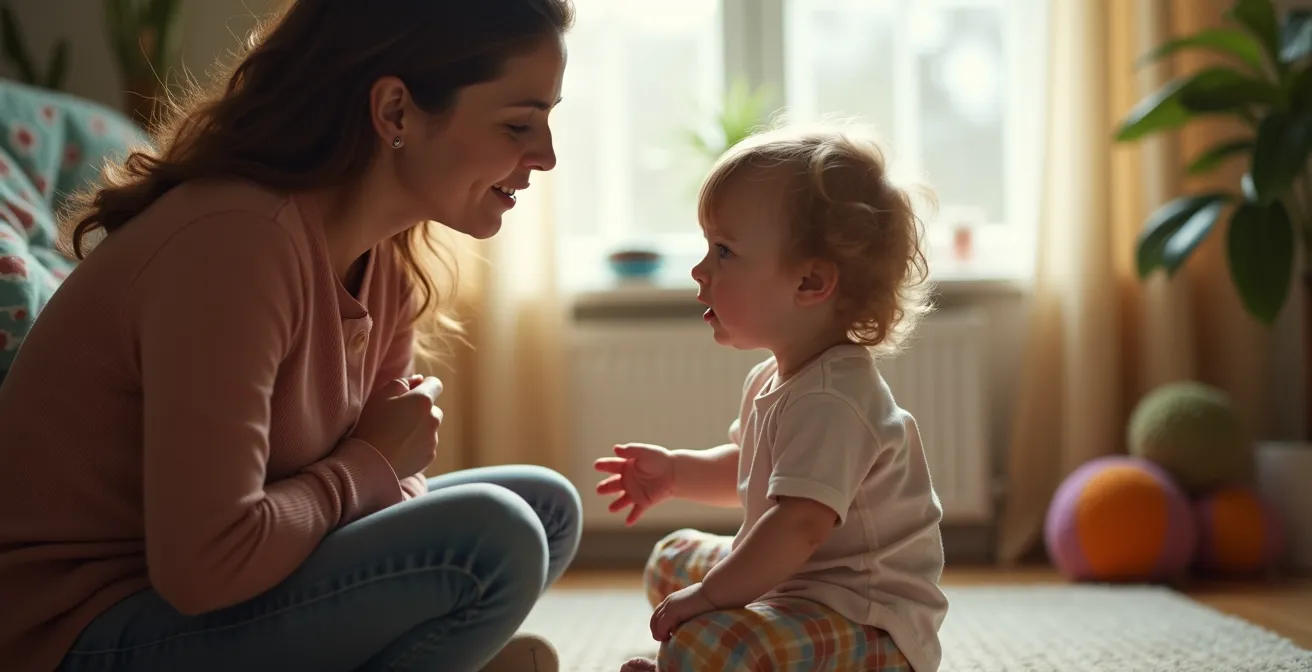
The goal isn’t to stop your toddler’s tantrums, but to transform them into powerful lessons in emotional intelligence by first regulating your own nervous system.
- A child’s ability to self-regulate is built through “co-regulation,” where they borrow your calm to manage their overwhelming feelings.
- Common phrases like “stop crying” or “be strong” actually hinder emotional development, while connection-focused strategies like a “time-in” build long-term resilience.
Recommendation: Shift your focus from controlling the behavior to connecting with the feeling underneath. Your calm is the most powerful parenting tool you have.
That familiar sound of a toddler’s wail escalating into a full-blown tantrum can trigger a parent’s own nervous system into high alert. In that moment, our instinct is to make it stop. We reach for common phrases: “Stop crying,” “You’re okay,” “It’s not a big deal.” We might try to distract them with a toy or, feeling exhausted, resort to a time-out. These are the strategies most of us have seen or experienced. They are aimed at managing the behavior—the noise, the flailing, the sheer intensity of it all.
But what if the tantrum itself isn’t the problem, but rather a raw, unfiltered communication? What if these emotional storms, which often peak between ages two and three, are actually the most critical opportunities we have to build our child’s emotional intelligence? The challenge is that a toddler’s brain is not yet equipped to handle big feelings like frustration, disappointment, or anger on its own. They are physically and neurologically overwhelmed.
The key, then, is not to suppress the emotion, but to lend them our own calm. It’s a shift from seeing our role as a “corrector” of bad behavior to an “emotional co-regulator.” This approach moves beyond simply naming a feeling and delves into the foundational work of helping a child feel safe *with* their feelings. It requires us to look inward first, calming our own internal storm so we can become a safe harbor for theirs.
This guide will walk you through this paradigm shift. We will explore why traditional discipline often fails, how to manage your own stress in the moment, and how to use connection as your primary tool for teaching resilience. You will learn not just how to survive the “terrible twos,” but how to use them to lay a foundation for a lifetime of emotional health for your child.
Table of Contents: A Guide to Building Your Toddler’s Emotional World
- Why Saying “Stop Crying” Hinder Your Child’s Emotional Intelligence?
- How to Calm Your Own Nervous System So You Can Calm Your Child?
- Time-Out or Time-In: Which Builds Better Long-Term Resilience?
- The “Be Strong” Mistake That Leads to Adult Anxiety Issues
- When to Talk About Bad Behavior: In the Moment or After the Storm?
- How to Design a 20-Minute Wind-Down Routine for Busy Parents?
- How to Roast Root Vegetables So Even Kids Will Eat Them?
- How to Practice Active Listening When You Just Want to Solve the Problem?
Why Saying “Stop Crying” Hinder Your Child’s Emotional Intelligence?
When a toddler is overwhelmed, their logical brain (the prefrontal cortex) is essentially offline. They are operating from a place of pure, unfiltered emotion. Hearing “stop crying” or “you’re okay” in this state doesn’t compute logically. Instead, it sends a powerful, implicit message: “Your feeling is wrong,” “Your emotion is too much for me,” or “You are safer if you hide what you feel.” This invalidation, however well-intentioned, becomes the first brick in a wall between a child and their own emotional world. They learn that certain feelings, like sadness or anger, are unacceptable and should be suppressed.
The goal is not to stop the tears, but to help the child understand what the tears mean. A tantrum is a distress signal, not a sign of manipulation. While some behaviors are certainly boundary-testing, the underlying emotion is always real. Most toddler tantrums are intense but brief. In fact, research from the National Institutes of Health shows that tantrums lasting more than 15 minutes or occurring frequently throughout the day may be considered atypical. For the vast majority of toddlers, these outbursts are a normal, albeit challenging, part of development.
By immediately trying to silence the emotion, we rob our children of the chance to learn how to move *through* it. The alternative is to provide what psychologists call emotional scaffolding. Instead of dismissing the feeling, we validate it and sit with them in their discomfort. This teaches a far more valuable lesson: that emotions are survivable, they are not dangerous, and that connection is always available, even in their hardest moments. This builds a foundation of trust and emotional safety, which is the bedrock of true emotional intelligence.
Instead of “stop crying,” try scripts that validate and connect. Simple swaps like, “I can see this is a big feeling. I’m right here with you,” or “That was really frustrating. I’m here,” can completely change the dynamic. It shifts the goal from silencing to supporting.
How to Calm Your Own Nervous System So You Can Calm Your Child?
A child’s nervous system is not fully developed; it learns how to regulate by syncing up with the nervous systems of their primary caregivers. This process is called co-regulation. When you are calm, your slow heart rate, steady voice, and relaxed posture send a biological signal to your child’s body that they are safe. Conversely, when your own stress levels rise—your jaw clenches, your voice gets tight, your heart races—you are signaling danger, which can escalate their distress. Therefore, the single most effective thing you can do to calm your child is to first calm yourself.
This is, of course, easier said than done. In the heat of the moment, your own fight-or-flight response is likely activated. The key is to have a simple, go-to grounding technique that you can do discreetly. One of the most powerful is focusing on your own body. Feel your feet flat on the floor. Notice the weight of your body. This simple act of physical awareness can pull you out of the reactive part of your brain and into the present moment.
Another powerful tool is deep, diaphragmatic breathing. Place one hand on your chest and the other on your belly. Inhale slowly through your nose for four counts, feeling your belly expand more than your chest. Hold for a moment, then exhale slowly through your mouth for six counts. This type of breathing activates the vagus nerve, which is a core component of the parasympathetic nervous system—your body’s natural “braking” system. Repeating this just two or three times can significantly lower your own stress response, allowing you to respond with patience instead of reacting with panic. Every moment you offer a soothing voice and a warm touch during a stressful situation, you’re teaching a child the earliest lessons in emotional safety.

As you can see in this gesture, the focus is on a physical, internal anchor. This isn’t about ignoring your child; it’s about getting yourself into a state where you can be the calm, steady presence they desperately need. Your calm is not just for you; it’s a gift you give to your child’s developing brain. It’s the foundation from which all other emotional teaching flows.
This practice of co-regulation is the active ingredient that makes a parent’s presence truly soothing. It is the silent, biological conversation happening beneath the words, and it’s what truly teaches a child how to feel safe with their big emotions.
Time-Out or Time-In: Which Builds Better Long-Term Resilience?
The traditional “time-out” was designed as an alternative to physical discipline, with the idea that a child would use the time alone to reflect on their behavior. However, from a developmental perspective, it often sends an unintended message: “When you have big, messy feelings, you must be alone.” For a toddler whose brain is overwhelmed, isolation can feel like abandonment. It can increase feelings of shame and fear, rather than promoting self-reflection. A dysregulated child cannot calm themselves; they need connection to regulate.
This is where the concept of a “time-in” offers a powerful alternative. A time-in is not a punishment, but a strategy for co-regulation. Instead of sending the child away, you invite them to a quiet space *with* you. The goal shifts from separation to connection. This might be a designated “cozy corner” with pillows and soft blankets, or it could simply be sitting together on the floor. You don’t need to talk much. Your role is to be a calm, steady, and loving presence, offering a hug or a hand to hold if they are open to it. You are the anchor in their emotional storm.
The time-in communicates, “All of your feelings are welcome here,” “You are safe with me, even when you’re upset,” and “I will help you through this.” It models the exact skill you want them to learn: how to sit with a difficult emotion without being consumed by it. This approach directly builds long-term resilience by strengthening their emotional regulation skills within the safety of the parent-child relationship. The following table breaks down the core differences in approach and impact, with insights drawn from a connection-based parenting framework.
| Aspect | Time-In Approach | Traditional Time-Out |
|---|---|---|
| Primary Goal | Connection and co-regulation | Isolation for reflection |
| Parent Role | Active calm presence | Enforcer of separation |
| Child’s Experience | Supported through emotions | Left to self-soothe alone |
| Message Conveyed | ‘You’re safe even when upset’ | ‘Your emotions are too much’ |
| Long-term Impact | Builds emotional regulation skills | May increase shame/disconnection |
While a time-out focuses on the behavior, a time-in focuses on the child and the emotion underneath. It’s a proactive investment in their emotional health, teaching them from the very beginning that they never have to face their biggest feelings alone.
The “Be Strong” Mistake That Leads to Adult Anxiety Issues
Much like “stop crying,” the phrase “be strong” is a well-intentioned attempt to encourage resilience. We want our children to be tough and capable. However, for a young child, this message is often interpreted as, “Your current feeling of sadness/fear/disappointment is a sign of weakness.” It teaches them to build a facade of strength by suppressing or disconnecting from their authentic emotions. Over time, this can lead to what psychologists call emotional avoidance, a core factor in the development of anxiety and other mental health challenges in adulthood. When we don’t learn how to process emotions, they don’t disappear; they get stored in the body and can manifest as anxiety, chronic stress, or depression.
True emotional strength isn’t the absence of feelings; it’s the ability to feel them, name them, and move through them without being derailed. As parenting expert Dr. Becky Kennedy puts it, “True strength isn’t being a brick wall that never feels anything; it’s being a strong tree that can bend in the wind of difficult emotions and not break.” We build this “bendiness” in our children by modeling it ourselves and by validating their entire emotional spectrum. The consistency of this modeling is key, as research from the Child Mind Institute indicates that children learn emotional regulation through co-regulation with caregivers, with consistent modeling across multiple caregivers significantly improving outcomes.
Instead of “be strong,” we can use language that validates the struggle while expressing confidence in their ability to get through it. This builds genuine self-esteem and resilience. It’s about teaching them that courage isn’t not being scared; it’s being scared and doing the hard thing anyway. This subtle shift in language makes a world of difference in fostering a healthy relationship with their inner world.
Action Plan: Scripts to Build True Resilience
- Validate the struggle: Instead of “Be strong,” say, “This is really hard, and I know you can get through it.”
- Reframe bravery: Try this powerful alternative: “It’s brave to feel something so big.” This redefines strength as emotional capacity, not suppression.
- Offer presence, not dismissal: Use this to show support: “I can see you’re sad, and I’m going to stay with you until it feels a little smaller.”
- Normalize all feelings: State clearly, “All feelings are okay. Let’s figure out what to do with this one together.” This removes shame.
- Listen to the body’s wisdom: Connect the physical to the emotional: “Your body is telling us something important right now.”
By shifting our vocabulary, we help our children see their emotions not as weaknesses to be hidden, but as valuable information to be understood. This is the foundation of a healthy inner life.
When to Talk About Bad Behavior: In the Moment or After the Storm?
A common parenting dilemma is when to address a behavior, such as hitting a sibling or throwing a toy. Attempting to lecture, reason with, or discipline a toddler in the middle of an emotional storm is almost always ineffective. As we’ve discussed, their rational brain is offline. They are in a state of survival, and they cannot access the parts of their brain responsible for learning, empathy, or cause-and-effect thinking. In that moment, your one and only job is safety and co-regulation. This means stopping any unsafe behavior (e.g., gently holding their hands to prevent hitting) and then focusing entirely on connection and calming, as with a “time-in.”
The teaching moment comes later. Much later. Once the emotional storm has completely passed and your child is calm, connected, and regulated again, their learning brain comes back online. Experts call the period after an outburst the “emotional hangover.” According to developmental research, the period 10-20 minutes after a tantrum is when children are most receptive to gentle guidance and learning. They are no longer defensive or overwhelmed, and they can actually absorb the lesson you want to impart.
This is the time for a “two-part conversation.” You can say something like, “That was a really big feeling. You were so angry that your brother took your toy. It’s okay to feel angry, but it’s not okay to hit. Next time you feel that angry, what can we do instead? Maybe we can hit a pillow or stomp our feet.” This framework accomplishes three critical things:
- It validates the emotion (anger was okay).
- It holds a clear, firm boundary on the behavior (hitting was not okay).
- It problem-solves for the future, empowering the child with alternative strategies.
This “connect, then correct” sequence is vital. By separating the moment of dysregulation from the moment of teaching, you preserve the relationship and make the lesson far more likely to stick.
By waiting for the emotional hangover, you shift from being an adversary in a power struggle to a trusted guide helping them navigate their complex inner world. This is where true, lasting learning happens.
How to Design a 20-Minute Wind-Down Routine for Busy Parents?
Many toddler tantrums are not simply behavioral; they are physiological. As medical research shows, fatigue and hunger are two of the most common triggers for emotional dysregulation in young children. Their limited self-control is easily depleted when their basic physical needs are not met. A consistent, predictable wind-down routine at the end of the day can act as a powerful preventative measure, helping to lower cortisol levels and ease the transition into sleep before a child becomes overtired and prone to meltdowns.
A successful routine doesn’t have to be long or complicated. In fact, for busy parents, a simple 20-minute ritual can be incredibly effective. The key is consistency and predictability. The routine should follow the same sequence of events each night, signaling to your child’s brain and body that it’s time to prepare for rest. It’s also a prime opportunity to practice the emotional skills discussed throughout this guide. It provides a dedicated space for connection and emotional check-ins after a busy day.
The goal is to move from high-energy activities to quiet, calming ones. This involves reducing stimulation—dimming the lights, turning off screens, and using a softer, quieter voice. The routine should focus on sensory soothing and emotional connection. Think of it as an “emotional checkout” for the day, a chance for both of you to process feelings and reconnect before separating for the night. This structured time helps fill your child’s “connection cup,” making them feel safe and secure, which is essential for both emotional regulation and peaceful sleep.
Here is a sample 20-minute ritual you can adapt for your family:
- Minutes 1-3: Transition Signal. Begin the routine with a clear cue. This could be dimming the lights, playing a specific calm song, or lighting a battery-operated candle. This signals the shift from “play time” to “quiet time.”
- Minutes 4-8: ‘Rose and Thorn’ Sharing. In this simple game, each person shares one “rose” (a happy or good moment from the day) and one “thorn” (a tricky or sad moment). This builds emotional vocabulary and normalizes talking about all feelings.
- Minutes 9-13: Sensory Wind-Down. Engage in a calming sensory activity, like a warm bath, a gentle foot rub with lotion, or even just quiet coloring side-by-side.
- Minutes 14-17: Story Time. Read a book together, preferably one that touches on emotions, to provide another opportunity for discussion.
- Minutes 18-20: Final Connection. End with a moment of quiet physical connection—a long hug, a back rub while humming a song, or simply cuddling in silence.
This routine is not just about getting a child to bed; it’s about ending the day with a profound sense of safety and connection, reinforcing the message that they are seen, heard, and loved.
How to Roast Root Vegetables So Even Kids Will Eat Them?
At first glance, a recipe for root vegetables seems out of place in a discussion about toddler emotions. But the kitchen, and the process of preparing a meal together, can be one of the richest, most organic classrooms for emotional learning. The principles of connection, validation, and empowerment are not limited to tantrum management; they can be woven into the fabric of your daily life. The challenge of getting a picky eater to try something new, like roasted carrots or sweet potatoes, provides a perfect, low-stakes opportunity to practice.
Instead of a power struggle over eating, reframe cooking as an exercise in choice and sensory exploration. Toddlers crave a sense of control. By involving them in the process, you give them agency. According to frameworks that emphasize naming emotions to help toddlers learn, everyday moments provide the best opportunities to talk about feelings and model management. The goal isn’t just to get them to eat the vegetables, but to use the experience to build their emotional vocabulary and resilience.
As you cook, you can narrate the entire emotional and sensory landscape. When they hesitate to touch a bumpy carrot, you can say, “Oh, that feels bumpy and new. You’re feeling a little unsure, and that’s okay. You’re being curious.” When they get frustrated waiting for the oven to preheat, you can validate it: “Waiting is so hard! You feel frustrated that the oven is hot and we can’t touch it yet. I get it.” This practice of naming feelings in real-time is incredibly powerful. You’re not just roasting vegetables; you’re building a shared language for emotions.
Here’s how you can apply the “Control & Choice” method during cooking:
- Let them choose: “Do you want to put the carrots or the potatoes in the bowl first?” This small choice gives them a sense of power.
- Narrate sensations: “This carrot feels bumpy and you’re curious about it. Let’s wash it together.” Connect physical experience to words.
- Name waiting feelings: “You feel frustrated that the oven is hot and we can’t touch it. I feel that way too sometimes.” Validate the impatience.
- Offer texture choices: “Should we roast them until they are super crispy or keep them a little softer today?”
- Celebrate patience: When the vegetables are done, praise the process, not just the outcome: “You waited so well while they cooked! Your patience helped make this delicious snack.”
By focusing on connection and validation, you may find your toddler is not only more willing to try the food, but you’ve also reinforced the crucial message that all their feelings—curiosity, frustration, and patience—are welcome and understood.
Key Takeaways
- Your calm is contagious. The most effective way to help a dysregulated child is to first regulate your own nervous system through grounding and breathing.
- Shift from “Time-Outs” to “Time-Ins.” Connection, not isolation, is what teaches a child to manage big emotions and builds long-term resilience.
- The teaching moment is not during the storm, but during the “emotional hangover” 10-20 minutes after your child is calm and regulated again.
How to Practice Active Listening When You Just Want to Solve the Problem?
As parents, our love often manifests as a desire to fix things. When our child is upset, our instinct is to solve the problem, offer advice, or explain why they shouldn’t be feeling that way. But for a toddler, the need to be heard and understood is far more powerful than the need for a solution. This is the essence of active listening: listening to connect, not to correct. It requires us to temporarily put aside our agenda and enter their world. This can be incredibly difficult when you’re tired, stressed, and just want the crying to stop.
Active listening with a toddler is less about words and more about observation and reflection. Since their verbal skills are limited, their body often does the talking. Are their fists clenched? Are they turning their back? Are they hiding their face? Decoding this body language is a form of listening. By reflecting what you see, you show them you are paying attention. As Dr. Laura Markham, a prominent voice in peaceful parenting, advises, your primary job in these moments is to “connect, not correct.”
My job is to connect, not correct.
– Dr. Laura Markham, Peaceful Parent, Happy Kids approach
This simple mantra can be a powerful anchor. When you feel the urge to jump in and fix, remind yourself: first, connect. This might look like simply getting down on their level, making soft eye contact, and saying, “You’re showing me how sad you are.” You don’t need to agree with the reason for their sadness (like not getting a third cookie), but you must validate that the feeling itself is real and legitimate. This validation is what allows the emotion to move through them, often much faster than if you were to argue or dismiss it.
The following guide can help you translate your toddler’s physical cues into emotional understanding, allowing you to respond with more effective empathy.
| Physical Cue | Likely Emotion | Parent Response |
|---|---|---|
| Clenched fists | Anger/Frustration | ‘Your hands are telling me you’re really angry’ |
| Turned back | Overwhelm/Need for space | ‘I see you need space. I’m here when you’re ready’ |
| Rigid posture | Fear/Anxiety | ‘Your whole body has gone stiff. Something feels scary’ |
| Covering ears | Sensory overload | ‘Too much noise. Let’s find a quieter spot’ |
| Hiding face | Shame/Embarrassment | ‘It’s okay to feel this way. I’m not going anywhere’ |
By prioritizing connection over correction, you provide the deep emotional safety your child needs to build a healthy, resilient inner world. You are not just raising a well-behaved child; you are raising a human being who knows how to understand themselves and, eventually, others.