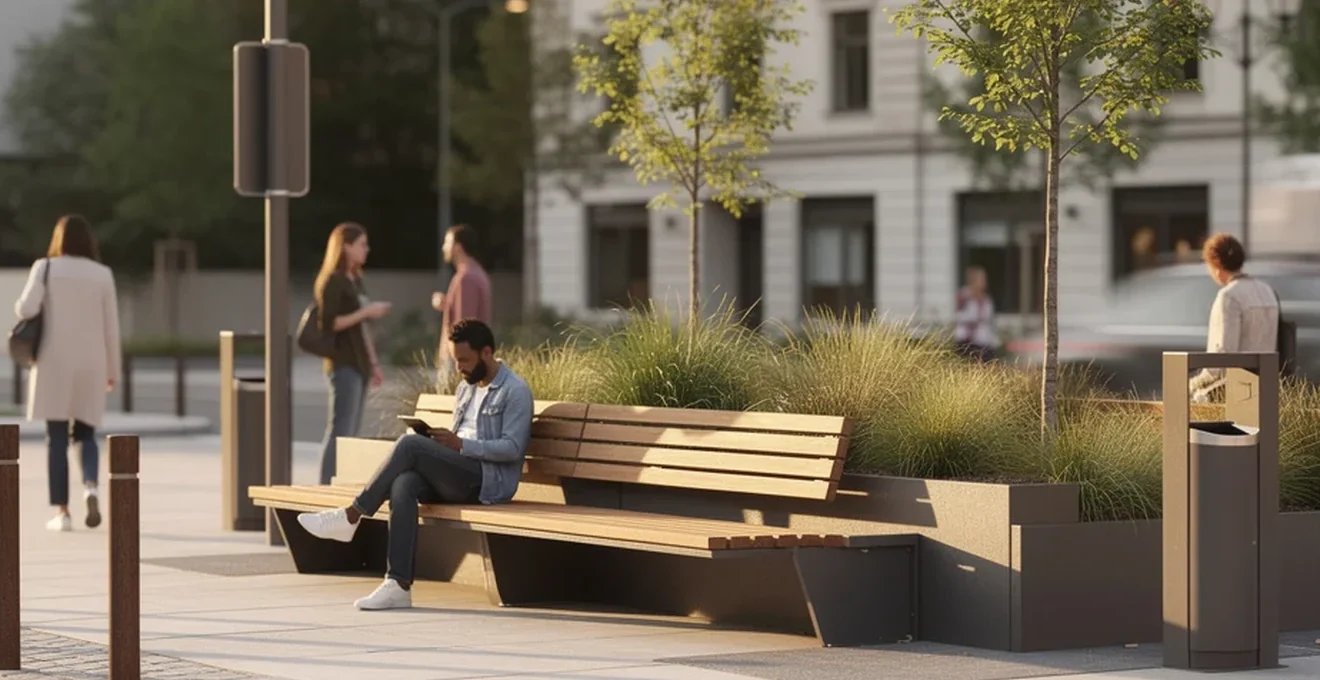
Public spaces rarely organise themselves. Left without guidance, a plaza, courtyard or pedestrian street tends to become a corridor people simply pass through rather than a place they choose to stay in. Urban furniture changes that dynamic. Benches, planters, bollards and bins do far more than provide a place to sit or dispose of rubbish: they shape how people move, where they pause, and how comfortable they feel lingering in a shared environment. This article looks at how different furniture typologies contribute to spatial zoning, what materials and standards underpin durable design, and how thoughtfully placed elements can turn transit zones into genuine social nodes. We also examine how technology and sustainability are reshaping procurement decisions, with reference to well-known public realm projects that illustrate these principles in practice.
Defining spatial zoning through street furniture typologies
Every piece of street furniture sends a signal about how a space should be used, even without any signage. A row of bollards suggests separation; a cluster of benches suggests gathering; a line of planters suggests a boundary that is firm but not hostile. Designers use these typologies deliberately, combining them to create legible zones within a single shared space without relying on walls, fences or rigid routes.
Bollards and barriers as boundary markers in pedestrian precincts
Bollards remain one of the simplest and most effective tools for defining pedestrian precincts. Positioned along the edge of a footway or plaza, they establish a clear threshold between vehicle access and pedestrian priority zones, discouraging vehicle intrusion while still allowing sightlines and pedestrian flow to remain open. Unlike solid barriers, bollards achieve this separation without visually enclosing the space, which helps maintain the sense of openness that makes a plaza feel welcoming rather than fenced off.
Bench clustering strategies for informal social nodes
A single bench invites one person to sit; a cluster of benches invites conversation. Grouping seating into small « islands », rather than distributing it in isolated units along a path, encourages eye contact and spontaneous interaction. Facing benches towards each other, or combining single and double-sided seating, allows a designer to create informal meeting points within a larger space. This clustering approach reflects a broader principle in ergonomic furniture design: people choose how to sit and where to meet when the layout gives them genuine options rather than a single, rigid arrangement.
Modular planters as soft dividers between traffic and leisure zones
Planters serve a dual purpose that few other furniture types can match. Visually, they soften hard urban surfaces and introduce greenery that improves thermal and visual comfort. Functionally, they act as subtle barriers that guide pedestrian flow without the harshness of a fence or wall. Positioned between a footpath and a seating area, for example, a line of planters can separate through-traffic from a leisure zone while still allowing the space to feel continuous and green rather than segmented.
Litter bins and signage placement following wayfinding principles
Bins and signage are often treated as afterthoughts, but their placement follows the same wayfinding logic as any other element of urban design. Bins positioned at natural pause points, such as near seating clusters or at the entrances and exits of a plaza, are used more consistently and reduce littering. Signage, similarly, works best when it reinforces the natural flow of movement through a space rather than interrupting it, helping people orient themselves while contributing to the overall visual order and sense of safety in the environment.
Materials and manufacturing standards in urban furniture design
The choice of material affects far more than appearance. It determines how furniture withstands weather, vandalism and intensive daily use, and how much a local authority or facility manager will need to spend on maintenance over the following decade.
Corten steel versus galvanised steel for weathering resistance
Steel remains a common structural choice for benches, tables and planter frames because of its strength and durability. Galvanised steel, protected with a high-performance powder coating, offers excellent resistance to corrosion even in humid or aggressive urban environments, helping structures maintain their appearance with minimal deterioration over time. Corten steel, which develops a stable oxidised surface layer, is often chosen for its distinctive weathered aesthetic. The right choice depends on whether a project prioritises a consistent, coated finish or the evolving patina associated with weathering steel.
Fsc-certified timber applications in public seating
Timber continues to appeal to designers seeking a traditional, natural aesthetic for benches and seating. Tropical hardwood, for instance, is valued for its warmth and classic appearance, though it typically requires more ongoing maintenance than composite alternatives. For projects with sustainability or green certification requirements, sourcing timber from certified, responsibly managed forests is an important consideration, ensuring that the material’s environmental credentials match the durability expected of public seating.
Vandalism-resistant coatings and Anti-Graffiti treatments
Public furniture is exposed to wear that private furniture never encounters, from constant use to occasional vandalism. Protective coatings and finishes help furniture resist scratching, staining and graffiti, extending its usable life without requiring frequent refinishing. Alongside surface treatments, modular construction plays a practical role here too: when components such as slats or legs are independent and replaceable, a damaged part can be swapped on site rather than requiring the replacement of an entire bench or table, which significantly reduces maintenance costs.
Compliance with EN 1176 and BS 8300 accessibility standards
Accessibility is not an optional add-on to good urban furniture design; it is central to it. Seat heights, optional armrests and clear approach paths all affect how easily elderly users or people with reduced mobility can sit down and stand up. Furniture that takes ergonomics and accessibility into account from the design stage, rather than retrofitting it later, creates genuinely inclusive environments that serve the widest possible range of users across public squares, campuses and shopping centres alike.
Urban furniture as a catalyst for community interaction
Beyond organising physical space, furniture plays a social role. It can either encourage people to linger and connect, or leave a space feeling transient and impersonal.
Placemaking frameworks inspired by jan gehl’s public life studies
A recurring theme in public realm design is the idea that people are drawn to places where other people already are. Seating arranged to allow eye contact, spaces that combine rest with a view of pedestrian activity, and layouts that avoid dictating a single path through a plaza all support this behaviour. When ergonomics, greenery and flexible layouts come together, a space stops being a mere passageway and becomes a destination in its own right, one where people choose to stay rather than simply pass through.
Chess tables and play equipment in multigenerational squares
Furniture that supports specific activities, such as tables designed for games, shared meals or informal outdoor work, extends the range of people a space can serve. A table and chair set placed near a cluster of benches, for example, can support everything from spontaneous meetings to collaborative outdoor work, while play elements nearby can bring younger users into the same space. This layering of uses within one area helps a square or courtyard serve multiple generations simultaneously rather than favouring a single demographic.
Pop-up parklets and their role in temporary public realm activation
Not every intervention in the public realm needs to be permanent. Temporary seating and greenery installations allow councils and property managers to test how a space is used before committing to a permanent layout. This approach aligns closely with the case for modular furniture systems: starting with a basic setup and expanding or reorganising it later, without losing visual coherence, protects the initial investment while allowing the design to respond to how people actually use the space over time.
Integrating smart technology into contemporary street furniture
Technology is gradually finding its way into everyday street furniture, adding functions that go beyond seating or storage.
Solar-powered benches with USB charging ports
As mobile devices become embedded in daily life, some public seating now integrates solar panels and charging points, allowing people to top up a phone while they rest. This kind of feature reflects a broader shift towards furniture that does more than one job at once, adding a practical utility to what was previously a purely restful function.
Sensor-equipped bins for waste management optimisation
Sensor technology is increasingly applied to street furniture to improve how public spaces are managed. Bins fitted with fill-level sensors, for instance, can help operations teams plan collection routes more efficiently, reducing unnecessary visits while ensuring bins are emptied before they overflow. This kind of data-driven approach to everyday furniture points towards a future in which street furniture contributes useful operational information, not just physical function.
Interactive digital kiosks in smart city deployments
Digital kiosks offering wayfinding information, event listings or local services are becoming a familiar sight in smart city projects. Positioned alongside more traditional furniture such as benches and planters, they extend the informational role that signage has always played, adapting it to a more interactive, real-time format suited to how people expect to access information today.
Sustainability metrics in urban furniture procurement
Sustainability in urban furniture is a technical decision affecting durability and maintenance, not simply a marketing claim. Procurement decisions increasingly weigh material origin, recyclability and long-term performance alongside upfront cost.
Life cycle assessment of recycled plastic street furniture
Recycled plastic, made from post-consumer waste, offers a practical option for projects with green certification requirements. It combines low maintenance with strong resistance to moisture and sunlight, and because it is derived from existing waste streams, it reduces reliance on virgin material. Products designed to be 100% recyclable at the end of their service life extend this sustainability thinking across the full lifespan of the furniture, from manufacture to eventual disposal or reprocessing.
Local sourcing policies to reduce embodied carbon
Where furniture is manufactured also affects its environmental footprint and its practical reliability. Manufacturing under strict ecodesign criteria within the country or region where furniture will be installed supports quality control, ensures compliance with relevant regulations, and improves the availability of spare parts, which in turn supports the kind of on-site, component-level repairs that keep modular furniture in service for longer.
Case studies of urban furniture shaping public realm strategy
Several well-known public realm projects illustrate how furniture choices can shape the character and use of a shared space at a city-wide scale.
Copenhagen’s superkilen park furniture concept
Superkilen is frequently cited as an example of how furniture and street objects, drawn from a wide range of cultural references, can be used to express the identity of a diverse local community within a single public space. Rather than imposing a uniform aesthetic, the park uses an eclectic mix of furniture and surface treatments to reflect the backgrounds of the neighbourhood’s residents, turning the park itself into a statement about inclusivity and shared ownership of public space.
London’s south bank seating and lighting schemes
The South Bank in London demonstrates how coordinated seating and lighting can support a heavily used riverside promenade that serves residents, commuters and tourists throughout the day and into the evening. Well-placed seating encourages people to pause and take in the river views, while lighting schemes extend the usability and perceived safety of the space after dark, supporting the area’s function as a continuous, lively public realm rather than a route that empties out once office hours end.
Barcelona’s superblocks and street furniture reallocation
Barcelona’s superblocks model reallocates street space that was previously dominated by vehicle traffic, replacing it with pedestrian-priority zones furnished with benches, planters and play areas. This reallocation shows how furniture can be central to a broader urban strategy: by introducing seating and greenery into former traffic corridors, the city has been able to convert space primarily designed for movement into space designed for dwelling, socialising and community life.