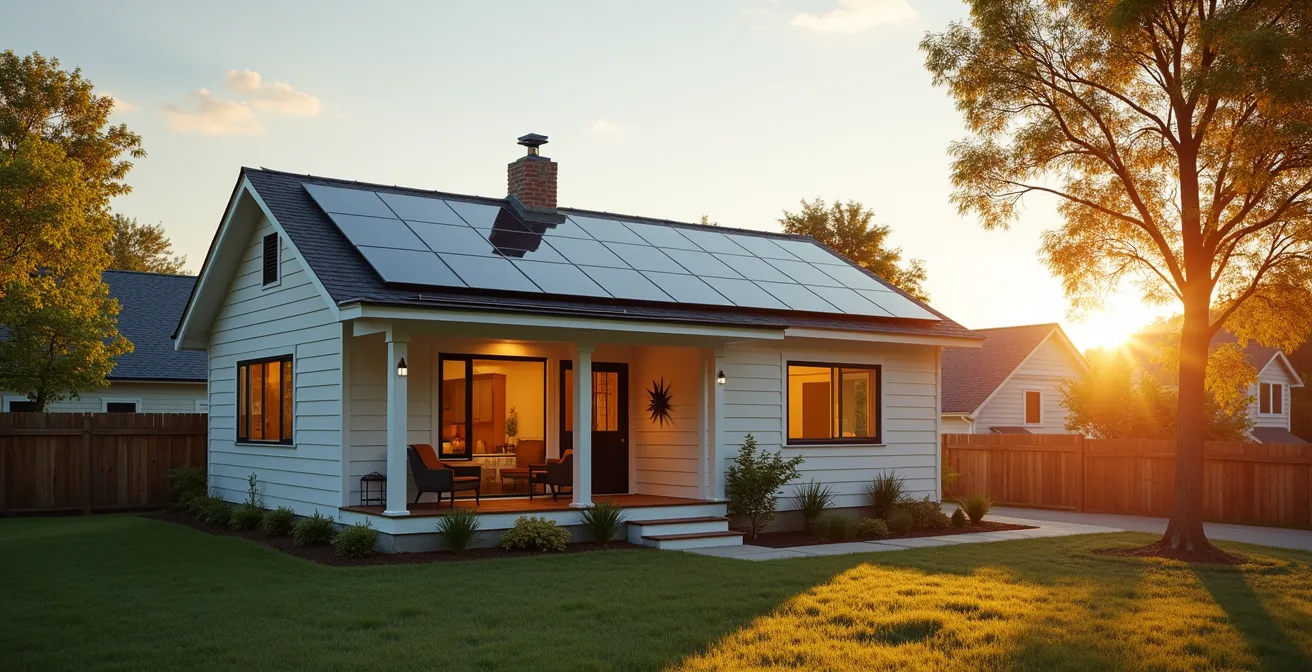
For a home under 1500 sq ft, the ROI of solar isn’t determined by roof size, but by smart system design that maximizes self-consumption.
- Pairing solar with a battery storage system is essential to avoid losing up to 40% of the power you generate.
- Integrating a high-efficiency heat pump can leverage your solar production, drastically reducing overall energy bills.
Recommendation: Focus on the total cost of ownership, including high-quality inverters and battery storage, rather than just the upfront cost per panel.
As a homeowner with a property under 1500 square feet, you’ve likely asked the question: is my roof even big enough for solar to be a worthwhile investment? It’s a pragmatic concern. The internet is filled with generic advice about calculating your energy usage, checking for incentives, and getting quotes. While these steps are valid, they miss the most critical factor for smaller homes: system architecture. The common belief is that solar viability is a simple equation of roof space versus panel count.
But what if the true key to a positive ROI wasn’t about cramming more panels onto your roof, but about architecting a complete, optimized energy ecosystem? The conversation needs to shift from “how many panels can I fit?” to “how can I use every kilowatt-hour I generate most effectively?” This is where concepts like system synergy and energy self-consumption become far more important than raw panel wattage. A smaller system, intelligently designed with the right components, can deliver a much faster and more substantial return than a larger, poorly planned one.
This guide moves beyond the basics to provide a consultant’s-eye view on the numbers that matter. We will deconstruct the components of a high-ROI solar installation for a compact home, focusing on how battery storage, heat pumps, and long-lasting hardware create a financially sound energy strategy. We’ll analyze the real-world costs, the impact of incentives, and how to turn your solar investment into a tangible asset that pays for itself.
This article provides a structured analysis of the key financial and technical decisions you’ll face. The following table of contents outlines the path to understanding the true return on investment for a small-footprint solar system.
Summary: A Pragmatic Guide to Solar ROI for Smaller Homes
- Why You Lose 40% of Your Solar Power Without a Battery Storage System?
- How to Heat Your Home With a Heat Pump When It’s -10°C Outside?
- Small Wind Turbine or Solar Array: Which Is Better for an Acre of Land?
- The Inverter Failure That Costs Solar Owners $2,000 After 10 Years
- When Will Government Rebates for Solar Panels Expire?
- The Energy Mistake of Deploying Millions of Sensors Without Green Batteries
- Why Most Airline Carbon Offsets Are Just Greenwashing?
- How to Travel the World Without Destroying It?
Why You Lose 40% of Your Solar Power Without a Battery Storage System?
The single greatest misconception about residential solar is that all the power your panels generate directly translates to savings. Without a battery storage system, this is fundamentally untrue. Your panels produce the most electricity during midday, when your home’s consumption is often at its lowest. This surplus energy is sent back to the grid, often for a fraction of the price you pay to buy it back in the evening. This mismatch between production and consumption is where you lose the value of your investment.
A battery storage system solves this economic inefficiency by enabling energy self-consumption. Instead of selling your valuable solar power for pennies, you store it for use during peak evening hours when electricity rates are highest. The numbers are compelling; data shows that for a typical solar-only home, grid usage is around 55%. Adding a battery dramatically changes this dynamic, with an analysis showing grid usage drops from 55% to 30% with battery storage. This is a direct conversion of lost energy into tangible savings.
Case Study: The California NEM 3.0 Shift
The impact of policy on battery adoption is undeniable. Since California’s NEM 3.0 policy drastically reduced the value of exported solar energy in April 2023, the market has seen a seismic shift. There has been a nearly 45% increase in storage attachment rates, and today, a staggering 80% of EnergySage shoppers in California now request storage quotes with their solar systems. This isn’t a fad; it’s a direct response from homeowners who understand that the ROI is now intrinsically linked to maximizing self-consumption by avoiding expensive peak-time grid usage.
For a home under 1500 sq ft, where every square foot of panel space is precious, wasting 40% of your production is not an option. A battery ensures that the limited energy you generate is fully utilized, making it the cornerstone of a high-ROI system.
How to Heat Your Home With a Heat Pump When It’s -10°C Outside?
Once you’ve secured your energy production with a battery, the next step in maximizing your solar ROI is strategic electrification. This means replacing fossil-fuel-burning appliances with efficient electric alternatives that can run on your self-generated solar power. The most impactful switch you can make is from a traditional furnace to a modern, cold-climate air source heat pump.
Gone are the days when heat pumps were only viable in mild climates. Today’s models are engineered to operate efficiently even in sub-zero temperatures, providing reliable heating down to -10°C (14°F) and beyond. By powering a heat pump with your solar-plus-battery system, you are effectively displacing one of your largest household expenses—heating fuel—with free energy from the sun. Department of Energy data shows a home with a heat pump has a median annual electricity use of 5,475 kWh, a load your solar system can be designed to offset.

The financial and environmental synergy becomes clear when we compare configurations. A heat pump alone is highly efficient, but when paired with solar, its operating costs plummet, and your home’s carbon footprint shrinks significantly. This combination represents the peak of system synergy.
The true power of this combination is in the numbers. The table below, based on industry analysis, quantifies the dramatic increase in savings and environmental benefits when a heat pump is paired with a solar array.
| Configuration | Energy Bill Savings | Efficiency Rating | CO2 Reduction |
|---|---|---|---|
| Heat Pump Alone | $300-$1,500/year | 300-400% | 2-3 tons/year |
| Solar + Heat Pump | Up to 84% reduction | 400% heat pump efficiency | 3.1 tons/year |
| Traditional HVAC | Baseline | 95% (gas) / 100% (electric) | Baseline |
Small Wind Turbine or Solar Array: Which Is Better for an Acre of Land?
For homeowners exploring renewable energy, the choice often seems to be between solar panels and small wind turbines. However, for a typical residential property, especially one under an acre, the decision is overwhelmingly in favor of solar for pragmatic reasons. Residential wind turbines require significant clear space—often a 30-foot radius free of obstructions—and face stringent zoning restrictions and noise complaints in many communities. Furthermore, their installation cost of $3-6 per watt is significantly higher than solar.
A solar array, by contrast, is silent, scalable, and leverages existing, unused space: your roof. For a 1500 sq ft home, the question is not about filling an acre, but efficiently using about 250-350 square feet of roof space. Analysis shows a typical 1500 square foot home needs approximately a 6.6 kW system, which equates to about 16 modern high-efficiency panels. This is a very manageable size for most smaller homes.
The decision-making process should be systematic and data-driven. Instead of guessing, follow a clear checklist to determine the right path for your specific property and energy needs. This ensures your investment is based on concrete facts, not just aspirational goals.
Action Plan: Sizing Your Renewable Energy System
- Calculate Energy Needs: Start with your utility bills. Gather the last 12 months to find your average annual consumption. A typical 1500 sq ft home uses around 10,500 kWh per year, which is your baseline target for offset.
- Assess Your Space: Measure your south-facing (or east/west) roof area free from shading. A ground-mount solar system requires roughly 400 sq ft per kW, while a small wind turbine needs a clear 30-foot radius and significant height.
- Verify Local Regulations: Contact your local planning or zoning office. Inquire specifically about permits required for rooftop solar versus height and noise restrictions for residential wind turbines. Many suburban areas prohibit turbines altogether.
- Compare Installation Costs: Obtain quotes based on a per-watt basis. Solar typically averages around $2.80/watt, whereas small residential wind systems can range from $3 to $6 per watt, making the upfront investment significantly higher.
- Evaluate Maintenance Demands: Factor in long-term upkeep. Solar panels require minimal maintenance, mainly periodic cleaning. Wind turbines, with their moving mechanical parts, demand annual servicing to ensure operational safety and efficiency.
For the vast majority of homeowners with smaller properties, the conclusion is clear: solar offers a more practical, cost-effective, and less intrusive path to energy independence.
The Inverter Failure That Costs Solar Owners $2,000 After 10 Years
While solar panels themselves are incredibly durable, often warrantied for 25 years, the brain of your system—the inverter—has a much shorter lifespan. This is a hidden cost that can significantly impact your long-term ROI. A standard string inverter typically lasts 10 to 15 years, meaning you are almost guaranteed at least one replacement over the life of your panels. This isn’t a minor expense; solar inverter replacement typically costs between $1,000 to $3,000 including labor.
Ignoring the component lifespan ROI is a common mistake. Homeowners focus on the upfront cost of panels but neglect to budget for the inevitable failure of the system’s most critical electronic component. This unexpected expense around year 10 or 12 can derail the financial projections that made the system seem attractive in the first place.
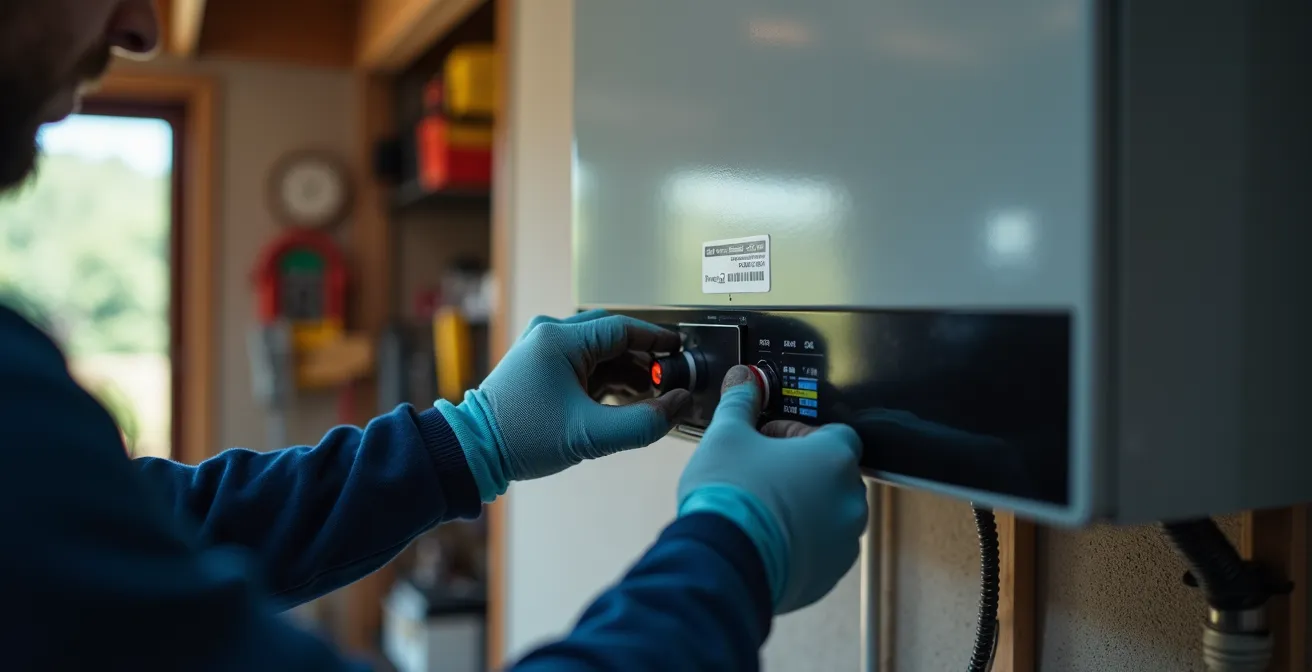
The solution lies in making a strategic choice at the outset. While they may have a slightly higher initial cost, microinverters or power optimizers offer a more robust long-term value proposition, especially for smaller or more complex roofs.
Case Study: String Inverters vs. Microinverters Lifespan
An analysis of inverter technology reveals a clear trade-off between upfront cost and long-term reliability. A standard string inverter, which manages all panels as a single unit, might cost $1,000-$2,500 to replace and typically comes with a 10-year warranty. In contrast, microinverters are installed on each individual panel. While the cost per unit is lower ($150-$350), the total upfront cost for the system is higher. However, their lifespan is 20-25 years, and they often come with warranties that match the panels themselves (15-25 years). This alignment of warranties de-risks the investment and eliminates the predictable, costly mid-life replacement cycle, making them a financially superior choice for homeowners focused on total cost of ownership.
For a small homeowner calculating a 25-year ROI, choosing an inverter with a 10-year lifespan is a planned failure. Opting for technology with a 25-year warranty is a planned success.
When Will Government Rebates for Solar Panels Expire?
The financial viability of a solar installation, especially for a budget-conscious homeowner, is dramatically accelerated by government incentives. These are not minor discounts; they can cut the net cost of a system by more than half. The single most significant incentive is the federal Residential Clean Energy Credit, often called the Solar Investment Tax Credit (ITC).
Currently, the Solar Investment Tax Credit offers a 30% federal tax credit on the total cost of your solar energy system, including panels, inverters, and battery storage. This is a dollar-for-dollar reduction of your federal tax liability. For a typical system on a 1500 sq ft home, this credit can be worth thousands of dollars. However, this credit is not permanent. It is scheduled to remain at 30% through 2032, step down to 26% in 2033, 22% in 2034, and expire completely thereafter. The window of maximum opportunity is open now, but it is finite.
This federal credit is just the starting point. Many states, local governments, and utility companies offer their own rebates, grants, or tax credits that can be “stacked” on top of the federal ITC. This incentive stacking is what can transform a 15-year payback period into a 5-year one.
Case Study: Net Cost for a 1500 Sq Ft Home
Let’s look at the real-world numbers. A solar system for a 1500 sq ft home typically costs between $12,000 and $16,000 before any incentives. After applying the 30% federal tax credit, that cost immediately drops to between $8,400 and $11,200. When combined with state and local rebates, which can reduce the cost by another 20-40%, the net investment can be surprisingly low. With these stacked incentives, homeowners often see payback periods as short as 5-7 years. A modest 4kW starter system can cover nearly half the electricity usage of an average home, making the financial case compelling and immediate.
Waiting for technology to get cheaper is a risky strategy when incentives are guaranteed to become less generous over time. The current incentive landscape presents a powerful, time-sensitive catalyst for investment.
The Energy Mistake of Deploying Millions of Sensors Without Green Batteries
The shift towards battery storage isn’t just a trend for individual homeowners; it’s a massive, grid-level transformation. The entire energy landscape is recognizing that generating renewable power is only half the battle; storing it is the key to a stable, green future. This macro-trend provides powerful context and confidence for your own investment in a home battery system. You are not an early adopter of a niche technology; you are joining a mainstream energy revolution.
The scale of this shift is staggering. As authorities in the energy sector highlight, the market is expanding at an exponential rate. This growth is driven by both utility-scale projects and residential adoption, creating economies of scale that benefit everyone.
Battery storage capacity will nearly double in 2024 as developers report plans to add 14.3 GW of battery storage to the existing 15.5 GW.
– U.S. Energy Information Administration, EIA Solar and Battery Storage Report 2024
This explosive growth is fueled by a critical factor: falling costs. Just as solar panels became more affordable over the last decade, battery technology is on a similar trajectory. Recent data indicates that battery storage costs fell dramatically in 2024, with a 33% decrease to $104/MWh for standard 4-hour systems. This rapid price drop is making battery storage an increasingly standard and financially logical addition to any new solar installation.
For the homeowner of a 1500 sq ft house, this means the most critical component for maximizing your ROI—the battery—is becoming more accessible every year. Investing now places you on the right side of a major technological and economic wave, ensuring your home’s energy system is aligned with the future of the grid.
Why Most Airline Carbon Offsets Are Just Greenwashing?
In an era of climate consciousness, many people purchase carbon offsets for flights, hoping to mitigate their environmental impact. However, the effectiveness of many of these offset programs is questionable, often amounting to little more than “greenwashing.” They promise to fund projects that reduce CO2, but verification is difficult, and the impact is often indirect and delayed. A residential solar system offers a stark contrast: a direct, measurable, and verifiable reduction in carbon emissions, right from your own roof.
The ROI of a solar system isn’t just financial; it’s also environmental. By generating your own clean electricity, you are directly displacing power that would otherwise be produced by fossil-fuel-burning power plants. This creates a tangible carbon offset that you control and can quantify. For a smaller home, the impact is still substantial. Industry data shows a typical 6 kW solar system reduces carbon emissions by 5-6 tons of CO2 annually. This is equivalent to taking a car off the road for an entire year, every year.
Unlike a nebulous offset certificate, you can calculate your personal carbon savings with precision. For example, a 4kW system on a 1500 sq ft home, assuming 4.5 peak sun hours per day, will generate approximately 5,840 kWh per year. Using the EPA’s average emissions factor, this translates to over 5,300 pounds (about 2.4 metric tons) of CO2 avoided annually. Over the 25-year life of the system, that’s 60 tons of CO2 that never entered the atmosphere because of your investment.
This provides a powerful psychological and ethical return. While others are paying for the *promise* of carbon reduction, your solar investment delivers the *proof*. It transforms your home from a passive energy consumer into an active contributor to a cleaner environment.
Key Takeaways
- Battery Storage is Non-Negotiable: For a smaller home, maximizing self-consumption with a battery is the single most important factor for a positive ROI, preventing the loss of up to 40% of your generated power.
- Embrace System Synergy: True ROI comes from an integrated system. Pairing solar and batteries with an electric heat pump drastically reduces overall household energy costs.
- Incentives are a Time-Sensitive Catalyst: The current 30% federal tax credit, combined with state and local rebates, can cut system costs by over 50%, making the payback period shorter than ever.
How to Travel the World Without Destroying It?
Ultimately, the return on a solar investment can be measured in more than just dollars on a utility bill or tons of CO2 avoided. For many, the most powerful metric is lifestyle enhancement. The annual savings generated by a well-designed solar-plus-storage system can be reframed as a dedicated fund for life experiences, like travel. Instead of simply reducing an expense, you are creating a new revenue stream to fund your goals.
Success Story: Tim’s Solar-for-Travel Fund
A 2024 case study of a homeowner named Tim perfectly illustrates this concept. By combining solar panels, a heat pump, a battery, and leveraging smart time-of-use utility tariffs, Tim created a powerful savings engine. His system generated over 6,580 kWh of energy, worth more than £900 per year. Critically, by storing solar power and charging his battery during cheap off-peak hours, his smart tariff strategy saved an additional £1,200 annually. The total annual savings of £2,100 (approx. $2,600) became his dedicated travel fund, allowing him to take substantial trips financed entirely by his home’s clean energy system.
This approach transforms a home improvement project into a lifestyle investment. The initial outlay for a solar system can be compared to the cost of a few premium vacations, but the return is a lifetime of travel opportunities paid for by the sun. The table below puts this powerful concept into perspective.
| Metric | 5kW Solar System | Annual Travel Budget Equivalent |
|---|---|---|
| Initial Investment | $14,000 (before credits) | 2 premium vacations |
| Annual Savings | $1,800/year | 1 international trip |
| 4-Year Cumulative Savings | $7,200 | Southeast Asia adventure |
| 25-Year Total Savings | $45,000 | Lifetime of travel |
For the owner of a home under 1500 sq ft, the message is clear: a solar investment is not just “worth it”—it can be the most effective savings and investment vehicle you have, powering not only your home but your life’s adventures as well.
The first step toward unlocking these financial and lifestyle benefits is to get a personalized analysis of your property and energy needs. A data-driven system design will provide you with a clear projection of costs, savings, and your specific return on investment.