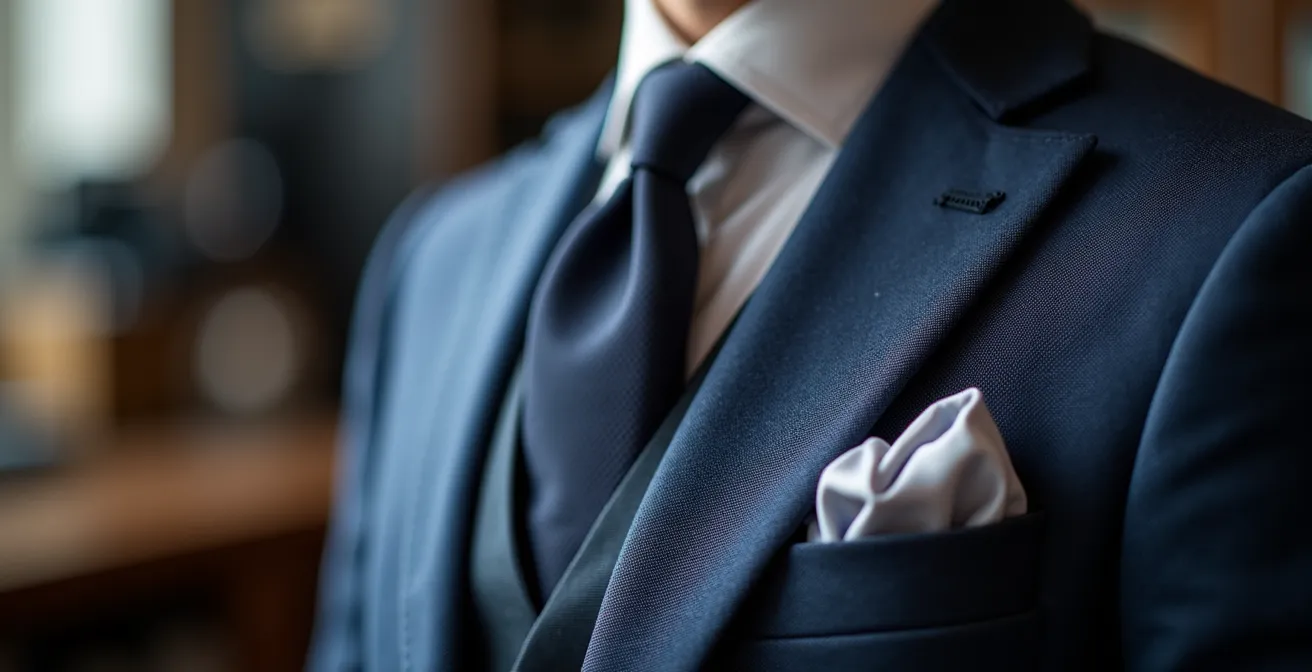
A bespoke suit isn’t a purchase; it’s a calculated investment with a superior return, proven by the simple metric of Cost Per Wear (CPW).
- Its structural integrity and superior materials guarantee a lifespan 5-10 times longer than an off-the-rack garment.
- A perfect, sculpted fit eliminates the hidden “alteration tax” and prevents the premature wear caused by poor construction.
Recommendation: Before buying your next suit, calculate its true cost—not by its price tag, but by its projected Cost Per Wear.
The professional’s dilemma is a familiar one. Faced with the choice between a single, exquisitely crafted $2,000 bespoke suit and three off-the-rack alternatives for the same price, logic seems to favor quantity. Three suits offer variety, a rotation for the week, and a lower initial barrier to entry. This thinking, however, is a classic example of a false economy. It focuses on the upfront price tag while completely ignoring the most crucial metric for any durable good: the Cost Per Wear (CPW). An off-the-rack suit is a consumable good, designed for a limited lifespan. A bespoke suit is an asset, engineered for longevity.
The true cost of a garment isn’t what you pay for it; it’s the price divided by the number of times you can wear it before it loses its structural integrity and aesthetic appeal. In my workshop, I don’t just see fabric and thread; I see engineering, geometry, and long-term value. The conversation must shift from “How much does it cost?” to “What is its return on investment?” This article will deconstruct the mathematics of a suit, proving that the initial investment in bespoke tailoring yields a dramatically lower CPW, making it the most financially sound decision a professional can make for their wardrobe.
For those who prefer a visual introduction, the following video offers a glimpse into the world of custom tailoring, showcasing the craftsmanship that forms the foundation of a suit’s long-term value.
To fully grasp the financial and structural advantages of a bespoke garment, we will dissect the key elements that contribute to its superior longevity and performance. This guide breaks down the critical differences in materials, fit, construction, and maintenance that ultimately determine the true value of your investment.
Contents: The Anatomy of a Suit’s True Value
- Super 100s vs Super 150s: Which Wool Is Durable Enough for Daily Wear?
- How to Spot a Poorly Fitted Shoulder Line on a Jacket?
- Custom or Bespoke: What Is the Real Difference in Construction?
- The Alteration Mistake That Ruins the Balance of a Jacket
- When to Order Your Wedding Suit to Avoid Rush Fees and Fit Panic?
- Climate Control or Acid-Free Paper: Which Is More Critical for Silk Preservation?
- Why Billionaires Are Switching to Unbranded Cashmere?
- Why Are Copper-Infused Fabrics Replacing Traditional Cotton in Activewear?
Super 100s vs Super 150s: Which Wool Is Durable Enough for Daily Wear?
One of the most misunderstood concepts in suiting is the “Super” number. A higher number, like Super 150s or 180s, indicates a finer, thinner wool fiber. While this creates a fabric with a luxurious feel and a beautiful drape, it comes at a direct and measurable cost to durability. As tailoring experts note, Super numbers don’t necessarily tell you how ‘good’ a suit is; they define its purpose. A high Super number fabric is delicate, prone to wrinkling, and wears out quickly with friction. It’s a fabric for special occasions, not the daily rigors of a professional life.
For a workhorse suit, the sweet spot for maximum longevity is in the Super 100s to Super 130s range. These wools have a thicker, more robust fiber that can withstand regular wear, travel, and cleaning. A well-constructed suit made from Super 120s wool can easily last a decade of consistent use, fundamentally altering the CPW calculation. A $2,000 suit worn twice a week for ten years (approximately 1,040 wears) has a CPW of just $1.92. In contrast, a $650 off-the-rack suit, often made of less durable material or a high, fragile Super number wool, might only last two years under the same conditions (208 wears), resulting in a CPW of $3.12—over 60% more expensive in the long run.
The choice of fabric is an engineering decision. For an asset intended for daily performance, durability is paramount. This comparative analysis shows why selecting the right material for the job is the first step in building a cost-effective wardrobe.
| Wool Grade | Fiber Diameter | Durability | Best Use Case | Care Level Required |
|---|---|---|---|---|
| Super 100s-120s | 18.5-17.5 microns | High – can last years | Daily business wear | Standard |
| Super 140s-150s | 16.5-16 microns | Moderate – more delicate | Special occasions, 1-2x monthly | Careful handling needed |
| Super 180s+ | Under 15 microns | Low – very delicate | Formal events only | Meticulous care required |
How to Spot a Poorly Fitted Shoulder Line on a Jacket?
The shoulder is the foundation of a jacket. If the shoulder is wrong, the entire garment is wrong. A poorly fitted shoulder is not just an aesthetic flaw; it’s a critical point of structural failure. Look for a “divot” or hollow space just below the shoulder seam on the arm, or a shoulder point that extends past your natural shoulder bone. These are signs that the jacket is not contoured to your body. Another tell-tale sign is fabric pulling or creasing across the upper back and shoulders when you move your arms. This tension is the enemy of longevity.
This isn’t a matter of opinion; it’s a matter of physics. Each time you raise an arm or reach forward in an ill-fitting jacket, you place unnatural stress on the shoulder and armhole (scye) seams. This constant tension accelerates wear and tear, eventually leading to seam separation or fabric tearing. Fit is a performance metric. A bespoke jacket, built on a unique pattern of your measurements, distributes this stress evenly. It moves with you, not against you. This is why it lasts.
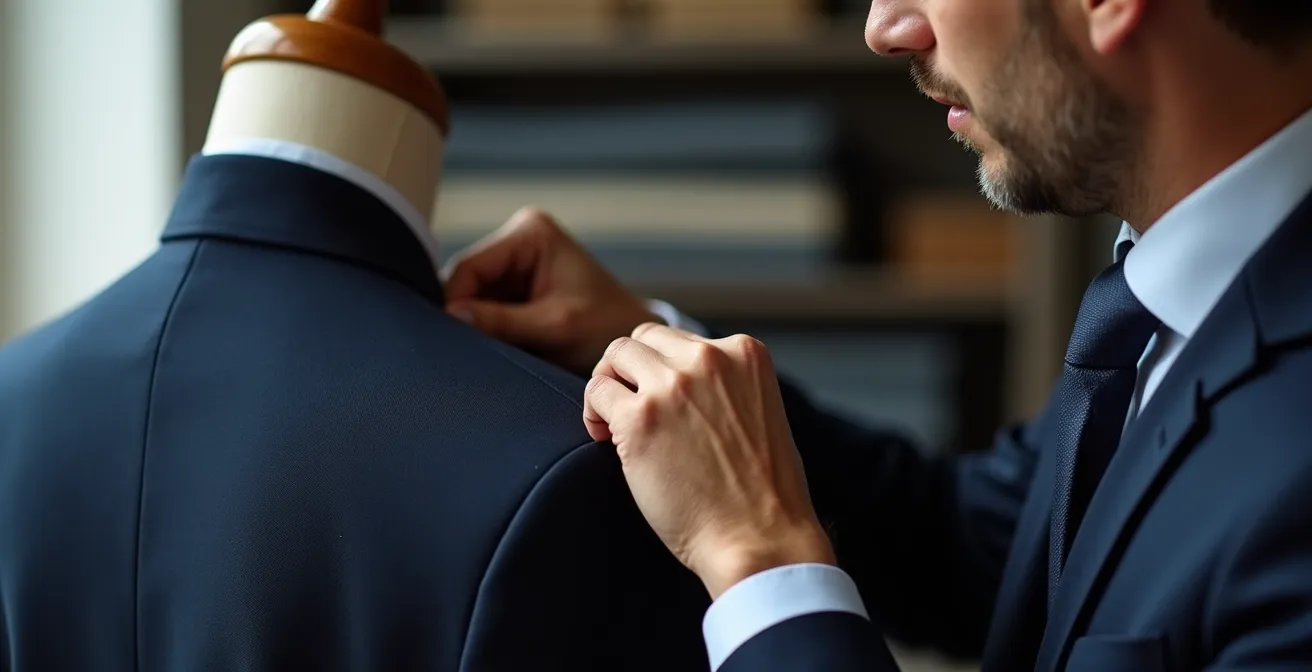
A famous movement test conducted by the Gentleman’s Gazette powerfully illustrates this. A $500 off-the-rack suit actively restricted movement and showed significant pulling at the shoulder when the wearer simply raised an arm to eat. Over time, this stress visibly deteriorated the suit’s structure. In stark contrast, a $5,000 bespoke suit maintained a flawless shoulder line through all ranges of motion. The cheaper suit wasn’t just less comfortable; it was actively self-destructing with every wear, dramatically increasing its true Cost Per Wear.
Custom or Bespoke: What Is the Real Difference in Construction?
The terms “custom” and “bespoke” are often used interchangeably, but they represent fundamentally different construction philosophies. A custom or made-to-measure suit starts with a pre-existing pattern block that is adjusted to your measurements. It’s a modification. Bespoke is creation. A unique paper pattern is drafted from scratch, exclusively for you. This pattern is an architectural blueprint that accounts for every nuance of your posture—a lower shoulder, a forward neck, the specific curve of your back. This is where the longevity of a garment is born.
The internal construction, or “guts,” of the jacket is where the real value lies. A bespoke jacket features a full canvas construction, typically of horsehair, that is hand-padded and hand-stitched to the fabric. This canvas allows the jacket to mold to your body over time, like a fine leather shoe. Most off-the-rack and many custom suits use a fused (glued) interlining, which is rigid, traps heat, and can bubble or delaminate after a few cleanings, destroying the suit’s shape. Furthermore, bespoke includes hand-sewn buttonholes for durability and significant inlay fabric (extra material at the seams), allowing the suit to be perfectly altered for weight fluctuations over its lifetime. An off-the-rack suit has minimal to no inlay, making significant alterations impossible.
These aren’t luxury frills; they are deliberate engineering choices for durability. It is this superior construction that allows bespoke suits to last upwards of 20-30 years, while their fused counterparts are often unwearable after 3-5 years. The difference is in the architecture, not just the appearance.
Your 5-Point Bespoke vs. Fused Suit Audit
- The Pinch Test: Pinch the fabric on the chest between the buttonholes. If you can feel three separate layers (fabric, floating canvas, lining), it’s canvassed. If you feel only one stiff layer, it’s fused.
- Lapel Roll: Look at the lapel. A bespoke jacket has a gentle, three-dimensional roll. A fused jacket has a flat, lifeless press.
- Buttonhole Stitching: Examine a buttonhole up close. Hand-sewn buttonholes have a slight, beautiful irregularity and a keyhole shape. Machine-made ones are perfectly uniform and often fray.
- Seam Inlay: Ask the tailor (or look inside an unlined jacket) to see the seam allowances. Bespoke will have generous inlays of fabric (an inch or more) ready for future alterations.
- Pattern Matching: On a patterned fabric (like pinstripes or checks), a high-quality suit will have patterns that match perfectly across seams, especially at the shoulder and pockets.
The Alteration Mistake That Ruins the Balance of a Jacket
One of the most common requests I hear is to shorten an off-the-rack jacket that is too long. This seems like a simple fix, but it is the single most destructive alteration one can perform. It is a mathematical mistake that irretrievably ruins the garment. A jacket is a system of proportions, a piece of geometry. The distance from the collar to the top button (the buttoning point), from the button to the bottom of the pockets, and from the pockets to the hem are all in a carefully calculated relationship.
When you shorten a jacket from the bottom, you don’t just change its length; you destroy its balance. The pockets and buttoning point are now disproportionately low, creating a visually jarring effect. The jacket will always look “off,” even if the wearer can’t articulate why. This is the hidden “alteration tax”—paying money to actively devalue an item. A bespoke suit avoids this entirely because the length is determined from the very first chalk mark, ensuring all proportions are in perfect harmony with your height and torso from the outset.
There is no “fixing” a fundamental design flaw. As one Savile Row tailor eloquently explained, this mistake is irreversible and turns a piece of clothing into a constant, subtle disappointment.
Shortening a jacket from the bottom throws off the entire balance – the relationship between lapels, buttoning point, and pockets. It’s like changing one wheel on a car to a different size. The garment will never look right again, turning a classic piece into something that feels wrong every time you wear it.
– Savile Row tailor, as quoted in Permanent Style
Investing in a garment that is proportionally correct from its conception eliminates the need for such compromising and costly alterations, preserving its value and integrity for its entire lifespan.
When to Order Your Wedding Suit to Avoid Rush Fees and Fit Panic?
While a bespoke suit is an investment for life, its creation process is governed by the unchangeable constant of time. This is never more critical than for a significant event like a wedding. The temptation to leave the suit until the last minute is a common and costly error. The typical bespoke suit production process takes 5-12 weeks, involving an initial consultation, at least two to three separate fittings, and weeks of meticulous handwork. This timeline is not arbitrary; it’s essential for quality control and a perfect fit.
Attempting to compress this process incurs a significant financial penalty. Tailors who accept rush orders must disrupt their entire production schedule, often requiring overtime work. This cost is passed directly to the client in the form of rush fees, which can add a 25-50% premium to the final price. A $2,000 suit can quickly become a $3,000 suit, purely due to poor planning. Beyond the financial cost, rushed work risks compromised quality. Stitches may be hurried, and crucial time for the garment to settle between fittings is eliminated.
The ideal timeline for ordering a wedding suit is a minimum of four to six months before the event. This allows for a calm, controlled process, accommodates any pre-wedding changes in fitness, and builds a buffer for any unforeseen delays. Planning is not just about avoiding stress; it’s a financial strategy. By respecting the time required for craftsmanship, you protect the value of your investment and avoid paying a premium for a potentially inferior product. The cost of panic is always higher than the cost of patience.
Climate Control or Acid-Free Paper: Which Is More Critical for Silk Preservation?
Once you have acquired a fine bespoke suit, you possess a valuable asset. Like any asset, its longevity depends on proper stewardship. Clients often ask about archival storage methods, such as using acid-free paper to protect silk linings. While this is a valid concern for museum-level preservation over a century, it misses the far more immediate and destructive threat: humidity. For the practical owner, climate control is infinitely more critical than the acidity of your storage materials.
Silk and wool are natural, organic fibers. In a humid environment (above 60% relative humidity), they become a perfect breeding ground for mold and mildew. Mildew can permanently stain a suit’s silk lining, weaken its fibers, and impart an odor that is nearly impossible to remove in a single season. The damage is swift and often irreversible. Acid damage from paper or a wooden hanger, by contrast, is an extremely slow process that takes decades to become noticeable. It is simply not the primary risk factor for a suit in active rotation.
Therefore, the most important preservation strategy is to store your suit in a space with controlled, stable humidity and good air circulation. A simple dehumidifier in a closet can be the most effective suit-preservation tool you own. Always hang your suit on a broad, shaped cedar hanger that supports the shoulders’ structure and helps absorb ambient moisture. Use a breathable garment bag, not a plastic one which traps moisture. Protecting your investment is not about complex archival techniques; it’s about mastering the fundamentals of a dry, cool, and dark environment.
Why Billionaires Are Switching to Unbranded Cashmere?
In the highest echelons of business and finance, there is a growing movement away from conspicuous branding. The new symbol of status is not a recognizable logo, but a quality so undeniable it needs no advertisement. This philosophy of “stealth wealth” is perfectly embodied by the bespoke suit. It is the ultimate unbranded item. Its “logo” is the perfect, unbroken line of the shoulder, the gentle roll of the lapel, and the way the fabric drapes without a single pull or crease. It is a signal understood only by those with a trained eye.
The value is not in a brand name, but in the tangible, quantifiable input of master craftsmanship. It takes approximately 50 man-hours of skilled labor to create a single bespoke suit. That is a week’s worth of a master artisan’s life, dedicated to a single garment. This is the value you are paying for—not marketing, not a retail footprint, not a celebrity endorsement. You are commissioning a piece of functional art, built by hand. An off-the-rack suit, by comparison, might be assembled in a few hours on a factory line.
This is why those who can afford anything often choose the unbranded. They are not buying a brand; they are buying a result. They are investing in a product whose quality is self-evident. As the experts at Gaetano Fashion note, the fit itself becomes the brand.
A bespoke suit is the ultimate unbranded item; its ‘logo’ is its perfect fit and drape, a signal of quality understood only by those ‘in the know’.
– Gaetano Fashion, Bespoke Suit Excellence Guide
Choosing bespoke is a statement that you value substance over symbols, and that you understand the mathematics of true, lasting quality.
Key Takeaways
- Cost Per Wear (CPW) is the only true measure of a suit’s value, and bespoke construction consistently delivers a lower CPW over time.
- Bespoke construction is not a luxury; it is a set of engineering choices deliberately made to maximize a garment’s structural integrity and lifespan.
- A perfect fit is a performance feature that prevents the premature structural failure caused by constant tension on the seams of an ill-fitting garment.
Why Are Copper-Infused Fabrics Replacing Traditional Cotton in Activewear?
The world of textiles is constantly innovating, with performance fabrics like copper-infused cotton gaining traction in activewear for their technical properties. This trend highlights a crucial principle: choosing the right tool for the right job. However, in the context of a professional wardrobe, the definition of “performance” must be reconsidered. The ultimate performance of a suit is not its ability to wick moisture during a workout, but its ability to project confidence, command respect, and endure for decades.
In this arena, the original performance fabric remains king: high-quality, high-twist wool. This natural fiber is breathable, thermo-regulating, and remarkably resilient. A suit made from a robust, well-constructed wool is the original performance garment for the professional. Its “technical feature” is its ability to maintain a sharp, composed appearance through a long day of meetings and travel. The modern bespoke tailor honors this by merging traditional craftsmanship with an understanding of modern needs, creating suits that are not just beautiful, but are formidable tools for the professional.
The choice is not about chasing the latest fabric trend, but about a clear-eyed assessment of your needs. The off-the-rack suit is a disposable tool for a temporary job. The bespoke suit is a durable, high-performance instrument designed for a long and successful career. The decision to invest in bespoke is the ultimate expression of choosing the right tool for the job—a job that requires not just function, but enduring presence and power.
The evidence is clear: from a purely mathematical and structural standpoint, a bespoke suit is not an expense but a high-performing asset. The next logical step is to move from theory to practice. Begin evaluating your wardrobe not by its purchase price, but by its true, long-term value.
Frequently Asked Questions About a Bespoke Suit
What’s the most critical factor for preserving a suit’s silk lining?
Climate control preventing humidity and mold is far more critical than acid-free paper. Mildew can ruin a suit’s lining in one season, while acid damage is a slow archival concern.
How should I store my bespoke suit between wears?
Use big cedar hangers to absorb moisture and maintain shoulder shape, store in a breathable garment bag, and ensure the storage area has controlled humidity below 60%.
How often should a high-quality suit be dry cleaned?
Sparingly – only when truly necessary. Use a gentle wool brush after each wear and air the suit overnight. Choose a specialist cleaner who understands natural fibers to avoid stripping silk linings of their luster.