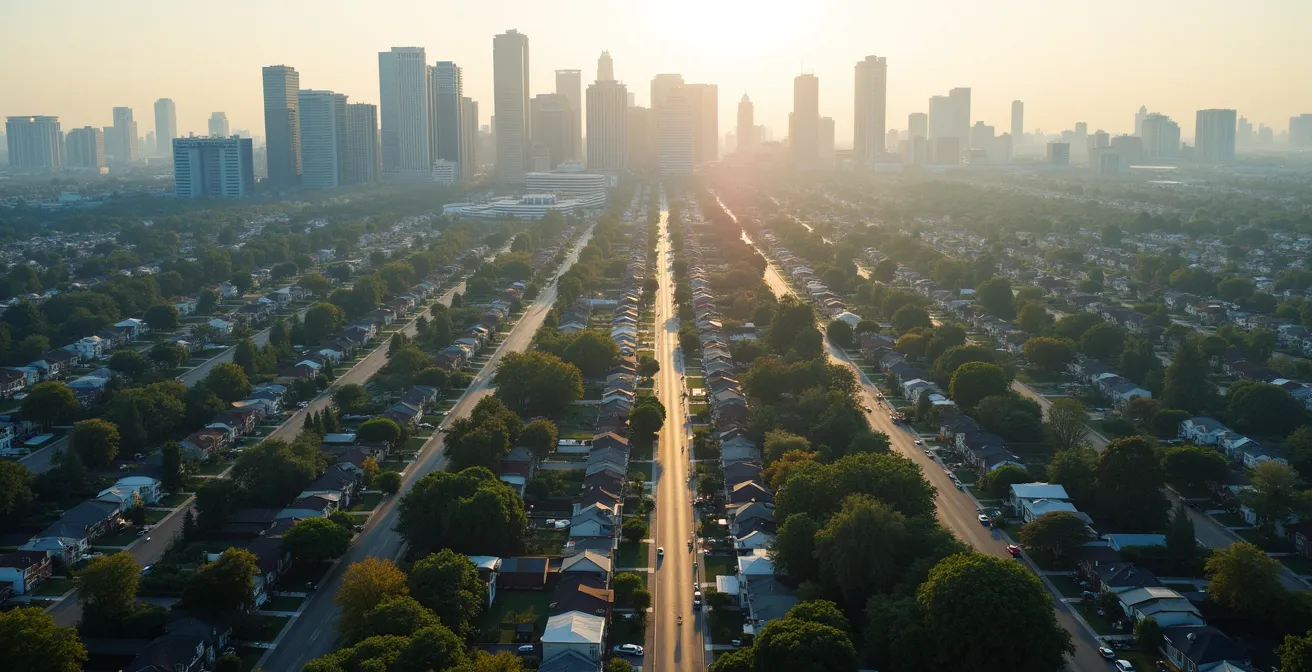
The suburban surge isn’t an exodus from cities but a strategic redistribution of life and work, fundamentally altering the economic geography of metropolitan areas.
- Economic activity and population are decentralizing from urban cores to surrounding suburbs in a phenomenon known as the “donut effect.”
- Successful suburbs are evolving from residential dormitories into “programmable,” service-rich communities by retrofitting infrastructure and fostering social hubs.
Recommendation: Investors and urban planners must shift focus from simply reviving the old downtown core to enabling this new, distributed network of living and working.
The sight of empty downtown office towers and thinning midday crowds has become a defining image of the post-2020 city. For urban planners and property investors, this visual is more than an anomaly; it’s a profound data point signaling a historic shift. The common narrative points to remote work as the primary catalyst, suggesting people are simply seeking larger homes and greener lawns. While this contains a kernel of truth, it’s a dangerously incomplete picture. The assumption that this is a temporary trend, or merely a matter of cheaper housing, overlooks the deeper, more structural transformation at play.
This migration is not a simple flight from density. It represents a fundamental re-engineering of the urban-suburban relationship. What we are witnessing is a shift in the very concept of “economic gravity,” where the single, monolithic pull of the central business district is being replaced by a distributed network of smaller, vibrant economic hubs in the suburbs. The key to understanding this future is not to ask if cities are “dead,” but to analyze how their functions are being unbundled and re-integrated into suburban landscapes that are becoming increasingly sophisticated, connected, and desirable.
This article moves beyond the surface-level explanations to provide a strategic analysis for those tasked with building and investing in the communities of tomorrow. We will dissect the mechanisms behind this great reshuffling, from the economic implications of the “donut effect” to the social and technological infrastructure required to turn a sleepy suburb into a thriving, programmable community. This is a look at the future of urbanism, where the most successful places will be those that adapt to a decentralized world.
To fully grasp the scale of this transformation, this analysis is structured around the critical questions that planners and investors must now answer. The following sections explore the tactical conversions, social challenges, and infrastructure innovations that are defining this new era.
Summary: The New Dynamics of Urban and Suburban Growth
- How to Convert Empty Office Spaces into Affordable Housing Units?
- The Social Risk of Remote Work That Affects 1 in 4 Professionals
- Lisbon or Bali: Which Hub Offers Better Infrastructure for Tech Workers?
- The Economic Impact of Reducing Commuting Time by 5 Hours a Week
- When Will Co-Living Become the Standard for Young Professionals?
- Why Adaptive Traffic Lights Reduce Commute Times by 20%?
- Why You Lose 40% of Your Solar Power Without a Battery Storage System?
- How to Prevent Smart Cities From Becoming Surveillance States?
How to Convert Empty Office Spaces into Affordable Housing Units?
The glut of vacant office space is not a liability but the primary raw material for the next wave of urban development. Adaptive reuse, specifically converting commercial buildings into residential units, is the most direct strategy for injecting life back into underutilized urban and suburban cores. This process addresses two critical post-pandemic needs simultaneously: it answers the housing affordability crisis while repurposing millions of square feet of obsolete real estate. The shift is already gaining significant momentum; a recent analysis reveals a staggering fourfold increase in office-to-apartment conversions since 2021, with over 55,300 new units expected in 2024 alone.
Successful conversion, however, requires more than just architectural ingenuity. It demands a supportive policy environment. A prime example is Washington D.C., which has become a national leader in this domain. The city’s “Housing in Downtown” program offers 20-year tax abatements for such projects, a powerful incentive that has unlocked a pipeline of nearly 6,000 units. This represents not only a massive increase in housing stock but a strategic pivot to a mixed-use downtown model. By transforming single-purpose business districts into vibrant, 24/7 neighborhoods, cities can rebuild their tax base and create the dense, walkable environments that attract and retain talent.
For investors, the key is to identify municipalities that are actively removing zoning barriers and offering financial incentives. These policy signals reduce project risk and accelerate timelines. From a planning perspective, these conversions are the foundational step in creating “programmable communities,” where the physical environment is actively and rapidly adapted to meet the evolving social and economic demands of its residents.
The Social Risk of Remote Work That Affects 1 in 4 Professionals
While the suburban shift offers benefits like more space and less commuting, it carries a significant social risk: professional and personal isolation. The office was more than a place of work; it was a primary hub for social interaction, mentorship, and spontaneous collaboration—the “weak ties” that are crucial for innovation and career progression. As work decentralizes, one in four professionals reports feelings of loneliness, a statistic that planners and developers cannot afford to ignore. A community that fails to replicate these social functions will ultimately fail to retain its new, high-value residents.
The solution lies in the intentional creation of “Third Places”—a concept referring to social environments separate from home (the first place) and the office (the second place). In the new suburban model, these third places become the essential social infrastructure. This is not about building another generic coffee shop; it’s about designing a diverse ecosystem of spaces that foster connection. This can include neighborhood-based co-working hubs in converted retail locations, community workshops, and even public “living rooms” that encourage serendipitous encounters.
This strategy, sometimes called “Engineering Serendipity,” is about designing physical spaces that nudge people toward interaction. It’s a crucial component in making suburbs not just livable, but socially vibrant and professionally enriching. For property investors, developing or integrating these social hubs into residential projects is no longer an amenity; it’s a core feature that directly combats the primary social downside of remote work.

As seen in the most forward-thinking communities, these spaces are bright, welcoming, and designed for human connection, not just heads-down work. They are the new social anchors in the decentralized landscape, proving that community can be built by design, even when the traditional office is gone.
Lisbon or Bali: Which Hub Offers Better Infrastructure for Tech Workers?
The question of where a tech worker should live is no longer confined to a few major metropolises. The rise of digital nomad hubs like Lisbon and Bali demonstrates that talent will flow to wherever the infrastructure is most supportive. As suburbs and smaller cities compete to attract this mobile workforce, they are effectively competing on a global stage. Understanding the criteria that define a successful hub is therefore essential for any community looking to attract and retain remote professionals. These factors go far beyond a good internet connection; they encompass a holistic ecosystem of services and policies.
The comparison between established and emerging hubs provides a clear blueprint for what matters most. Infrastructure for the modern worker is a multi-layered concept that includes digital, social, and civic components.
| Infrastructure Factor | Lisbon | Bali | Austin |
|---|---|---|---|
| Average Internet Speed | 100+ Mbps fiber | 50-75 Mbps variable | 1 Gbps available |
| Digital Nomad Visa | Yes (D7 Visa) | Yes (B211A Visa) | N/A (domestic) |
| Co-working Spaces | 50+ established | 100+ spaces | 75+ spaces |
| Healthcare Access | EU standard universal | Private clinics required | Insurance-based |
| Monthly Living Cost | $1,500-2,500 | $800-1,500 | $2,000-3,500 |
This table highlights that while cost is a factor, the winning locations offer a robust package: high-speed connectivity, a critical mass of co-working spaces, and streamlined access to essentials like healthcare. For American suburbs, the visa issue is moot, but the other columns serve as a direct checklist. The growth of so-called “Zoom towns” and the fact that housing inventory in exurbs and suburbs grew by 15% and 14% respectively through 2022 shows this competition is already underway. Suburbs are no longer just competing with the city next door, but with a global standard of livability-as-a-service.
The Economic Impact of Reducing Commuting Time by 5 Hours a Week
The most profound economic shift of the remote work era is not the reduction in office rent but the redirection of human time and capital. A five-hour reduction in weekly commuting is not just a lifestyle benefit; it’s a massive transfer of economic activity from central business districts to suburban and residential neighborhoods. This phenomenon, known as the “donut effect,” describes the hollowing out of the urban core as economic life flourishes in the surrounding ring. Data from the Economic Innovation Group confirms this trend, revealing a 10% reduction in city center employment in large urban counties post-pandemic, a figure twice as high as the 5% reduction seen in adjacent suburbs.
This shift represents a fundamental change in economic gravity. The money once spent on downtown lunches, transportation, and after-work entertainment is now being injected directly into local suburban economies. This creates a virtuous cycle: as local demand for services grows, more businesses open, which in turn makes the suburb a more attractive place to live and work, further solidifying its economic base. This is the birth of the self-sufficient suburb, an ecosystem that captures a much larger share of its residents’ discretionary spending.
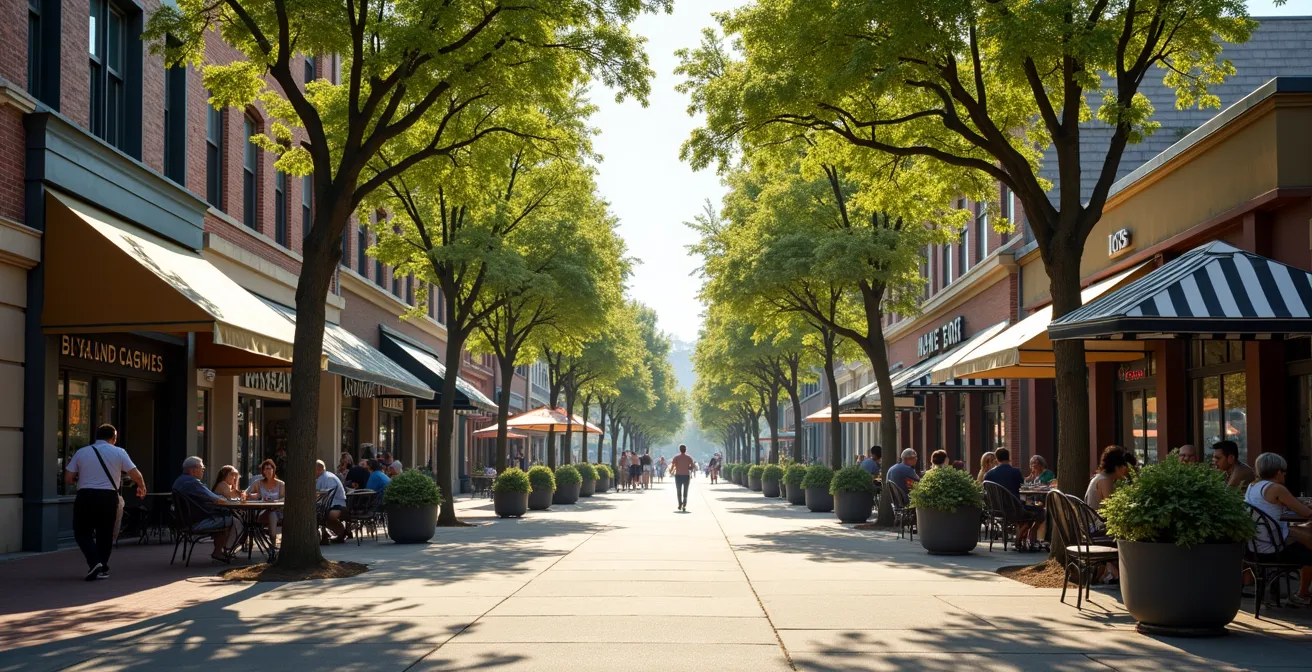
The visual evidence is appearing on main streets across the country, which are now bustling on weekday afternoons. This is not just a reallocation of consumer spending; it is a reallocation of talent and entrepreneurial energy. For investors, this means the most promising commercial real estate opportunities are no longer concentrated in downtown high-rises but are distributed across suburban commercial corridors. The donut effect is actively reshaping metropolitan economies, creating new centers of value far from the traditional core.
When Will Co-Living Become the Standard for Young Professionals?
As young professionals increasingly move to the suburbs, their housing expectations are evolving. The traditional single-family home model does not always align with the desires of a generation that values flexibility, community, and affordability. This creates a fertile ground for co-living and other innovative housing models to become a standard suburban offering. The demand is certainly present; a Bank of America study shows that a consistent 43-45% of millennials across all age groups expect to buy a house in the suburbs. The challenge is to provide a product that meets their modern needs.
Co-living in a suburban context is not about replicating cramped urban dormitories. It’s about creating “community-as-an-amenity.” This can take the form of purpose-built developments with shared kitchens, workspaces, and recreational facilities, or the retrofitting of larger homes into smaller, private units with communal areas. As urban theorists Richard Florida and Adam Ozimek noted in a Wall Street Journal analysis, the onus is on these communities to adapt their offerings:
Smaller cities, suburbs and rural areas must up their games… Apartment buildings and condominiums can add workspaces and conference rooms for remote workers to book as needed.
– Richard Florida and Adam Ozimek
This advice underscores the core idea: housing is no longer just shelter, but a platform for living and working. For co-living to become the standard, it must offer a clear value proposition: a solution to social isolation, a lower cost of entry than traditional homeownership, and access to a built-in professional network. Developers who master this formula in a suburban setting will tap into a massive and underserved market.
Action Plan to Audit Your Community’s Future-Readiness
- Points of Contact: List all channels where the “service-rich” signal is emitted, such as local government websites, community boards, and business improvement districts.
- Asset Collection: Inventory existing “third places” (e.g., co-working spaces, independent cafes, accessible parks) and smart infrastructure (e.g., fiber internet availability, EV charging stations).
- Coherence Check: Confront existing assets with the community’s master plan. Does the infrastructure support the stated goal of attracting tech families, or is it better suited for retirees?
- Memorability Audit: Identify unique, emotionally resonant assets (e.g., a historic main street, a unique natural feature) and contrast them with generic, replaceable elements (e.g., strip malls).
- Integration Plan: Prioritize key projects to fill the most critical gaps, such as a pilot program to convert a vacant storefront into a pop-up co-working hub.
Why Adaptive Traffic Lights Reduce Commute Times by 20%?
The suburban migration has completely scrambled traditional traffic patterns. The classic 9-to-5 rush hour, with its predictable inbound morning peak and outbound evening peak, is a relic of the past. In a hybrid work world, traffic is more distributed throughout the day and week, creating new and often unpredictable congestion points. Traffic data from Inrix, for example, shows that even on major arteries like Interstate 77, traffic levels have not fully returned to pre-pandemic peaks. This new reality renders fixed-timer traffic signals inefficient and obsolete. They are a rigid solution for a fluid problem.
The answer lies in smart, adaptive infrastructure. Adaptive traffic signal control systems use real-time data from sensors and cameras to adjust signal timing dynamically based on actual traffic flow. Instead of following a pre-programmed schedule, they respond to the moment. Studies and real-world deployments have shown these systems can reduce travel times by up to 20% and decrease stops and delays by over 30%. This is not just a marginal improvement; it’s a significant boost to a community’s quality of life and economic efficiency.
For urban planners, investing in this technology is a critical step in future-proofing their communities. It’s a key element of the “service-rich suburbia,” demonstrating a commitment to using technology to solve practical problems for residents. Optimizing traffic flow is a high-visibility, high-impact investment that directly addresses one of the most common frustrations of suburban life, making a community more attractive to potential residents and businesses.
Smart Traffic Optimization for Hybrid Work Patterns
- Implement IoT streetlights that adjust brightness based on real-time pedestrian and vehicle activity levels to save energy.
- Deploy smart traffic signals that use AI and sensor data to respond to actual traffic flow rather than fixed timers.
- Create dynamic street spaces that can be reallocated for pedestrian-only use or outdoor dining during peak social hours.
- Integrate real-time traffic data with public transit and ride-sharing apps to provide holistic mobility solutions.
- Prioritize and dynamically manage bicycle and micro-mobility lanes, expanding their access during off-peak vehicle hours.
Why You Lose 40% of Your Solar Power Without a Battery Storage System?
The move to the suburbs is not just about physical space; it’s also intertwined with a desire for greater self-sufficiency and sustainability. As remote work increases daytime household energy consumption, technologies like residential solar become increasingly attractive. However, the intermittent nature of solar power presents a major challenge: solar panels generate the most electricity in the middle of the day, but peak household demand often occurs in the evening. Without a way to store that midday energy, a significant portion—often as much as 40%—is either lost or sold back to the grid for a fraction of its value.
This is where battery storage systems become a critical piece of infrastructure, both for individual homes and for the community at large. A home battery allows a resident to capture their excess solar generation and use it during peak evening hours, maximizing their energy independence and reducing their reliance on the grid. On a larger scale, communities that encourage and integrate this technology are building a more resilient, decentralized power network. The case of Chattanooga, Tennessee, is illustrative. By deploying citywide high-speed fiber connectivity, they not only enabled seamless remote work but also created a smart grid backbone capable of managing distributed energy resources. As an official from their EPB utility noted, this infrastructure makes Chattanooga a model for energy-independent remote work communities.
Furthermore, the integration of AI can optimize this entire system. Research shows that smart home energy management systems can reduce a household’s carbon emissions by 40% and lower gas consumption by 5%. This combination of local generation, storage, and intelligent management is the blueprint for the sustainable, self-reliant suburb of the future.
Key Takeaways
- The suburban boom is an economic reshuffling, not just a residential one, as capital and talent follow the shift to remote and hybrid work.
- The key differentiator for successful suburbs is the quality of their infrastructure, both digital (fiber internet) and social (co-working spaces, third places).
- Adaptive reuse of obsolete commercial buildings into new housing and community hubs is the primary tactical tool for this suburban transformation.
How to Prevent Smart Cities From Becoming Surveillance States?
As suburbs evolve into service-rich, programmable communities, they will inevitably rely on a vast network of sensors, data, and AI-driven systems. Adaptive traffic lights, smart energy grids, and public safety monitoring all generate enormous quantities of data about residents’ movements and behaviors. While this technology offers undeniable benefits in efficiency and quality of life, it also presents a profound governance challenge: ensuring that the “smart city” does not become a “surveillance state.” This is the central ethical tightrope that planners and municipal leaders must walk.
The prevention of a surveillance state hinges on a commitment to transparency, accountability, and citizen control. This is not a technical problem, but a political and ethical one. Winning strategies include establishing independent civilian oversight boards for data usage, implementing strict data anonymization policies, and building “privacy-by-design” principles into every new technology procurement. The goal is to use data to serve citizens, not to monitor them. Without a robust framework for digital rights, communities risk a public backlash that could derail their technological progress entirely.
Ultimately, the future health of our cities and suburbs depends on their ability to balance innovation with core human values. As Stanford economist Nicholas A. Bloom observes, the focus must shift. Cities must “provide appealing services and control crime to attract residents, shoppers, and diners. The future of cities looks healthy, but it is different – less office and more leisure focused.” This vision of a more experience-oriented urbanism applies equally to the newly ascendant suburbs. The smartest communities will be those that use technology to enhance human freedom and connection, not to constrain them.
For urban planners and property investors, the time for passive observation is over. The great reshuffling demands proactive strategy. The next step is to begin auditing your own communities and portfolios, identifying the gaps and opportunities to build the resilient, connected, and service-rich environments that will thrive in this new, decentralized era.