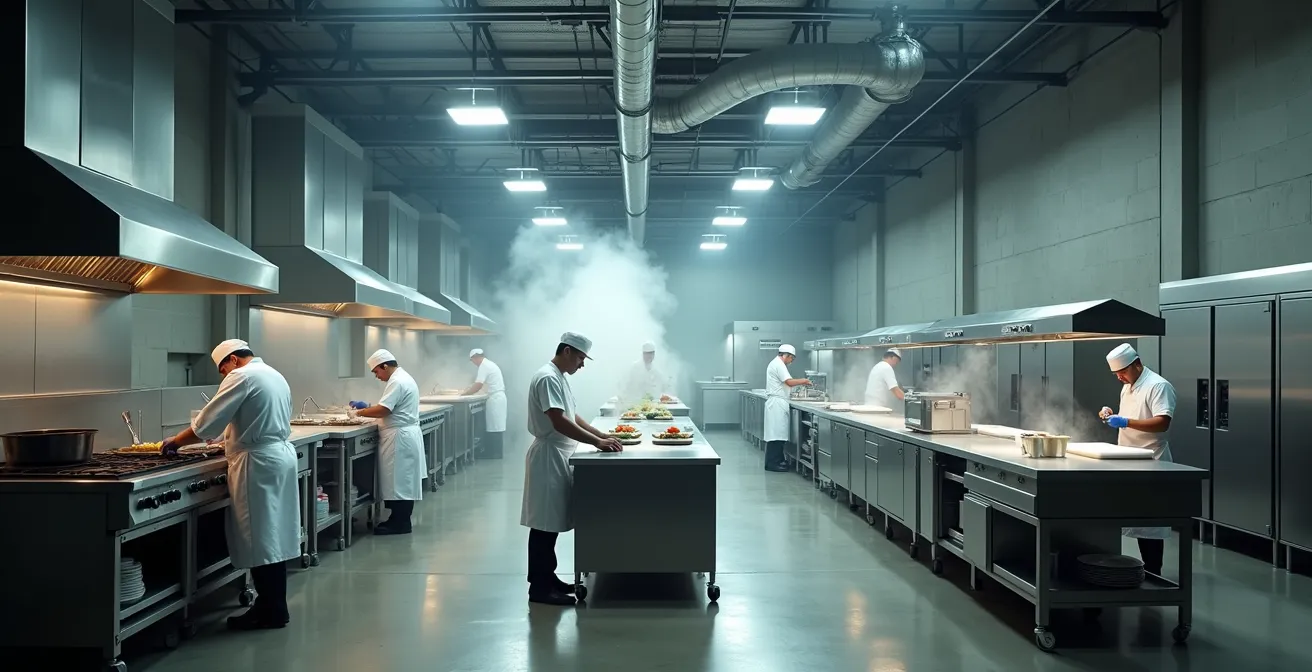
Ghost kitchens are far more than just restaurants without a dining room; they are a complex, high-pressure system that re-engineers food, finance, and branding.
- Food quality for delivery depends on “operational engineering,” from specialized coatings on fries to recipes designed to survive the crucial last mile of transit.
- Extreme financial pressure from a “commission squeeze,” where delivery apps can take 15-30% of revenue, forces operators into a high-stakes battle for profitability.
Recommendation: Look beyond the virtual brand on the app; the true story of your meal lies in the hidden economics of the warehouse it came from.
You scroll through a delivery app and discover a new spot, “Supreme Burger Co.,” with mouth-watering photos and stellar reviews. You place an order, and it arrives promptly. But out of curiosity, you search for its address and find nothing—no storefront, no dining room, just a pin dropped in the middle of an industrial park. You’ve just encountered a ghost kitchen, the definitive restaurant model of the digital age. This phenomenon, also known as cloud kitchens or dark kitchens, represents a seismic shift in the food industry.
The common explanation is simple: operators save on expensive retail rent and front-of-house staff. While true, this barely scratches the surface. The pandemic accelerated their adoption, but the foundation was laid by the rise of third-party delivery platforms. These app-based ecosystems created a new reality where a physical presence is no longer a prerequisite for reaching customers. The convenience for consumers is undeniable, but it masks a fiercely competitive and operationally complex world hidden from view.
But what if the savings on rent are merely an entry ticket to a much tougher game? The real story of the ghost kitchen is not one of simple cost-cutting, but of total operational engineering. It’s an industry built on food science designed for travel, a constant battle against the clock, and a precarious financial balancing act dictated by the powerful delivery apps. The central question isn’t just about saving money, but about whether a restaurant can fundamentally reinvent itself to survive in a delivery-first world.
This analysis will pull back the curtain on this new food economy. We will dissect the science of making food travel-proof, expose the brutal ‘commission squeeze’ that can bankrupt unaware operators, and reveal the transparency risks behind the virtual façades of these digital-only brands. Understanding this hidden system is key to understanding the future of how we eat.
Summary: The Secret World of Delivery-Only Restaurants
- How to Keep Fries Crispy During a 20-Minute Delivery Ride?
- Burger or Curry: Which Travels Better Without Losing Flavor?
- The Commission Mistake That Bankrupts Small Restaurants on Delivery Apps
- The Transparency Risk of One Kitchen Running 10 “Different” Burger Brands
- When to Shut Off Delivery Tablets to Save Your Kitchen Staff?
- Upwork vs. Fiverr: Which Platform Offer Better Long-Term Client Retention?
- Why Adaptive Traffic Lights Reduce Commute Times by 20%?
- Why Does Local CSA Produce Cost More Upfront But Less Over Time?
How to Keep Fries Crispy During a 20-Minute Delivery Ride?
The humble french fry is the ultimate test for any ghost kitchen. For a dine-in restaurant, fries travel a few dozen feet from the fryer to the table. For a delivery-only brand, they face a grueling 20-minute journey trapped in a bag, where their greatest enemy—steam—is generated by their own heat. Solving this “last mile challenge” is a matter of pure food science and operational engineering. Simply using a standard recipe is a recipe for disaster, leading to the sad, soggy fries that disappoint customers and tank reviews.
To combat this, successful ghost kitchens re-engineer their product. Many adopt specialized coatings made from rice flour or cornstarch, which create a microscopic, brittle barrier that shields the potato’s interior from moisture. The cooking process itself is often modified, favoring a double-fry method that drives out more internal water, resulting in a sturdier, longer-lasting crunch. This isn’t just cooking; it’s designing a product specifically for the harsh conditions of delivery, a market that continues to expand rapidly. In fact, analysts project that the ghost kitchen market will reach $157.26 billion by 2030, and that growth is fueled by solving these precise logistical puzzles.
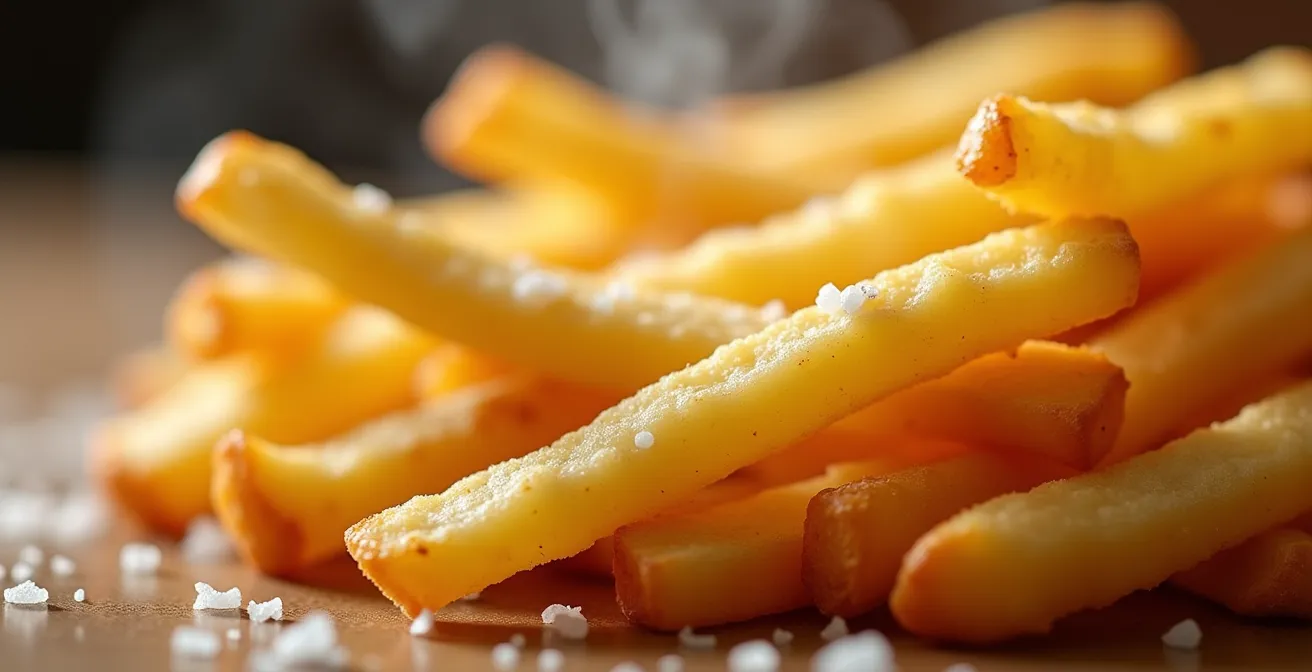
As this image reveals, the surface of a delivery-optimized fry is a complex landscape engineered for crispiness. But the innovation doesn’t stop with the food itself. Packaging is the second critical component. Leading suppliers have developed materials like vented paperboard containers, which allow steam to escape rather than condensing on the food. More advanced solutions even include temperature-sensitive packaging with QR codes, allowing customers to verify the food has remained at a safe temperature throughout its journey. This focus on the technical details is what separates a successful virtual brand from a failed experiment.
Burger or Curry: Which Travels Better Without Losing Flavor?
Not all foods are created equal in the world of delivery. The success of a ghost kitchen hinges on a crucial, early decision: choosing a menu that is resilient to the rigors of travel. A dish that is magnificent when served fresh can become a culinary tragedy after 25 minutes in a delivery container. This is why you see a proliferation of certain types of cuisines on delivery apps—they are not just popular, they are operationally robust. Foods with high moisture content and stable structures, like curries, stews, and rice bowls, are ideal candidates. Their flavors can even meld and deepen during transit, arriving at the customer’s door in excellent condition.
Conversely, dishes built on textural contrast and temperature differences are notoriously difficult. A classic burger is a prime example. The hot patty wilts the cool lettuce, the steam from the meat makes the bun soggy, and the whole structure can lose its integrity. As Dot It Restaurant Solutions, an industry supplier, notes in its analysis, “Since customers won’t be sitting down and eating the food at your restaurant, you will need to come up with recipes that can stand up to being placed in travel containers.” This single consideration can make or break a virtual brand’s reputation.
The following table, based on industry analysis, breaks down how different food types hold up during delivery, highlighting the key challenges operators must solve.
| Food Type | Travel Time Tolerance | Quality Retention | Key Challenge |
|---|---|---|---|
| Burgers | 15-20 minutes | Medium | Bun sogginess, temperature loss |
| Curry/Stews | 30-45 minutes | High | Container seal integrity |
| Fried Items | 10-15 minutes | Low | Moisture migration |
| Pasta | 20-30 minutes | Medium-High | Sauce separation |
This data illustrates why a ghost kitchen’s menu is less a creative expression and more a strategic calculation. The most successful concepts are those that either choose inherently durable foods (like curries) or invest heavily in the operational engineering required to make fragile foods (like fries and burgers) travel-proof. Ignoring this reality is a fast track to failure.
The Commission Mistake That Bankrupts Small Restaurants on Delivery Apps
While ghost kitchens save on rent, they trade one major expense for another: the staggering commission fees charged by third-party delivery apps. This is the central, brutal economic reality of the model. For every order a customer places, platforms like Uber Eats, DoorDash, and Grubhub take a significant cut. This isn’t just a small service charge; industry reports show that delivery apps charge a convenience fee that can consume 15 to 30 percent of the order’s total value. For a small restaurant operating on already thin margins, this “commission squeeze” can be fatal.
Many aspiring entrepreneurs are lured by the low startup costs, failing to model the long-term impact of these commissions. A restaurant might typically aim for a food cost of around 30% and labor cost of 30%. When you add another 25% commission on top of that, the profit margin evaporates entirely, or even becomes negative. This forces operators into extreme measures: either raising prices to levels that alienate customers, drastically cutting ingredient quality, or achieving an almost impossible level of volume and efficiency to compensate.

The high-stakes nature of this financial model is perfectly illustrated by the case of MrBeast Burger, one of the most famous virtual brands. Despite generating millions in revenue, the complex profit-sharing and commission structure of the venture became a point of major conflict. The financial arrangements highlight how even a massively popular brand can struggle with profitability when the underlying economics are skewed by high commissions. For an independent operator without the leverage of a global celebrity, navigating this commission squeeze is an even greater challenge, turning the dream of a low-cost restaurant into a potential financial nightmare.
The Transparency Risk of One Kitchen Running 10 “Different” Burger Brands
The ghost kitchen model unlocks a powerful, yet perilous, capability: the creation of multiple “virtual façades” from a single physical location. An operator can launch “Gourmet Burger Bistro,” “Spicy Wing Shack,” and “Healthy Salad Bowls” on delivery apps, all while the food for each is being prepared on the same cookline in one anonymous warehouse. While this allows for rapid market testing and targeting of different customer segments, it introduces a significant risk to consumer trust. With an estimated 1,500 ghost kitchen locations operating in the U.S. alone, this practice is becoming widespread.
The issue came to a head when delivery platforms became saturated with these near-identical offerings. As a former Uber Eats executive, John Mullenholz, described it to the Wall Street Journal, the situation can quickly get out of hand. He noted that when a single kitchen spams the app with minor variations of the same menu, it creates a “Wild West” environment that ultimately erodes consumer confidence.
Customers are ‘effectively seeing 12 versions of the same menu’ on the app, which sparks a ‘Wild West, anything goes kind of situation’ that ‘erodes consumer confidence’
– John Mullenholz, as reported by TechCrunch
This lack of transparency can lead to a disconnect between brand promise and reality. A customer ordering an expensive burger from a seemingly artisanal brand may be shocked to discover it was made in an unexpected or lower-quality environment. This exact scenario played out and created a public relations issue for a major virtual brand.
Case Study: The MrBeast Burger Quality Control Crisis
The brand trust issue was vividly illustrated when customers began complaining about the quality of MrBeast Burger orders. One frustrated parent, disappointed with the meal served to his children, managed to trace the ghost kitchen fulfilling his order back to a local 7-Eleven convenience store. He expressed a sentiment shared by many: “I just don’t see how a place like 7-11 should be preparing and serving $10 burgers.” This incident exemplifies the brand illusion risk, where the customer’s expectation of quality, set by the virtual brand, clashes jarringly with the reality of its origin.
When to Shut Off Delivery Tablets to Save Your Kitchen Staff?
In a traditional restaurant, the flow of customers is visible. A line at the door is a clear signal that the kitchen is approaching its limit. In a ghost kitchen, orders arrive silently and relentlessly through a chorus of tablets, each connected to a different delivery app. There is no line at the door—only an endless stream of digital tickets. This creates a huge operational challenge: identifying the throughput breaking point, the moment when order volume exceeds the kitchen’s capacity to produce quality food in a timely manner. Pushing past this point leads to burnt-out staff, sloppy mistakes, and cold food, all of which destroy a brand’s reputation.
The pressure is immense, especially given the lean staffing model ghost kitchens employ. Many successful operations generate between 40-60% of a traditional restaurant’s revenue using only 25% of the staff. This hyper-efficiency is profitable until it isn’t. Without a dining room manager to “pause” seating, the only defense a ghost kitchen has is to proactively shut off the delivery tablets, temporarily making the “restaurant” unavailable. Knowing when to do this is a critical skill, requiring a shift from instinct to data-driven management. It means trusting metrics over the temptation to accept one more order.
The solution lies in implementing a system to monitor kitchen capacity in real-time. By tracking key performance indicators, an operator can establish clear thresholds that, when crossed, automatically trigger a pause in accepting new orders. This proactive approach is essential for maintaining both quality and staff sanity.
Action Plan: Managing Kitchen Order Capacity
- Centralize Orders: Implement a centralized Point-of-Sale (POS) system that aggregates orders from all delivery apps into a single, manageable queue.
- Establish Protocols: Set up instant order assignment rules to ensure every ticket is immediately directed to the correct station and staff member without delay.
- Monitor Real-Time Reports: Use your POS dashboard to track active ticket times, orders per hour, and average wait times to assess performance and identify emerging bottlenecks.
- Track Leading Indicators: Pay close attention to error rates (e.g., incorrect orders, missing items) and ticket times. A sudden spike in either is a primary indicator that staff are overloaded.
- Set Automatic Triggers: Establish clear thresholds for your key metrics. Configure your system to automatically pause incoming orders on one or all apps when these thresholds are exceeded for a set period.
Upwork vs. Fiverr: Which Platform Offer Better Long-Term Client Retention?
In the world of freelancing, platforms like Upwork and Fiverr have democratized access to global talent. However, they are built on fundamentally different philosophies that heavily influence a freelancer’s ability to build lasting client relationships. Fiverr is structured around a “productized service” model. Freelancers offer “Gigs”—specific, pre-defined tasks with a fixed price, such as “I will design a logo for $50.” This transactional nature is excellent for one-off projects and clients seeking quick, predictable results. However, it can make it difficult to evolve a relationship beyond the initial scope, as the platform’s DNA is geared toward single purchases.
Upwork, in contrast, operates closer to a traditional job market. It facilitates both fixed-price projects and, crucially, hourly contracts. This hourly model is the key to long-term retention. It allows for flexible, ongoing work where the scope can evolve organically. Clients can “hire” a freelancer for a few hours a week indefinitely, integrating them into their team in a much deeper way than a one-time Gig purchase allows. The platform’s features, like work diaries and detailed invoicing, are built to support these extended, trust-based engagements.
Ultimately, the choice depends on a freelancer’s business model. For those focused on high volume and standardized deliverables, Fiverr’s transactional efficiency is hard to beat. But for freelancers and consultants aiming to become long-term strategic partners to their clients, Upwork’s structure is inherently more conducive to fostering retention. It provides the framework for moving from a simple service provider to an indispensable part of a client’s operations. The most successful freelancers often use both, leveraging Fiverr for client acquisition and then migrating larger, more complex relationships to an ongoing hourly model on a platform like Upwork.
Why Adaptive Traffic Lights Reduce Commute Times by 20%?
Traditional traffic lights operate on fixed timers, cycling through green, yellow, and red in a predetermined sequence, regardless of actual traffic conditions. This “dumb” system is a primary source of urban congestion, creating unnecessary stops on empty roads and failing to adapt to sudden surges in volume. Adaptive traffic signal control (ATSC) systems represent a paradigm shift, transforming these intersections into responsive, intelligent networks. By using a system of sensors, cameras, and artificial intelligence, these lights can reduce commute times by up to 20% or more in optimized corridors.
The mechanism behind this improvement is real-time data processing. Inductive loops buried in the pavement, video cameras, or radar sensors constantly feed data to a central traffic management system. This data includes the number of vehicles queued at an intersection, their speed, and the overall flow along an entire arterial road. An AI-powered algorithm then analyzes this information and makes instantaneous decisions. Instead of a rigid timer, the system can dynamically allocate green-light time where it is most needed. If a main road is heavily congested while a side street is empty, the system will extend the green for the main road, clearing the bottleneck efficiently.
Furthermore, these systems enable signal coordination on a massive scale. The algorithm can create “green waves,” timing a series of consecutive lights to turn green just as a platoon of cars approaches. This minimizes the stop-and-go driving that wastes fuel and time. The result is a smoother, more efficient flow of traffic that adapts to unpredictable events like accidents, special events, or daily rush hour patterns. By replacing static timers with a dynamic, data-driven brain, adaptive traffic lights don’t just manage traffic—they optimize the entire urban transport system.
Key Takeaways
- The economics of ghost kitchens are dominated by a “commission squeeze,” with delivery apps taking 15-30% of revenue, forcing operational extremes.
- Food for delivery isn’t just cooked, it’s engineered with special packaging and recipes to survive transit, impacting taste and texture.
- The rise of “virtual façades,” where one kitchen runs multiple brands, erodes consumer trust and raises questions about transparency and quality.
Why Does Local CSA Produce Cost More Upfront But Less Over Time?
At first glance, the cost of a Community Supported Agriculture (CSA) share can seem high compared to a weekly grocery bill. Paying a lump sum of several hundred dollars at the beginning of the season for a weekly box of vegetables feels like a significant investment. This upfront cost, however, masks the true economic and value proposition of the CSA model. The initial payment is not just a pre-purchase of produce; it’s a direct investment in the farm’s operational stability for the entire season. This capital allows the farmer to buy seeds, repair equipment, and manage cash flow without relying on high-interest loans.
When you break down the lump sum over the length of the season (typically 20-26 weeks), the cost per weekly box is often competitive with, or even cheaper than, buying the same quantity and quality of organic produce at a retail store or farmers’ market. For example, a $600 share for a 24-week season averages out to $25 per week. Filling a cart with a similar volume of fresh, locally-grown, organic vegetables at a premium grocery store would frequently exceed that amount. The perception of high cost is a function of its payment structure, not its actual value.
The long-term savings extend beyond the per-box price. CSA members often report a reduction in overall food waste, as the weekly share encourages them to cook with what they have rather than making impulse buys at the store. Furthermore, the produce is significantly fresher, having been harvested days or even hours before pickup, which translates to a longer shelf life at home and better nutrient retention. The upfront cost is therefore a commitment that yields dividends in weekly value, reduced waste, and superior quality, making it a more economical choice over the full course of a season.
The next time you browse a delivery app or a farmers’ market, look beyond the price tag and the flashy menu. By understanding the hidden system of commissions, logistics, and investment models that bring food to your table, you become a more conscious and empowered consumer in our rapidly evolving food landscape.