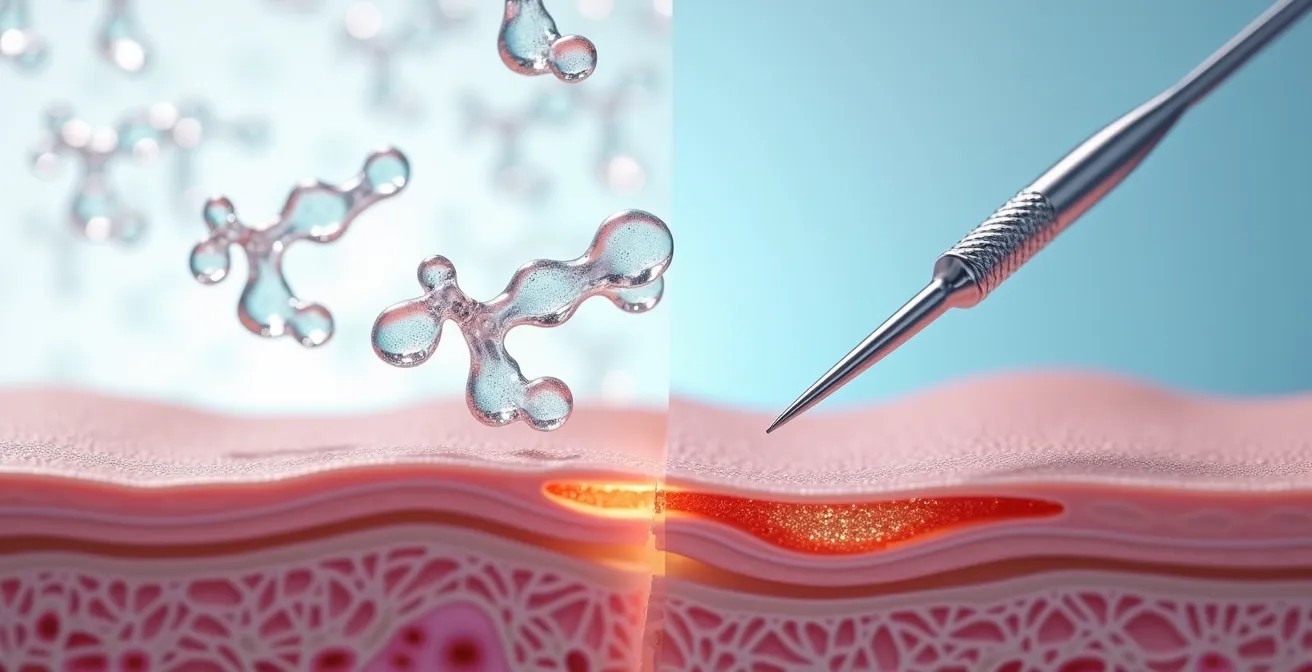
Despite marketing claims, topical peptides fundamentally cannot replicate the results of Botox because they operate on completely different biological principles.
- Botox works by physically blocking nerve signals to paralyze muscles, a mechanical action that topical products cannot achieve due to the skin’s protective barrier.
- Peptides are cell-signaling ingredients that can encourage collagen production, but their effect is slower, less dramatic, and heavily dependent on their ability to penetrate the skin.
Recommendation: Use peptides to support skin texture and health, but understand that for preventing and treating dynamic wrinkles caused by muscle movement, injectables like Botox are in a separate, more effective category.
The beauty industry thrives on the allure of a miracle in a jar. The concept of “Botox in a bottle,” driven by sophisticated peptide formulations, is perhaps the most powerful modern example. It promises the wrinkle-smoothing power of a medical procedure without the needle, a tempting proposition for anyone contemplating preventative aging strategies. Consumers are often caught in a confusing crossroads, weighing the high cost of advanced creams against the commitment of a cosmetic treatment. But this comparison, however common, is based on a fundamental misunderstanding of skin biology.
From a biochemical standpoint, comparing topical peptides to botulinum toxin is like comparing a motivational speech to a physical switch. One sends a suggestion, while the other forces an outcome. Peptides are messengers that *encourage* skin cells to behave differently—to produce more collagen, for instance. Botox, on the other hand, is a neuromodulator that *blocks* the signal between a nerve and a muscle, forcing it to relax. It doesn’t ask; it tells. The skin’s primary function is to be a barrier, and this “bioavailability barrier” is precisely why a topical cream struggles to deliver a message with the same authority as a targeted injection.
This article will deconstruct the “Botox in a bottle” myth by examining the distinct mechanisms at play. We will not be dismissing peptides, but rather placing them in their correct context. We will explore how to genuinely support skin structure from a young age, dissect the lifestyle factors that sabotage your efforts, and clarify why some anti-aging strategies are preventative while others are merely corrective. The goal is to equip you with the scientific literacy to see past the marketing and make an informed decision based on how your skin actually works.
To navigate this complex topic, we will break down the science behind skin aging, prevention, and treatment. This guide will clarify the roles of internal health and external products, helping you understand which tools are right for which jobs.
Summary: Deconstructing the “Botox in a Bottle” Myth
- How to Stimulate Collagen Production Before It Starts Declining in Your 20s?
- The Sugar Habit That Breaks Down Your Skin’s Elastin
- Preventative Botox or Facial Yoga: Which Maintains Muscle Tone Better?
- The DNA Mistake: Assuming You Will Age Exactly Like Your Parents
- How to Sleep to Avoid Forming Deep Sleep Wrinkles?
- The Sugar Mistake That Feeds Bad Bacteria and Causes Bloating
- Blue Light Blockers or Screen Curfew: Which Improves Melatonin More?
- Why Using 10 Products is Destroying Your Skin Barrier?
How to Stimulate Collagen Production Before It Starts Declining in Your 20s?
The conversation about anti-aging often feels premature in one’s twenties, but the biochemical reality is that this is precisely when the foundational changes begin. Your skin’s firm, plump structure is primarily thanks to collagen, a protein that acts as its internal scaffolding. However, the body’s production of this vital protein doesn’t last forever at peak levels. The process of decline is subtle but starts early; after the age of 20, we experience roughly a 1% annual decrease in collagen production. This isn’t a catastrophe, but rather a slow, gradual shift in your skin’s architectural integrity.
Further research confirms this timeline. One detailed analysis of skin across different age groups reported a peak in collagen content for subjects between 25-34 years old, followed by a steady decline. Therefore, the most effective preventative strategy isn’t about correcting wrinkles but about “collagen banking.” This involves adopting habits that protect your existing collagen and support the fibroblasts—your collagen-producing cells—so they can work as efficiently as possible for as long as possible. This proactive approach focuses on providing the raw materials and the right environment for optimal skin function.
Key strategies in your 20s include incorporating ingredients known to support collagen synthesis. Topical Vitamin C is a non-negotiable, as it’s a crucial cofactor in the collagen production process. Similarly, retinoids (starting with gentle forms like retinaldehyde) are proven to boost collagen production. Most importantly, diligent, daily sunscreen use is the single most effective action you can take. UV radiation is a primary driver of collagen degradation, and protecting your skin from it is like putting your collagen savings in a high-security vault.
The Sugar Habit That Breaks Down Your Skin’s Elastin
While we often focus on topical solutions, what you consume has a direct, molecular-level impact on your skin’s structural integrity. One of the most significant, yet often overlooked, culprits in accelerated skin aging is sugar. The damaging process it initiates is called glycation. In simple terms, when you have excess sugar molecules in your bloodstream, they can attach themselves to proteins, including the collagen and elastin that give your skin its firmness and elasticity. This bonding creates harmful new molecules called Advanced Glycation End-products (AGEs).
These AGEs are bad news for your skin. They make the normally flexible and resilient collagen and elastin fibers become rigid, brittle, and weak. This molecular stiffening prevents the proteins from functioning correctly, leading to a loss of elasticity, increased wrinkling, and a compromised ability for the skin to repair itself. Essentially, a high-sugar diet causes your skin’s support structure to crystallize and break down from the inside out. This internal damage cannot be fixed with a cream.

As the illustration above depicts, this isn’t a vague concept but a real, physical interaction. The cross-linking of these fibers diminishes the skin’s ability to bounce back, making it more susceptible to sagging and wrinkling. Reducing your intake of refined sugars and high-glycemic carbohydrates is therefore a primary preventative strategy. It’s not about eliminating all sugar, but about minimizing the unnecessary spikes that fuel the glycation process. This dietary discipline protects your protein framework more effectively than many expensive topical treatments.
Preventative Botox or Facial Yoga: Which Maintains Muscle Tone Better?
When it comes to dynamic wrinkles—the lines formed by repeated facial expressions like frowning or squinting—the debate often narrows to two opposing philosophies: paralyze the muscle with Botox or strengthen it with facial yoga. This choice highlights a fundamental confusion about muscle tone and wrinkle formation. Facial yoga is designed to exercise and strengthen the 40+ muscles in your face, aiming to lift and firm the overlying skin. The premise is that stronger muscles provide a better foundation, preventing sagging. However, dynamic wrinkles aren’t caused by weak muscles; they are caused by overactive muscles.
Botox works on this exact principle. It is a neuromodulator that temporarily blocks nerve signals to specific, targeted muscles. By preventing the muscle from contracting, it stops the overlying skin from creasing. This forced relaxation allows the skin to smooth out, and with preventative use, it can stop deep-set wrinkles from ever forming. From a purely mechanical perspective of stopping dynamic lines, its effectiveness is well-documented. For instance, clinical studies show Botox achieves up to an 80% reduction in wrinkles within just one week.
This is where the comparison to even the most advanced topical peptides becomes stark. A study on a biomimetic peptide known as XEP-30, designed to mimic the paralytic effect of a component in cone snail venom, showed it resulted in an average wrinkle reduction of 64% over a 14-day period. While impressive for a topical, it’s slower and less effective than the near-total, rapid cessation of muscle movement achieved with Botox. Facial yoga, while potentially beneficial for circulation and releasing tension, can in some cases exacerbate dynamic wrinkles by repeatedly strengthening the very muscles that cause them. Therefore, for maintaining smooth skin free of expression lines, preventing muscle contraction (Botox) is a more direct and effective strategy than reinforcing it (facial yoga).
The DNA Mistake: Assuming You Will Age Exactly Like Your Parents
A common refrain in conversations about aging is, “I have my mother’s skin, so I’m destined for the same wrinkles.” While genetics certainly play a role in your intrinsic aging process—determining your skin type and baseline structure—they are far from the whole story. The belief that your genetic blueprint is an unchangeable destiny is a significant mistake. The science of epigenetics shows us that lifestyle and environmental factors act as “switches” that can turn genes on or off, dramatically influencing how your genetic predispositions are expressed.
Think of your DNA as the hardware and your lifestyle as the software. You might be genetically predisposed to collagen loss, but a life of diligent sun protection, a low-sugar diet, and no smoking can keep the “collagen degradation” genes in the “off” position for much longer. Conversely, someone with “good genes” can accelerate their aging process significantly through poor lifestyle choices. This is known as extrinsic aging, and experts believe it accounts for the vast majority of visible signs of aging.
Factors like chronic UV exposure, pollution, smoking, poor diet, and chronic stress are powerful epigenetic modulators. They create oxidative stress and inflammation, which damage cellular DNA and accelerate the breakdown of collagen and elastin, regardless of your genetic inheritance. This is incredibly empowering. It means you have far more control over how you age than you might think. Your choices matter more than the lines on your parents’ faces. Focusing on these controllable factors—sunscreen, antioxidants, a healthy diet, and stress management—is the most effective way to write your own aging story.
How to Sleep to Avoid Forming Deep Sleep Wrinkles?
We’re often told to get our “beauty sleep,” focusing on the duration of rest for cellular repair. However, the *way* you sleep can be just as impactful on your skin, specifically through the formation of sleep wrinkles. Unlike expression lines, which are caused by muscle movement, sleep wrinkles are the result of mechanical compression and shear forces on the face. When you sleep on your side or stomach, your face is pressed against the pillow for hours, folding and creasing the skin. Over time, these temporary creases can become permanently etched into your skin, especially as collagen and elastin levels decline with age.
These compression wrinkles typically appear as vertical or diagonal lines on the forehead, cheeks, and décolletage. The most effective way to prevent them is to modify the mechanical forces at play. The ideal, though often difficult, solution is to train yourself to sleep on your back. This position eliminates the direct pressure on your facial skin. For many, this is not a natural or comfortable position to maintain throughout the night.

If you are a committed side or stomach sleeper, switching your pillowcase can make a significant difference. Standard cotton pillowcases grip the skin, holding it in a creased position. A silk or satin pillowcase, however, provides a smooth, low-friction surface. This allows your skin to glide rather than get snagged and folded, drastically reducing the shear forces that contribute to these deep wrinkles. It’s a simple, passive intervention that addresses the physical cause of a specific type of wrinkle that Botox and fillers cannot treat.
The Sugar Mistake That Feeds Bad Bacteria and Causes Bloating
The link between diet and skin health extends deep into your digestive system. The sugar habit we previously identified as a driver of glycation also has a profound effect on your gut microbiome—the complex ecosystem of bacteria living in your digestive tract. A diet high in refined sugar and processed foods provides the perfect fuel for pathogenic (bad) bacteria, yeasts, and fungi to thrive. This overgrowth can lead to a state of imbalance known as dysbiosis.
When these harmful microbes proliferate, they ferment sugars and produce gas, leading to the uncomfortable symptoms of bloating, cramping, and digestive distress. But the damage isn’t just confined to your gut. Dysbiosis can compromise the integrity of your intestinal lining, a condition often referred to as “leaky gut.” This allows inflammatory molecules and microbial byproducts to leak into the bloodstream, triggering a low-grade, systemic inflammatory response throughout the body.
This chronic inflammation is a major accelerator of the aging process. It puts your entire system on high alert, diverting resources away from regenerative processes like collagen synthesis. Inflammatory cytokines circulating in your blood can directly contribute to the breakdown of collagen and elastin in the skin, a process sometimes called “inflammaging.” Therefore, the bloating you experience after a sugary meal is more than just temporary discomfort; it’s an outward sign of an internal imbalance that is actively working against your skin health. Managing your sugar intake is not just about preventing glycation, but also about maintaining a healthy gut microbiome to keep systemic inflammation in check.
Blue Light Blockers or Screen Curfew: Which Improves Melatonin More?
Effective skin regeneration is intrinsically linked to the quality of your sleep, and sleep quality is regulated by the hormone melatonin. Melatonin is your body’s powerful “darkness hormone,” signaling that it’s time to rest and initiate cellular repair processes. This includes repairing DNA damage in skin cells and reducing oxidative stress accumulated during the day. However, modern life constantly disrupts melatonin production, primarily through our exposure to blue light from screens (phones, tablets, computers) in the evening.
Blue light has a wavelength that the brain interprets as daylight, effectively tricking it into thinking it’s still daytime. This suppresses the natural evening rise in melatonin, delaying the onset of sleep and reducing its restorative quality. This leads to a crucial question for prevention: is it better to block the blue light or to avoid the screens altogether? While blue light blocking glasses or screen filters can help by filtering out the most disruptive wavelengths, they are not a perfect solution. The very act of engaging with stimulating content on a screen can keep your brain aroused, hindering the transition to sleep.
Therefore, a strict screen curfew—powering down all electronic devices at least 60-90 minutes before bedtime—is biochemically the more effective strategy. It eliminates both the light-based and the content-based stimulation, allowing your brain to receive the unambiguous signal that it is time to produce melatonin and prepare for deep, restorative sleep. During this deep sleep, your body maximizes the production of human growth hormone, which is essential for repairing skin cells and building collagen. Sacrificing this critical repair window for a few more minutes of screen time directly sabotages your skin’s natural anti-aging mechanisms.
Key Takeaways
- Topical peptides are signaling molecules for skin health, while Botox is a mechanical agent that paralyzes muscles; they are not interchangeable.
- True preventative aging starts in your 20s by focusing on systemic support like a low-sugar diet and diligent sun protection, not just corrective creams.
- Lifestyle factors, such as sleep position and evening screen time, have a direct, physical, and hormonal impact on skin aging that products cannot fully override.
Why Using 10 Products is Destroying Your Skin Barrier?
The “more is more” philosophy, popularized by complex multi-step routines, often stems from the desire to layer as many “active” ingredients as possible, hoping one of them will be the magic bullet. This approach frequently includes multiple peptide serums, each promising to be the elusive “Botox in a bottle.” However, this strategy is not only biochemically flawed but can be actively harmful to your skin’s most critical feature: its barrier. The stratum corneum, your outermost layer of skin, is designed to keep harmful things out and moisture in. Over-cleansing, over-exfoliating, and layering a multitude of products with different pH levels and preservatives can compromise this barrier.
When the skin barrier is damaged, it leads to increased transepidermal water loss (dehydration) and chronic low-grade inflammation, making the skin more sensitive, red, and prone to breakouts. Ironically, a damaged barrier also makes it even harder for active ingredients to work effectively. Furthermore, the fundamental challenge for topical peptides remains: getting to their target. The skin’s barrier is so effective that research confirms peptides face a significant bioavailability challenge, with low and variable absorption rates. A 10-step routine is often a futile attempt to overwhelm a biological system designed for defense.
Even when peptides do penetrate, their effect is limited compared to injectables. For example, peptides like Argireline and SYN-Ake, which are specifically designed to interfere with the neurotransmitter pathway, have been shown to achieve up to a 52% reduction in wrinkles over four weeks. This is a significant result for a topical product, but it pales in comparison to the faster, more complete results of Botox. The answer isn’t to add more products, but to simplify. A minimal routine focused on cleansing, moisturizing, and sun protection keeps the barrier healthy, creating the best possible canvas for a one or two targeted treatment serums to do their job without interference.
Your 5-Step Skin Barrier Rescue Plan
- Points of contact: List every single product that touches your face daily, from cleansers to mists to serums.
- Collecte: Inventory the active ingredients in your core products. Identify overlaps (e.g., three products with hyaluronic acid) and potential irritants (fragrance, alcohol, multiple exfoliants).
- Coherence: Confront your product list with your actual skin goals. Does each product serve a specific, necessary purpose, or is it redundant? A healthy barrier is the primary goal.
- Mémorabilité/émotion: Separate the “must-haves” (cleanser, moisturizer, SPF) from the “nice-to-haves” (essences, masks). Temporarily eliminate all but the essentials for two weeks to allow your barrier to reset.
- Plan d’intégration: Slowly reintroduce one active serum at a time, monitoring your skin for any signs of irritation. The goal is a simple, effective routine, not a crowded shelf.
The most logical step forward is to critically evaluate your current skincare shelf. Instead of seeking the next miracle product, focus on building a simple, consistent routine that supports your skin’s fundamental health. This empowers you to move from being a passive consumer of marketing hype to an active curator of your own long-term skin wellness.