Prescription retinoids are superior not because of marketing, but due to fundamental principles of medical science: a direct mechanism of action and superior bioavailability.
- Over-the-counter (OTC) retinol must undergo a two-step conversion process in the skin, losing significant potency before it becomes active.
- Prescription retinoids, like tretinoin, are already in their active form (retinoic acid), allowing them to work directly on skin cell receptors for maximum efficacy.
Recommendation: Instead of experimenting with expensive cosmetic products, consult a board-certified dermatologist to determine if a prescription retinoid is the appropriate clinical solution for your skin concerns.
If you’ve ever felt the frustration of spending a significant amount of money on a highly-rated retinol serum from a beauty retailer only to see minimal results, you are not alone. The skincare market is saturated with products promising transformative effects, yet the gap between marketing claims and clinical reality can be vast. This often leads patients to wonder why the prescription-strength retinoids a dermatologist provides seem to operate on an entirely different level of efficacy and speed.
The common answer is that they are simply “stronger.” While true, this explanation is incomplete and fails to capture the core scientific principles at play. The superiority of a medical-grade treatment is rooted in its precise mechanism of action, bioavailability, and the clinical protocol governing its use. In fact, clinical evidence shows that prescription retinoids are up to 20 times more potent than their cosmetic counterparts because they bypass the metabolic hurdles that render most OTC products inefficient. The difference isn’t just a matter of degree; it’s a fundamental difference in biochemical design.
To truly understand this, we must look beyond retinoids alone. The principle of clinical superiority is a recurring theme across all of dermatology. By examining analogous treatments—from the focused energy of lasers to the molecular precision of gene-editing tools—we can deconstruct why a medical intervention, guided by a diagnosis and protocol, will always outperform a cosmetic product sold on a shelf.
This article will explore the core reasons behind the efficacy gap. By drawing parallels from various dermatological procedures, we will build a clear understanding of why prescription-strength topicals are a distinct category of medicine, not just a more potent version of a cosmetic.
Table of Contents: Why Clinical Treatments Outperform Cosmetics
- Fraxel or CO2 Laser: Which Is Better for Deep Acne Scars?
- How Chemical Sunscreens Convert UV Rays Into Heat?
- The Infection Risk of Using a 1.5mm Dermaroller at Home
- Hydroquinone or Vitamin C: Which Fades Melasma Effectively?
- When to Schedule Chemical Peels to Avoid Sun Damage Risks?
- How to Restore Your Skin Barrier After Over-Exfoliating?
- How Does CRISPR Edit DNA Sequences With High Precision?
- Why “Botox in a Bottle” Peptides Cannot Replicate Injectable Results?
Fraxel or CO2 Laser: Which Is Better for Deep Acne Scars?
The debate between Fraxel and CO2 lasers for treating atrophic acne scars offers our first parallel. Both are medical devices that use light energy to create a controlled thermal injury in the dermis, stimulating a powerful collagen-remodeling response. The question isn’t whether light energy works—it does—but rather which delivery system and mechanism are optimal for a specific clinical endpoint. A CO2 laser ablates the entire surface, offering dramatic results with significant downtime, while a Fraxel laser creates microscopic columns of injury, treating a fraction of the skin at a time for safer, more gradual improvement.
A dermatologist’s choice depends on the scar type, patient’s skin phototype, and tolerance for downtime. This illustrates a core principle: effective treatment is about applying a precise, potent force in a controlled manner to achieve a predictable biological outcome. OTC devices that use light (like LED masks) operate at energy levels thousands of times lower and lack the specificity to induce this level of dermal remodeling. Like the laser debate, the choice in a clinical setting isn’t about a generic concept like “light” but about the precise application of a specific wavelength and energy to a targeted depth. This is the essence of a medical intervention versus a cosmetic gesture.
How Chemical Sunscreens Convert UV Rays Into Heat?
Chemical sunscreens provide our next lesson: the principle of chemical conversion. Ingredients like avobenzone or oxybenzone don’t physically block the sun’s rays. Instead, their molecular structure allows them to absorb high-energy ultraviolet (UV) photons. This absorption excites the molecule into a higher energy state, which it then releases as low-energy, harmless heat, returning to its original state to repeat the process. This is a direct, efficient chemical reaction designed for a single purpose.
This concept directly relates to the retinoid family and sun exposure. Potent actives often increase photosensitivity, a sign that real cellular changes are occurring. As Stanford dermatologist Dr. Zakia Rahman notes, this is a temporary and manageable part of the clinical process. In her insights for Stanford Medicine, she explains:
Retinoids initially increase the skin’s sensitivity to ultraviolet light. But after a few months of regular use, that sensitivity dissipates.
– Dr. Zakia Rahman, Stanford Medicine
The efficiency of a chemical sunscreen’s UV conversion is analogous to the efficiency of a retinoid. Prescription tretinoin is retinoic acid—the final, active molecule. OTC retinol, however, is an inactive precursor. It must be converted by enzymes in your skin to become active, a process that is inefficient and varies from person to person. Just as a poorly formulated sunscreen fails to convert UV effectively, a retinol cream fails to deliver a clinically significant dose of active retinoic acid to the target cell.
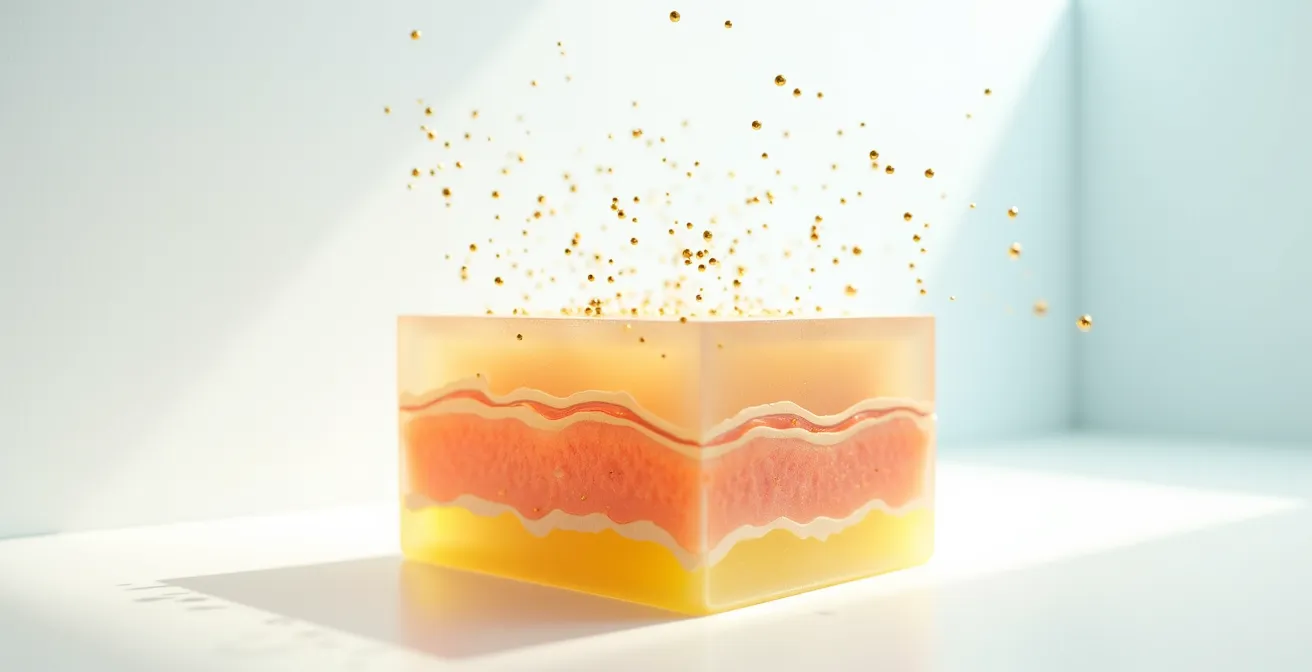
This visualization shows how a healthy, retinoid-treated skin barrier interacts with the environment. The integrity of this barrier is paramount, especially when cellular turnover and UV sensitivity are modulated by active ingredients, making daily sun protection a non-negotiable component of any retinoid protocol.
The Infection Risk of Using a 1.5mm Dermaroller at Home
Microneedling with a 1.5mm dermaroller is a medical procedure, not a home facial. At this needle depth, the device penetrates well into the dermis, creating thousands of micro-wounds. When performed in a clinical setting, this controlled injury triggers powerful wound-healing and collagen-induction cascades. However, when performed at home, it represents potency without protocol—a recipe for disaster. The risk of dragging bacteria from the skin surface deep into the dermis, causing severe infection, granulomas, or permanent scarring, is exceptionally high.
This illustrates the danger of confusing a tool’s potential with its safe application. The effectiveness of medical microneedling comes from the sterile environment, the precise technique (no dragging or tearing), and the post-procedure care. Home use negates all of these safety controls. This is directly analogous to the Tretinoin vs. Retinol debate. Tretinoin is a potent, direct-acting molecule. Its power necessitates a clinical protocol to manage side effects and ensure proper use. In contrast, OTC retinol is an indirect approach; to become the active retinoic acid, retinol requires two conversion steps. This built-in inefficiency is a form of “safety” that also severely limits its efficacy, making its final effect less predictable—much like an uncalibrated, non-sterile home device.
Action Plan: A Safe Retinoid Application Protocol
- Cleanse and Dry Thoroughly: Wash the skin with a mild, non-irritating cleanser and warm water. Gently pat the skin dry and wait 20-30 minutes to ensure all moisture has evaporated, which minimizes the risk of irritation.
- Apply a Precise, Minimal Amount: Dispense a pea-sized amount of the retinoid. This is sufficient to cover the entire face in a very thin layer. More is not better and will only increase irritation.
- Buffer if Necessary: If you have sensitive skin or are in the initial phase of use, apply a layer of a simple, fragrance-free moisturizer before and/or after the retinoid to buffer its intensity and support the skin barrier.
- Avoid Conflicting Actives: Do not use other potentially irritating active ingredients in the same routine, such as alpha-hydroxy acids (AHAs), beta-hydroxy acids (BHAs), or high-concentration Vitamin C, unless specifically advised by your dermatologist.
- Mandatory Sun Protection: Apply a broad-spectrum sunscreen with an SPF of 30 or higher every single morning. Retinoids increase photosensitivity, making daily sun protection the most critical step for both safety and efficacy.
Hydroquinone or Vitamin C: Which Fades Melasma Effectively?
Melasma is a complex and stubborn form of hyperpigmentation. In the clinical armamentarium, hydroquinone has long been the gold standard for treatment. It works by inhibiting tyrosinase, the key enzyme responsible for melanin production. Its action is specific, potent, and targeted directly at the root cause of pigment overproduction. Because of its potency and potential for side effects like ochronosis with improper long-term use, its use is regulated and requires medical supervision.
On the other hand, Vitamin C is a popular OTC antioxidant. It can help brighten the skin and offers some mild pigment-inhibiting properties, but it does not target the melanin production pathway with the same specificity or power as hydroquinone. For a persistent clinical condition like melasma, comparing Vitamin C to hydroquinone is like comparing a general-purpose vitamin supplement to a targeted pharmaceutical drug. One offers general support, while the other enacts a specific, therapeutic change. This again mirrors the retinoid world. Even within the category of prescription retinoids, there is a spectrum of potency and tolerability designed for different conditions, as shown in the table below. This level of nuance is absent in the one-size-fits-all OTC market.
| Retinoid Type | Strength | Primary Use | Key Characteristics |
|---|---|---|---|
| Tretinoin | 0.025%-0.1% | Acne, Anti-aging, Melasma | Most studied, affordable, wide availability |
| Adapalene | 0.1%-0.3% | Acne | Better tolerated, less irritating |
| Tazarotene | 0.05%-0.1% | Acne, Psoriasis, Photoaging | Most potent topical, more expensive |
| Trifarotene | 0.005% | Acne (face & trunk) | Newest, fewer side effects, very expensive |
When to Schedule Chemical Peels to Avoid Sun Damage Risks?
A medium-depth chemical peel (like a TCA peel) is a powerful resurfacing treatment that can dramatically improve texture, pigmentation, and fine lines. However, its success is inextricably linked to protocol and timing. Performing such a peel during a summer month when UV exposure is high carries a significant risk of post-inflammatory hyperpigmentation (PIH), potentially worsening the very condition it was meant to treat. For this reason, dermatologists typically schedule these procedures during the fall and winter.
This dependence on a strict protocol highlights that potent interventions require medical oversight. It’s not just about applying a chemical; it’s about preparing the skin beforehand, performing the procedure correctly, and managing the healing process afterward, including absolute sun avoidance. This is also why certain conditions are contraindications. As Dr. Anne Chapas, a board-certified dermatologist, states on behalf of the American Academy of Dermatology:
If someone has a lot of redness or inflammation in their skin, they should avoid retinoids and ask their dermatologist about other therapies that are more directed to a condition called rosacea.
– Dr. Anne Chapas, MD, FAAD, American Academy of Dermatology
This same logic applies to retinoids. Tretinoin is not just a cream; it’s a long-term therapy. While not as intense as a single peel, its nightly application creates a sustained “micro-peel” effect, fundamentally altering skin cell turnover over months.
Case Study: The “Micro-Peel” Effect of Tretinoin
On a biostimulation scale of 1 to 100, where a CO2 laser resurfacing ranks over 80 for collagen induction, a topical like tretinoin ranks around 1. While this seems low, the power lies in consistency. A single CO2 laser treatment is a massive inflammatory event. Tretinoin provides a ‘micro-peel’ and a tiny amount of biostimulation every single night. Over the course of a year, this consistent, low-level stimulation leads to significant collagen production and textural improvement with far less risk and downtime than an aggressive peel.

This process of gradual but profound renewal is why patience and adherence to a clinical protocol are paramount for achieving results with prescription retinoids. The transformation is not instantaneous, but it is built on a real, biological foundation.
How to Restore Your Skin Barrier After Over-Exfoliating?
Over-exfoliation from enthusiastic but misguided use of acids, scrubs, or brushes is a common issue that brings patients to a dermatology clinic. The result is a compromised skin barrier, leading to redness, stinging, sensitivity, and dehydration. Restoring this barrier requires a “less is more” approach: ceasing all active ingredients, using gentle cleansers, and applying bland, ceramide-rich moisturizers to give the skin time to heal itself.
This scenario is highly relevant to the initial phase of using a prescription retinoid, known as “retinization.” The peeling, dryness, and irritation that can occur are not an allergic reaction but a predictable sign that the medication is working, accelerating cell turnover faster than the skin is accustomed to. This is a clinically managed side effect. A dermatologist will prescribe the correct starting strength and provide a strict protocol—very similar to a barrier repair protocol—to help the patient’s skin adapt. The goal is to get the benefits of the medication without overwhelming the skin’s natural defenses. Managing this phase is critical, as achieving clinical improvement can take 8 to 12 weeks of consistent, careful use.
This managed adaptation period is a hallmark of a true medical treatment. OTC products are formulated to avoid this process entirely, which is precisely why they fail to produce significant structural change. They are designed to be cosmetically elegant and non-irritating, a goal that is often at odds with being biochemically effective. The retinization phase is the price of admission for the profound, long-term benefits of accelerated cell turnover and collagen synthesis.
Key Takeaways
- The efficacy gap is due to a direct, active mechanism of action in prescription retinoids versus an inefficient, multi-step conversion in OTC retinol.
- Bioavailability is paramount: prescription-strength products are designed to reach their cellular targets, while many cosmetic formulas are not.
- Potent medical treatments, from retinoids to lasers, are inseparable from their clinical protocols, which ensure safety and maximize results.
How Does CRISPR Edit DNA Sequences With High Precision?
To grasp the ultimate expression of medical precision, we can look to the field of genetics and CRISPR-Cas9 technology. In simple terms, CRISPR acts as a pair of “molecular scissors” that can be programmed to find a specific DNA sequence and cut it. This allows scientists to remove, replace, or repair genes with unprecedented accuracy. It is the epitome of a targeted mechanism of action. It doesn’t just flood a system with a chemical; it performs a precise, predefined task at a specific molecular address.
While topical dermatology is a world away from gene editing, the underlying principle of molecular specificity is the same. The superiority of prescription retinoids is a story of applied biochemistry. As a study published in the *Journal of Cutaneous Medicine and Surgery* explains, the journey from a cosmetic ester to the active molecule is a multi-step, inefficient process:
The conversion sequence is retinyl esters to retinol, which gets converted to retinaldehyde, giving rise to the final product, retinoic acid. The biologically active form, retinoic acid, leads to improvement in skin texture, fine lines and dyspigmentation. Since retinaldehyde requires only one conversion step to retinoic acid, compared to 2 steps for retinol, it is considered more potent.
– Motamedi et al., Journal of Cutaneous Medicine and Surgery
Tretinoin *is* retinoic acid. It requires zero conversion. It binds directly and with high affinity to the retinoic acid receptors (RARs) inside our skin cells, directly influencing gene expression to normalize cell turnover and stimulate collagen. This is a level of precision that OTC retinol, which must pass through two inefficient conversion steps, can never achieve.
Case Study: The Precision of Receptor Specificity
The science goes even deeper. Skin cells have different subtypes of retinoic acid receptors (RARα, RARβ, RARγ). Different prescription retinoids have different affinities for these receptors. For instance, Tretinoin binds to all three, giving it a broad range of powerful effects. Adapalene, however, selectively binds to RARβ and RARγ, which may explain why it can be better tolerated while still being highly effective for acne. This receptor-level specificity is the dermatological equivalent of CRISPR’s targeted approach—it’s about using the right key for the right lock.
Why “Botox in a Bottle” Peptides Cannot Replicate Injectable Results?
Our final case study is perhaps the most common example of marketing over-promising and under-delivering: the “Botox in a bottle” claim often attached to peptide serums. Peptides are short chains of amino acids, the building blocks of proteins like collagen. Some, like argireline, are marketed as having a “Botox-like” effect by interfering with neurotransmitters to relax facial muscles.
This claim fails when scrutinized against the principles we’ve established: bioavailability and delivery system. Botulinum toxin (Botox) is a neurotoxin that works by being injected directly into a specific muscle, where it blocks nerve signals to prevent contraction. Its effect is potent, localized, and guaranteed to reach its target. A peptide in a cream, however, faces an almost insurmountable challenge. It is a relatively large molecule that must penetrate the stratum corneum, navigate through the epidermis, and somehow reach a neuromuscular junction deep in the dermis in a high enough concentration to have an effect. For the vast majority of topical peptides, this journey is impossible. Their bioavailability is near zero.
In contrast, prescription tretinoin is a small molecule designed for topical delivery, and it has been clinically proven to generate profound changes. Unlike the vague promise of peptides, tretinoin treatments result in significantly increased collagen synthesis over time. The timeline comparison below solidifies this reality: medical treatments operate on a faster, more predictable schedule because their active ingredients actually reach their target and work.
| Product Type | Initial Results | Full Results | Strength |
|---|---|---|---|
| Prescription Tretinoin | 2-4 weeks | 3-6 months | 0.025%-0.1% |
| OTC Retinol | 6-12 weeks | 6-12 months | 0.1%-1% |
| Retinaldehyde | 4-8 weeks | 4-8 months | 0.05%-0.1% |
| Peptide Serums | 8-12 weeks | Ongoing use required | Variable |
The difference between a store-bought retinol and a prescription retinoid is not just marketing—it is fundamental science. It is the difference between an indirect precursor and a direct-acting molecule; between a hopeful promise and a clinically proven mechanism; between a cosmetic gesture and a medical treatment.
Therefore, the next logical step for anyone frustrated with the lack of results from cosmetic skincare is to bypass the beauty counter. Schedule a consultation with a board-certified dermatologist to receive a proper diagnosis and a treatment plan built on evidence-based medicine, not marketing hype.