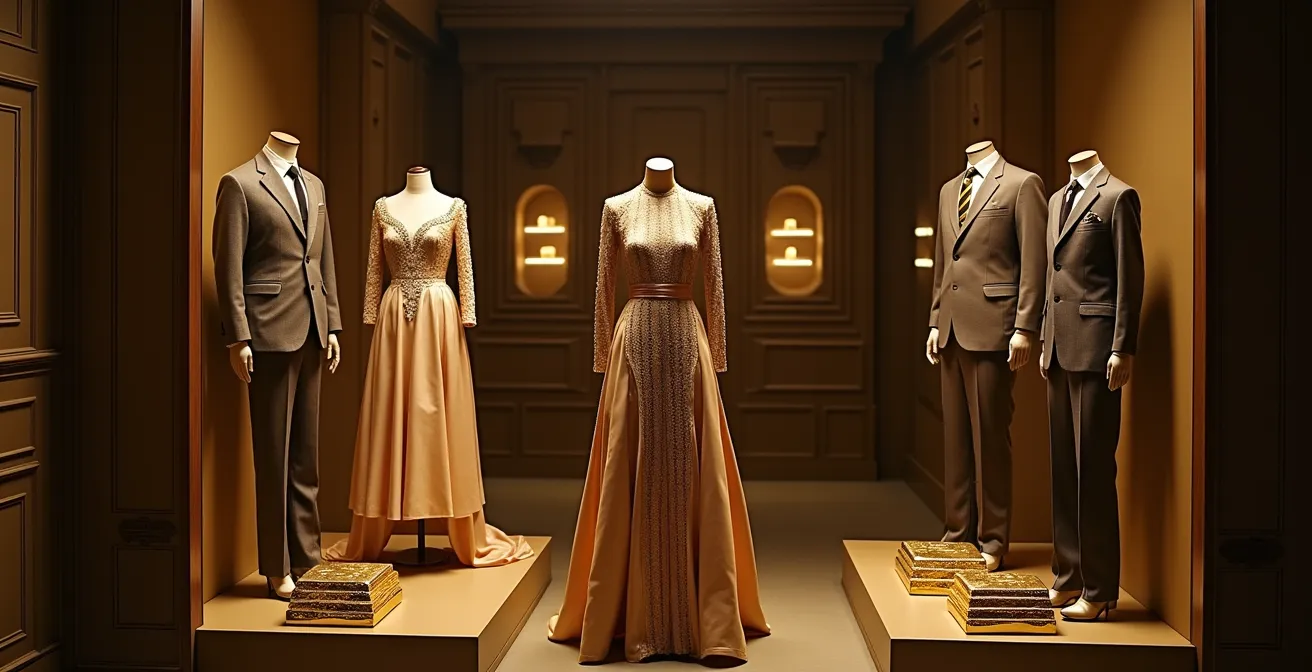
Vintage haute couture is generating returns that eclipse traditional assets, but only for investors who treat it as a disciplined financial instrument, not a fashion hobby.
- Value is protected by technological authentication and material-specific preservation, not just a keen eye.
- Optimal ROI comes from a “Core-Satellite” portfolio strategy, balancing low-risk “Old Masters” with high-growth “Emerging Talent.”
Recommendation: Shift your perspective from collector to asset manager by analyzing market timing, sales channels, and hype-cycle risks before the next acquisition.
For the discerning investor seeking to diversify beyond equities and precious metals, a new asset class is demonstrating remarkable appreciation: vintage haute couture. While the idea of fashion as an investment is often dismissed as frivolous, certain garments from legendary houses are not only holding their value but delivering returns that rival, and in some cases surpass, traditional safe-haven assets like gold. This isn’t about collecting pretty dresses; it’s about acquiring tangible, portable assets with a unique risk-return profile.
The common approach focuses on buying “classics” and hoping for the best. This strategy, however, is insufficient in a market flooded with sophisticated counterfeits and subject to rapid shifts in cultural relevance. The true key to unlocking value in this space lies not in taste, but in a rigorous, analytical framework. Success requires treating each acquisition with the same diligence as a piece of fine art or a rare vintage wine, focusing on the mechanics of authentication, preservation, market timing, and portfolio construction.
This analysis will deconstruct the haute couture investment thesis. We will move beyond platitudes to provide a strategic guide for the serious asset manager. We will explore how to verify authenticity in an era of “superfakes,” quantify preservation risks, determine the optimal sales channel for maximizing profit, and build a balanced portfolio that manages risk while capturing alpha. By applying a financial lens to this unique market, we can identify the factors that separate a museum-quality asset from a depreciating luxury good.
To navigate this complex but rewarding market, it is essential to understand the key pillars that support the value of these tangible assets. The following sections break down the critical decision points an investor must face, providing a clear framework for analysis and action.
Summary: Deconstructing the Investment Thesis for Vintage Haute Couture
- How to Spot a High-Quality Fake Chanel Jacket?
- Climate Control or Acid-Free Paper: Which Is More Critical for Silk Preservation?
- Sotheby’s or Depop: Where to Sell Your Vintage Dior for Maximum Profit?
- The “It Bag” Mistake That Loses 60% of Value in One Season
- When Is the Best Time to Buy Winter Couture for Investment?
- Emerging Talent or Old Master: Which Offers Higher ROI Risk?
- How to Patent a Software Algorithm Without Stifling Future Innovation?
- Why Do We Pay 10x More for a Logo T-Shirt Made in the Same Factory?
How to Spot a High-Quality Fake Chanel Jacket?
For the couture investor, authentication is the bedrock of value. In a market where fakes are increasingly sophisticated, relying on traditional markers like stitching quality or hardware feel is no longer sufficient. The challenge is immense; the digital marketplace has amplified the distribution of counterfeits. The modern investor must, therefore, shift their focus from subjective connoisseurship to objective, technological verifiability. This represents the single most important step in de-risking a potential acquisition.
Leading houses have recognized this threat and are implementing solutions drawn from the world of secure assets. Chanel, for instance, has moved beyond authenticity cards, which are easily replicated, towards a more robust system. As the Bag Religion Authentication Guide notes, this evolution is critical for asset security.
Case Study: Chanel’s Blockchain Authentication Implementation
Beginning with its 21A collection in 2021, Chanel began embedding NFC-enabled microchips into its products, replacing traditional authenticity cards. These chips, which cost a mere nine cents per item to implement, are integrated with blockchain technology. This system stores the product’s entire lifecycle data, from its creation and distribution to every subsequent transaction. This creates a digital provenance that is virtually impossible for counterfeiters to replicate, providing investors with an unparalleled level of certainty and securing the item’s long-term value and liquidity, as detailed in a report on Chanel’s move to NFC microchips. An investor’s due diligence should now include verifying the presence and functionality of these digital authenticators.
Therefore, the new standard for spotting a high-quality fake is to demand technological proof. For post-2021 Chanel pieces, this means verifying the microchip. For older items, it means relying on third-party authentication services that use advanced technology and comprehensive databases. The question is no longer “Does it look real?” but rather “Can its authenticity be digitally and irrefutably proven?” This mindset transforms a high-risk purchase into a secured investment.
Climate Control or Acid-Free Paper: Which Is More Critical for Silk Preservation?
Once an asset’s authenticity is secured, its value is contingent upon its physical integrity. For haute couture, preservation is not merely “good storage”; it is an active risk management strategy. Different materials face different primary threats, and misallocating preservation resources can lead to catastrophic, and often irreversible, value destruction. The question is not whether to use climate control or acid-free paper, but which threat poses the greatest financial risk to a specific material and prioritizing the mitigation strategy accordingly.
An investor must adopt the mindset of a museum registrar, analyzing the inherent vulnerabilities of each garment. Silk, for example, is exceptionally sensitive to shifts in relative humidity, which can cause its fibers to weaken and break. Leather, conversely, is most threatened by desiccation, leading to cracking. Understanding this asset-specific risk is paramount. A generalized approach to preservation is an inefficient use of capital and fails to protect against the most probable cause of depreciation.
The following matrix breaks down the primary threats and preservation priorities for key couture materials, quantifying the potential financial impact of failure. This data-driven approach allows an investor to allocate resources effectively, focusing on the highest-impact interventions first.
| Material | Primary Enemy | Storage Priority | ROI Impact |
|---|---|---|---|
| Silk | Humidity fluctuations | Climate control (55% RH) | 40% value loss if damaged |
| Wool | Pests (moths) | Cedar storage + mothproofing | 30% depreciation risk |
| Leather | Desiccation | Conditioning + breathable storage | 50% value loss if cracked |
| Beaded/Embroidered | Weight stress | Flat storage mandatory | 60% loss if beading damaged |
As this analysis from couture experts highlights, for a silk garment, investing in a sophisticated hygrometer and climate control system is far more critical than the type of archival paper used. For a heavily beaded gown, flat storage to prevent stress on the threads outweighs all other concerns. The sophisticated investor doesn’t just store; they create a bespoke preservation plan for each asset based on its material composition and financial risk profile.
Sotheby’s or Depop: Where to Sell Your Vintage Dior for Maximum Profit?
The divestment strategy for a haute couture asset is as critical as its acquisition. The choice of sales channel is not a matter of convenience but a strategic decision that directly impacts both the final sale price and the liquidity of the asset. The spectrum of options, from a high-touch auction house like Sotheby’s to a peer-to-peer platform like Depop, offers a trade-off between maximizing value and speed of sale. The sophisticated investor must analyze this landscape and select the channel that aligns with their specific financial objective for that asset.

Prestigious auction houses like Sotheby’s or Christie’s offer unparalleled access to a global network of high-net-worth collectors. They create an environment of competitive bidding and lend an institutional seal of approval, which can significantly enhance an item’s final price through provenance arbitrage. This is particularly true for pieces with historical significance or those from highly sought-after collections. However, this channel comes with higher seller’s premiums (typically 15-25%), longer lead times, and less control over the final price.
Conversely, specialized online marketplaces and consignment platforms offer greater speed and liquidity. While they may not achieve the record-breaking prices of a major auction, they provide a faster path to cash and can be highly effective for pieces in the €5,000 to €50,000 range. For the utmost discretion and access to top-tier collectors, private brokers remain the preferred channel for ultra-high-value items. To make an informed decision, an investor must have a clear framework.
Action Plan: Structuring Your Divestment Strategy
- Assess the Asset’s Value: Is the item valued above €50,000? If so, the global reach of a top-tier auction house (Sotheby’s, Christie’s) is your primary channel.
- Define Liquidity Needs: Do you require a sale within 30-60 days? Platforms like The RealReal offer guaranteed sale options, prioritizing speed over maximum price.
- Target the Mid-Market: For investment-grade pieces in the €5,000-€50,000 range, specialized vintage auction houses like Kerry Taylor Auctions provide focused expertise and a targeted buyer pool.
- Prioritize Discretion: For exceptional pieces where privacy is paramount, engage a private broker to discreetly access a curated list of ultra-high-net-worth collectors.
- Calculate Net Return: Before committing, calculate the total cost of sale. Factor in the seller’s premium, insurance, photography, and shipping fees to understand your true net profit.
The “It Bag” Mistake That Loses 60% of Value in One Season
One of the most common and costly errors for new investors in this asset class is confusing fleeting fashion trends with enduring value. The “It Bag”—a handbag heavily promoted by media and influencers for a single season—is a prime example of a depreciating asset masquerading as an investment. These items are subject to the violent swings of the hype cycle depreciation phenomenon, where their secondary market value can plummet by as much as 60% within 18 months as fashion’s gaze shifts elsewhere.
The value of these trendy items is built on marketing momentum, not on the pillars of true investment-grade assets: timeless design, exceptional craftsmanship, and controlled scarcity. When the marketing engine moves on to the next “It” item, the perceived value collapses, leaving the investor with a significant capital loss. This is the antithesis of a sound investment strategy. The sophisticated investor must be able to distinguish between an item that is merely popular and one that possesses intrinsic, long-term value.
The contrast with true investment pieces is stark. As noted by luxury market analysts, some classic designs appreciate with the steadiness of a blue-chip stock.
Hermès Birkin handbags have increased over 500 percent in value in the last 35 years
– Arts & Collections, Investing in Haute Couture
This steady, long-term appreciation is characteristic of a true asset. The Bottega Veneta case study provides a cautionary tale. During its peak hype in 2021, authentication volumes for the brand surged over 200%. However, a recent State of the Fake report shows that secondary market prices for its trending bags dropped by 40-60% within two years as the trend faded. In stark contrast, a classic like the Hermès Kelly bag maintained a steady 8-12% annual appreciation during the same period, utterly insulated from the whims of fashion cycles. The lesson is clear: invest in timeless design and scarcity, not in fleeting Instagram fame.
When Is the Best Time to Buy Winter Couture for Investment?
In any market, timing is a critical component of maximizing returns. The haute couture market is no exception. While it is less volatile than public equities, it is subject to predictable cycles and influenced by external events that create clear buying opportunities for the astute investor. Acquiring an asset is not just about what you buy, but when. Buying “off-season”—for instance, acquiring winter couture in the spring—is a basic tactic, but the sophisticated investor looks for more powerful market signals.
One such signal is the “museum effect.” When a major museum like The Met or the V&A announces a retrospective on a specific designer, it recasts their work in a historical, artistic context. This institutional validation invariably triggers a significant re-evaluation of their vintage pieces on the secondary market. For example, following a major retrospective, there was a documented 65% increase in Charles James dress value in just 2 years. An investor who acquires pieces *before* such an exhibition is announced or opens can realize substantial appreciation.
Other key timing indicators include changes in creative direction at a major house and macroeconomic shifts. When a celebrated creative director departs, pieces from their tenure often see a surge in demand as that era is closed and becomes “vintage.” Similarly, economic downturns can create opportunities, as liquidity-seeking collectors may be more willing to part with significant pieces at a discount. The key is to monitor these signals and be prepared to act, transforming market knowledge into financial advantage. A reactive approach means paying the premium; a proactive one captures the value.
Emerging Talent or Old Master: Which Offers Higher ROI Risk?
A mature investment strategy requires portfolio construction that balances risk and reward. In the context of haute couture, this translates to a “Core-Satellite” approach. The “Core” of the portfolio should consist of pieces from established “Old Masters”—designers whose historical importance is undisputed, such as 1950s Christian Dior or 1960s Cristóbal Balenciaga. These assets function like blue-chip stocks, offering stable, predictable appreciation (typically 8-15% annually) and lower downside risk. They provide the foundation of the portfolio’s value.

The “Satellite” portion is where an investor can seek “alpha,” or outsized returns. This involves allocating a smaller percentage of capital (20-30%) to carefully selected pieces from emerging or transitional designers. These are higher-risk, higher-reward propositions. An investment in an LVMH Prize winner could become worthless if their brand fails, or it could generate a 200%+ return if they become the next creative director of a major house. Similarly, pieces from a designer’s “transitional period,” like Tom Ford’s tenure at Gucci or Phoebe Philo’s at Celine, can offer significant upside as their influence is historically re-evaluated.
This balanced approach allows an investor to participate in the potential high growth of new talent while protecting the bulk of their capital with the proven stability of masterworks. The key is disciplined allocation, as outlined in the following portfolio model.
The following table, inspired by couture investment strategies, provides a framework for building a balanced portfolio.
| Investment Type | Portfolio % | Risk Level | Expected Annual Return | Examples |
|---|---|---|---|---|
| Old Masters (Core) | 70-80% | Low | 8-15% | 1950s Dior, 1960s Balenciaga |
| Emerging Talent (Satellite) | 20-30% | High | -50% to +200% | LVMH Prize winners, Dover Street picks |
| Transition Period | 10% | Medium | 15-40% | Phoebe Philo Celine, Tom Ford Gucci |
How to Patent a Software Algorithm Without Stifling Future Innovation?
While seemingly disparate, the world of software intellectual property offers a powerful metaphorical framework for understanding value in haute couture. For the sophisticated investor, drawing parallels between these two high-value domains can yield profound insights into protecting and growing an asset base. The question of how to “patent” a software algorithm is analogous to how a couture house protects its most valuable asset: its unique design DNA.
In technology, a patent grants a temporary monopoly on a novel invention. In couture, a house’s signature silhouette or a unique fabrication technique functions as its de facto patent. Think of Dior’s “New Look” or Balenciaga’s cocoon coat. These were not legally patented, but they were so innovative and difficult to replicate that they provided a powerful “first-mover advantage,” creating a moat of brand equity and design authority that has lasted for decades. An investor acquiring a piece from these seminal collections is, in essence, buying a share of that foundational “IP.”
The debate in tech over “stifling innovation” also has its parallel. An overly aggressive IP strategy can create a backlash. In fashion, when a brand becomes too litigious or derivative, it can lose cultural relevance. Conversely, the “open-source” model, where foundational code is shared to encourage wider development, is mirrored in the way traditional craft techniques are passed down and reinterpreted. A designer who masterfully reinterprets a classic technique—like a modern take on Vionnet’s bias cut—is participating in this “open-source” ecosystem, creating new value from a shared language. The investor’s challenge is to identify which “IP” is truly defensible and which is simply a fleeting implementation.
Key Takeaways
- Haute couture investment requires a financial framework, not just a fashion sensibility, focusing on authentication, preservation, and market analysis.
- Value is protected through technology (like microchips) and asset-specific risk management (like climate control for silk), not subjective judgment.
- A “Core-Satellite” portfolio, balancing low-risk “Old Masters” with high-risk “Emerging Talent,” is the optimal strategy for managing risk and capturing growth.
Why Do We Pay 10x More for a Logo T-Shirt Made in the Same Factory?
To fully grasp the investment potential of haute couture, one must first understand the fundamental economics of luxury branding, which can be distilled into the paradox of the logo t-shirt. Why does a simple cotton t-shirt bearing a luxury logo command a price ten times that of an identical, unbranded garment made in the same factory? The answer lies in the concept of brand equity as an intangible asset. The price difference is not for the cotton or the labor; it is a fee paid for access to the brand’s accumulated history, prestige, and social signaling power.
These goods are what economists call Veblen goods: items for which demand increases as the price increases, because the high price itself is a key feature of the product, signaling status and exclusivity. The logo acts as a shorthand for this entire value proposition. It is a tangible representation of an intangible asset, and the premium paid is the return on the billions of dollars the luxury house has invested in runway shows, advertising campaigns, and retail environments over decades.
Haute couture is the apex of this model. It is the “research and development” lab of the luxury world, where the brand’s most potent ideas and highest levels of craftsmanship are realized. A couture piece is not just a garment; it is the purest distillation of the brand’s equity. While a logo t-shirt offers a diluted, mass-market taste of this equity, a couture garment is the source code itself. Its value is not tied to a logo but is intrinsic to its design, its one-of-a-kind nature, and its direct connection to the house’s creative pinnacle. Understanding this allows an investor to see why a couture piece has the potential for capital appreciation, while a logo t-shirt is purely a consumer good destined for depreciation.
Ultimately, treating vintage haute couture as a serious asset class requires a paradigm shift. Moving from the mindset of a consumer to that of an asset manager—armed with a framework for authentication, risk management, and portfolio strategy—is what separates the collector from the successful investor. To capitalize on these opportunities, the next step is to apply this rigorous analytical framework to evaluate potential acquisitions and divestments within your own portfolio.
Frequently Asked Questions About Investing in Haute Couture
When do auction houses schedule their major couture sales?
Major houses like Sotheby’s and Christie’s hold their most prestigious couture auctions in January and July, coinciding with the fashion calendar. However, smaller sales in March and October can often offer better value and less competition for savvy buyers.
How do creative director changes affect vintage prices?
Pieces from a departing creative director’s tenure typically see a significant appreciation of 20-30% within the 12 months following their exit. This is because their body of work for the house becomes a finite, historically defined collection, increasing its desirability among collectors and investors.
What macroeconomic conditions favor couture buyers?
Economic downturns and recessions often create significant buying opportunities. During these periods, some collectors may face liquidity constraints and be more motivated to sell major pieces. This can lead to discounts of 15-25% on ultra-luxury vintage items for cash-ready investors with a long-term perspective.